PCCN QUESTIONS AND ANSWERS 2023
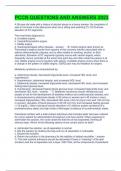
PCCN QUESTIONS AND ANSWERS 2023 A 58-year-old male with a history of alcohol abuse is a heavy smoker. He complains of pain in his chest in the afternoons when he is sitting and watching TV. ECG shows elevation of ST segments. The most likely diagnosis is: a. Unstable angina. b. Variant/Prinzmetal's angina. c. Stable angina. d. Gastroesophageal reflux disease. B: Variant angina (also known as Prinzmetal's angina) results from spasms of the coronary arteries associated with or without atherosclerotic plaques; and is often related to smoking, alcohol, or illicit stimulants. Elevation of ST segments typically occurs with variant angina, which frequently occurs cyclically at the same time each day and often while the person is at rest. Stable angina occurs regularly with activity. Unstable angina occurs when there is a change in the pattern of stable angina. GERD pain may be mistaken for angina. Metabolic syndrome is characterized by: a. Abdominal obesity, decreased triglyceride level, increased HDL level, and hypertension. b. Hypertension, abdominal obesity, and increased HDL level. c. Abdominal obesity, increased triglyceride level, decreased HDL level, and increased fasting blood glucose level. d. Hypotension, decreased fasting blood glucose level, increased triglyceride level, and decreased HDL level. C: Metabolic syndrome (insulin resistance) puts people at risk for the development of diabetes mellitus and cardiovascular disease, and is characterized by abdominal obesity (35 inches in women and 40 inches in men), increased triglycerides (150), decreased HDL level (40 mm Hg in men and 50 mm Hg in women), elevation of blood pressure (130/ 85 mm Hg), and increased fasting glucose ( 110 mg/dL). Other indicators include elevation of C-reactive protein (evidence of a proinflammatory state) and high levels of fibrinogen (evidence of a prothrombotic state). Parenteral nutrition with a total nutrient admixture that includes lipids has been ordered for a burn patient for administration throughout a 24-hour period. When preparing to administer the solution, the nurse observes that the oil has separated, forming an obvious layer. Which of the following options is the correct action to take? a. Administer the solution, as oil separation is normal. b. Mix the solution by shaking the bag until no oil separation is noticeable. c. Discard the solution. d. Return the solution to the pharmacy for the addition of added emulsifier. C: The total nutrient admixture should be discarded if there is "cracking" of the lipid emulsion and the oil separates into a layer. With TNA, all the components of parenteral nutrition and lipids are admixed together in one container to create a 3-in-1 formula. Components of parenteral nutrition generally include proteins, carbohydrates, fats, electrolytes, vitamins, sterile water, and trace vitamins. While most postoperative patients need 1500 calories per day to prevent protein breakdown, those with fever, burns, major surgery, trauma, or hypermetabolic disease may need up to 10,000 more calories daily. A 30-year-old patient complains of post-operative pain at 8 on a 1-to-10 scale 12 hours after surgery, but is not moaning, grimacing, or exhibiting any standard physical signs of pain. The patient last received pain medication 6 hours earlier, and has orders for morphine every 4 hours as needed and ibuprofen every 6 hours as needed. Which is the most appropriate action? a. Administer ibuprofen. b. Administer morphine. c. Administer ibuprofen, and if the patient does not feel relief after one hour post-dose, then administer morphine. d. Question present family members about the patient's pain tolerance before making a decision. B: The nurse should give morphine, as 8 on a 1 to 10 scale is representative of severe pain, not uncommon in the first 24 hours after surgery. Patients have a right to pain control, and the nurse should trust that the pain is what the patient says it is. Patients may show very different behavior when they are in pain. Some may cry and moan with minor pain, and others may exhibit little difference in behavior when truly suffering. Thus, judging pain by behavior can lead to the wrong conclusions. Questioning family members is not appropriate. Q-wave myocardial infarction is characterized by: a. ST-T wave changes with ST depression that reverses within a few days. b. Small infarct size-due to spontaneous reperfusion. c. Peak CK levels in 12 to 13 hours. d. Complete coronary occlusion in 80% to 90% of patients. D: Q-wave myocardial infarction is characterized by complete coronary occlusion in 80% to 90% of patients. Abnormal Q waves (wider and deeper) are especially common in the morning. Infarction is usually prolonged, resulting in transmural necrosis. Peak CK levels occur in approximately 27 hours. Non-Q-wave myocardial infarction is characterized by ST changes with ST depression. Infarct is typically non-transmural and small with coronary occlusion in only 20% to 30% of patients. Peak CK levels occur in approximately 12 to 13 hours. A nursing team leader delegates a task to an unlicensed assistive member of the personnel. Who is responsible for patient outcomes? a. The unlicensed person who completes the task b. Both the team leader and the unlicensed person who completes the task c. The team leader who delegates the task d. The administrative staff C: The nurse who delegates remains accountable for patient outcomes and for supervision of the person to whom the task was delegated. The scope of nursing includes delegation of tasks to unlicensed assistive personnel, providing those personnel have adequate training and knowledge. Delegation can be used to manage the workload and to provide adequate and safe care. Delegation should be done in a manner that reduces liability by providing adequate communication. A patient with acute lung injury has crackling, tachypnea, and cyanosis. Oxygen therapy is instituted to maintain oxygen saturation at: a. 85% b. 90% c. 95% d. 98% B: Acute lung injury results in severely compromised lungs with crackling and wheezing, decreased pulmonary compliance, and cyanosis, so oxygen therapy is provided to maintain oxygen saturation 90%. Oxygen should be administered at 100% because of the mismatch between ventilation (V) and perfusion (Q), which can result in hypoxia upon change in positioning. Endotracheal intubation may be needed if oxygen saturation falls or carbon dioxide levels rise. The normal blood, urea, nitrogen (BUN)/creatinine ratio is: a. 5:1 b. 8:1 c. 10:1 d. 20:1 C: The normal BUN/creatinine ratio is 10:1. Normal serum creatinine is 0.6 to 1.2 mg/dL) and increases with impaired renal function, urinary tract obstruction, and nephritis. Levels should remain stable with normal functioning. Normal blood urea nitrogen (BUN) is 7 to 8 mg/dL for patients younger than age 60, and 8 to 20 mg/dL for patients 60 years of age and older. BUN increases with hypovolemia. The ratio remains normal with intrinsic kidney disease but both the BUN and creatinine levels are increased. A myocardial infarction usually causes damage to the myocardium, progressing from the endocardium to the epicardium. The first stage in myocardial damage is: a. Formation of zone of ischemia b. Formation of zone of necrosis c. Formation of zone of injury d. Decreased perfusion from hypotension A: An MI causes damage to the myocardium in stages beginning when ischemia develops, creating a zone of ischemia with viable cells. Cellular injury then occurs to those cells surrounding the infarcted area in the zone of injury. Infarction with necrosis of tissue comprises the zone of infarction, where cells are destroyed and eventually replaced with scar tissue. People may exhibit either hypertension or hypotension during an MI. A patient presents with pulmonary edema characterized by tachypnea, tachycardia, hypertension, cough, fever, and cough with frothy sanguineous sputum. What initial treatments are most common? a. Oxygen, nitroglycerine, loop diuretics (furosemide), and morphine b. Oxygen, thiazide diuretics, and ACE inhibitors c. Oxygen and thiazide diuretics d. Oxygen, morphine, and calcium channel blockers A: The most common initial treatment of acute pulmonary edema is oxygen to relieve dyspnea, nitroglycerine to reduce preload, loop diuretics, usually furosemide, to promote diuresis and venodilation, and morphine to reduce associated anxiety (although some doctors avoid morphine because of side effects). ACE inhibitors are also sometimes used to reduce afterload, but thiazide diuretics are not used to treat acute pulmonary edema. Calcium channel blockers may induce acute pulmonary edema if used with tocolytics. Acquired immunodeficiency syndrome (AIDS) is diagnosed when the following criteria are met: a. HIV infection and AIDS-defining condition, such as cytomegalovirus. b. HIV infection and CD4 count 400 cells/mm. c. HIV infection, CD4 count 100 cells/mm, and AIDS-defining condition. d. HIV infection, CD4 count 200 cells/mm, and AIDS-defining condition. D: AIDS is diagnosed with HIV infection, CD4 count 200 cells/mm, and AIDS-defining condition, such as opportunistic infections (cytomegalovirus, tuberculosis), wasting syndrome, neoplasms (Kaposi's sarcoma) or AIDS dementia complex. Patients with AIDS may present with many types of symptoms, depending on the AIDS-defining condition, but more than half exhibit fever, lymphadenopathy, pharyngitis, rash, and myalgia/arthralgia. Upon physical examination a 23-year-old female complains of chest pain and faintness upon exertion, fatigue, and loss of appetite. She has tachycardia with a weak pulse. Auscultation identifies an ejection click, a brief high-pitched sound occurring immediately after SI. Which of the following cardiac disorders is the most likely diagnosis? a. Coronary artery disease b. Mitral valve stenosis c. Pericarditis d. Aortic valve stenosis D: These symptoms, including the abnormal heart sound (ejection click), are common to aortic valve stenosis. The aortic valve controlling the flow of blood from the left ventricle narrows, causing the left ventricular wall to thicken. Aortic stenosis may result from a birth defect or from damage caused by childhood rheumatic fever. Coronary artery disease is not directly associated with abnormal heart sounds although gallop rhythms can occur with related ventricular hypertrophy. Mitral valve stenosis may cause an opening snap, while pericarditis causes a friction rub. Which of the following rhythm disturbances is most common after cardiac surgery? a. Ventricular fibrillation b. Ventricular tachycardia c. Premature ventricular contractions (PVCs) d. Atrial fibrillation, flutter, and tachycardia D: Atrial arrhythmias, including fibrillation, flutter, and tachycardia, are very common after cardiac surgery, occurring in more than half of patients with valvular surgery. Arrhythmias occur usually in the first 2-3 postoperative days and are often transient but may recur. Arrhythmias are often related to surgical manipulation. Treatment includes digoxin, blockers, calcium channel blockers, and amiodarone (often given preoperatively for 7 days to reduce incidence of postoperative arrhythmias. Electrical cardioversion may be indicated after 24 hours if sinus rhythm remains abnormal. A 64 year-old male with chronic heart failure presents with dyspnea, cough, blood-tinged frothy sputum, cyanosis, wheezing, rhonchi, and diaphoresis. He is diagnosed with pulmonary edema, placed on oxygen by mask and given morphine and IV nitrate as well as inhaled aminophylline for bronchospasm. Which of the following diuretics is the most appropriate concomitant treatment option? a. Furosemide (Lasix) b. Spironolactone (Aldactone) c. Hydrochlorothiazide (Dyazide) d. Eplerenone (Inspra) A: A short-acting intravenous loop diuretic, such as furosemide (Lasix) or bumetanide (Bumex) is indicated to rapidly reduce fluid retention and decrease pulmonary edema. Spironolactone and eplerenone are potassium-spring diuretics that have weaker diuretic actions than loop diuretics. Hydrochlorothiazide is a long-acting thiazide diuretic given as a first line treatment for hypertension rather than for acute crises.
Written for
- Institution
- Pccn
- Course
- Pccn
Document information
- Uploaded on
- June 5, 2023
- Number of pages
- 13
- Written in
- 2022/2023
- Type
- Exam (elaborations)
- Contains
- Questions & answers
Subjects
- a nursing team le
-
pccn questions and answers 2023
-
a 58 year old male with a history of alcohol abuse
-
a 30 year old patient complains of post operative
-
q wave myocardial infarction is characterized by

Also available in package deal