SC304-6- TERM 2
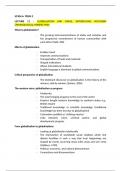
LECTURE 11 – GLOBALISATION AND CRIME: INTRODUCING SOUTHERN
CRIMINOLOGICAL PERSPECTIVES
What is globalisation?
- The growing interconnectedness of states and societies and
the progressive enmeshment of human communities with
each other (Held, 200)
Effects of globalisation
- Enables travel
- Improves communications
- Transportation of foods and materials
- Shaped institutions
- Allows international students
- English language is dominant in global communications
Critical perspective of globalisation
- The dominant discourse on globalisation is the history of the
winners, told by winners (Santos, 2006)
The western story: globalisation as progress
- Modernity
- The west bringing progress to the rest of the world
- Empires bought western knowledge to southern states e.g.,
British empire
- Traditional knowledge vs scientific knowledge (traditional
knowledge has been lost due to globalisation)
- Colonialism justified as ‘civilising mission’
- Links between crime, criminal justice, and global
development progress
From globalisation to globalisations
- Looking at globalisation relationally
- The intersection of worldwide social relations which link
distant localities in such a way that local happenings are
shaped by events occurring many miles away and vice versa
(Giddens, 1990)
- Political, economic, and cultural phenomenon
- Connections and disconnections
, The technological revolution
- This global movement produced a sense of convergence
between distant parts of the globe
- Accelerated by rapid advances in technology that aided
interconnection and global flows
- Cultural influences began travelling through the internet
- Internet connections went from 1% of the information
flowing through telecom networks in the year 1993, to 51%
by 2000, and more than 97% of the telecommunicated
information by 2007
Alternative stories of globalisation
- Understanding globalisation as globalisations
- Learning of histories of colonialism and their modern
communities
- Examining how processes of globalisation shape post-colonial
worlds
- Critiquing neoliberal systems of mitigating climate change
- Finding intersections between state crime and the war on
terror
- Considering justice alternatives and their place within
criminal justice systems
- Thinking of crime not as something that is external to
globalisation or caused by it (crime drives globalisation)
Time-space compression
- Time-space compression and the rise of the network society
(David Harvey)
- Made possible by and operates through technological
advancements in mobility infrastructure and communication
technologies
- Allowing for better and faster mobility and flows of people,
goods, and information
Neoliberal capitalism
Neoliberalism is a model of free market capitalism that favours:
- greatly reduced government spending
- deregulation (weak states)
- globalisation
- free trade (neoliberal economy)
LECTURE 11 – GLOBALISATION AND CRIME: INTRODUCING SOUTHERN
CRIMINOLOGICAL PERSPECTIVES
What is globalisation?
- The growing interconnectedness of states and societies and
the progressive enmeshment of human communities with
each other (Held, 200)
Effects of globalisation
- Enables travel
- Improves communications
- Transportation of foods and materials
- Shaped institutions
- Allows international students
- English language is dominant in global communications
Critical perspective of globalisation
- The dominant discourse on globalisation is the history of the
winners, told by winners (Santos, 2006)
The western story: globalisation as progress
- Modernity
- The west bringing progress to the rest of the world
- Empires bought western knowledge to southern states e.g.,
British empire
- Traditional knowledge vs scientific knowledge (traditional
knowledge has been lost due to globalisation)
- Colonialism justified as ‘civilising mission’
- Links between crime, criminal justice, and global
development progress
From globalisation to globalisations
- Looking at globalisation relationally
- The intersection of worldwide social relations which link
distant localities in such a way that local happenings are
shaped by events occurring many miles away and vice versa
(Giddens, 1990)
- Political, economic, and cultural phenomenon
- Connections and disconnections
, The technological revolution
- This global movement produced a sense of convergence
between distant parts of the globe
- Accelerated by rapid advances in technology that aided
interconnection and global flows
- Cultural influences began travelling through the internet
- Internet connections went from 1% of the information
flowing through telecom networks in the year 1993, to 51%
by 2000, and more than 97% of the telecommunicated
information by 2007
Alternative stories of globalisation
- Understanding globalisation as globalisations
- Learning of histories of colonialism and their modern
communities
- Examining how processes of globalisation shape post-colonial
worlds
- Critiquing neoliberal systems of mitigating climate change
- Finding intersections between state crime and the war on
terror
- Considering justice alternatives and their place within
criminal justice systems
- Thinking of crime not as something that is external to
globalisation or caused by it (crime drives globalisation)
Time-space compression
- Time-space compression and the rise of the network society
(David Harvey)
- Made possible by and operates through technological
advancements in mobility infrastructure and communication
technologies
- Allowing for better and faster mobility and flows of people,
goods, and information
Neoliberal capitalism
Neoliberalism is a model of free market capitalism that favours:
- greatly reduced government spending
- deregulation (weak states)
- globalisation
- free trade (neoliberal economy)