OCR GCSE MATHS 8.3 SIMULTANEOUS EQUATIONS A+GRADED
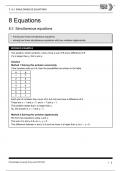
8.3 Simultaneous equations ©Cambridge University Press and OCR 2021 1 8 Equations 8.3 Simultaneous equations • forming two linear simultaneous equations • solving two linear simultaneous equations with two variables algebraically. WORKED EXAMPLE Two positive, whole numbers x and y have a sum of 8 and a difference of 6. If x is larger than y, find x and y. Solution Method 1 Solving this problem numerically If the numbers add up to 8, then the possibilities are shown in the table. x y 1 7 2 6 3 5 4 4 5 3 6 2 7 1 Each pair of numbers has a sum of 8, but only two have a difference of 6. These are x = 1 and y = 7, and x = 7 and y = 1. The problem states that x is larger than y. So, the answer is x = 7 and y = 1. Method 2 Solving this problem algebraically We form two equations using x and y. The sum of x and y is 8, so x + y = 8. The difference between x and y is 6 and we know x is larger than y, so x − y = 6. 8.3 Simultaneous equations ©Cambridge University Press and OCR 2021 2 Now write the two equations one above the other: x + y = 8 x − y = 6 As the signs in front of each y are different we can add the equations vertically to solve them. 2x = 14 x = 7 Substituting x = 7 into x + y = 8 we get 7 + y = 8 , which solves to give y = 1. The answer is x = 7 and y = 1. Note: x + y = 8 and x − y = 2 are called simultaneous equations. TIP Simultaneous equations with two variables (e.g. x and y) that are used in the same problem have only one pair of solutions. Exercise 1 1 Solve the simultaneous equations algebraically. a x + y = 5 x − y = 3 b x + y = 7 x − y = 1 c x + y = 8 x − y = −2 WORKED EXAMPLE Solve 2x + y = 8 x + y = 5 Solution As the signs in front of each y are the same, we subtract the equations. 2x + y = 8 Equation 1 − x + y = 5 Equation 2 x = 3 Now that we know x = 3, we can substitute this value into either Equation 1 or 2 to help us find y. Equation 2 is simpler to use, so substituting x = 3 into that gives us 3 + y = 5, which solves to give y = 2. The answer is x = 3 and y = 2. 2 Solve these simultaneous equations. a 3x + y = 9 x + y = 5 b 3x + 4y =15 x + 4y =13 c 2x − y = 8 x − y = 2 d 3x − 2y = 7 x − 2y =1 8.3 Simultaneous equations ©Cambridge University Press and OCR 2021 3 WORKED EXAMPLE Solve 4x + 3y = 23 x + y = 6 Solution The coefficients of neither x nor y are the same, so before we can add or subtract the equations, we need to make the coefficients of either x or y the same. Here, we can do this by multiplying x + y = 6 by 3 on both sides to give 3x + 3y = 18. So, we now have the first equation: 4x + 3y = 23 and a new second equation: 3x + 3y = 18 Subtracting the second equation from the first gives x = 5. Now substitute this value of x into one of the equations above (x + y = 6 is simplest to use) to get y = 1. The answer is x = 5 and y = 1. 3 Solve these simultaneous equations. a 3x + y = 20 4x + 2y = 26 b 4x + 3y = 29 x + y = 8 c 4x + y =13 3x + 2y =11 d 5x − 3y = 2 4x − 6y = −20 TIP Sometimes you will need to multiply both equations by a different number in order to solve them. 4 Solve these simultaneous equations. a 4x + 2y = 26 x + 3y = 9 b 2x + 3y = 27 5x − 2y = 20 c 7x − 3y = 9 5x − 4y = −1
Written for
- Institution
- GCSE
- Course
- GCSE
Document information
- Uploaded on
- June 17, 2023
- Number of pages
- 5
- Written in
- 2022/2023
- Type
- Exam (elaborations)
- Contains
- Questions & answers
Subjects
-
83 simultaneous equations
-
1 solve the simultaneous equations algebraically
-
3 solve these simultaneous equations

Document also available in package deal