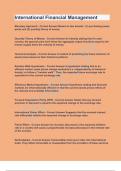
International Financial Management Correct Updated Answers
Monetary Approach Based on two tenants: (1) purchasing power parity and (2) quantity theory of money Quantity Theory of Money An identity stating that for each country, the general price level times the aggregate output should be equal to the money supply times the velocity of money. Technical Analysis A method of predicting the future behavior of asset prices based on their historical patterns Random Walk Hypothesis A hypothesis stating that in an efficient market, asset prices change randomly (i.e. independently of historical trends), or follow a "random walk". Thus, the expected future exchange rate is equivalent to the current exchange rate. Efficiency Market Hypothesis Hypothesis stating that financial markets are informationally efficient in that the current assets prices reflect all the relevant and available information. Forward Expectation Parity (FEP) States that any forward premium or discount is equal to the expected change in the exchange rate. International Fisher Effect Suggests that the nominal interest rate differential reflects the expected change in exchange rates. Fisher Effect An increase (decrease) in the expected inflation rate in a country will cause a proportionate increase (decrease) in the interest rate of the country. Nontradables Commodities that never enter into international trade. They either immovable or inseparable from the providers of these services Real Exchange Rates Measures the degree of deviation from PPP over a period of time, assuming PPP held at the beginning of the period. Purchasing Power Parity (PPP) This theory states that the exchange rate between currencies of two countries should be equal to the ratio of the country's price levels. Currency Carry Trade Involves buying a high-yield currency and funding it with a low-yielding currency, without any hedging. Uncovered Interest Rate Parity This parity condition holds that the difference in interest rates between two countries is equal to the expected change in exchange rate between the country's currencies. Covered Interest Arbitrage A situation which occurs when IRP does not hold, thereby allowing certain arbitrage profits to be made without the arbitrageur investing any money out of pocket or bearing any risk. Arbitrage Portfolio Involves... (1) No net investment and (2) No risk Interest Rate Parity An arbitrage equilibrium condition holding that the interest rate differential between two countries should be equal to the forward exchange premium or discount. Violation of IRP gives rise to profitable arbitrage opportunities. Arbitrage The act of simultaneously buying and selling the same or equivalent assets or commodities for the purpose of making certain, guaranteed profits.
Written for
- Institution
- International Financial Management
- Course
- International Financial Management
Document information
- Uploaded on
- June 30, 2023
- Number of pages
- 11
- Written in
- 2022/2023
- Type
- Exam (elaborations)
- Contains
- Questions & answers
Subjects
-
international financial management correct updated

Also available in package deal