The following summary is provided regarding the Cultural Orientations Framework set forth in
EXHIBIT THREE.
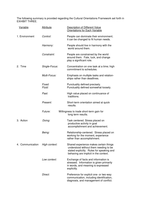
Variable Attribute Description of Different Value
Orientations for Each Variable
1. Environment Control: People can dominate their environment;
it can be changed to fit human needs.
Harmony: People should live in harmony with the
world around them.
Constraint: People are constrained by the world
around them. Fate, luck, and change
play a significant role.
2. Time Single-Focus: Concentration on one task at a time; high
commitment to schedules.
Multi-Focus: Emphasis on multiple tasks and relation-
ships rather than deadlines.
Fixed: Punctuality defined precisely.
Fluid: Punctuality defined somewhat loosely.
Past: High value placed on continuance of
traditions.
Present: Short-term orientation aimed at quick
results.
Future: Willingness to trade short-term gain for
long term results.
3. Action Doing: Task centered. Stress placed on
productive activity in goal
accomplishment and achievement.
Being: Relationship-centered. Stress placed on
working for the moment, experience
rather than accomplishment.
4. Communication High context: Shared experience makes certain things
understood without them needing to be
stated explicitly. Rules for speaking and
behaving are implicit in the context.
Low context: Exchange of facts and information is
stressed. Information is given primarily
in words, and meaning is expressed
explicitly.
Direct: Preference for explicit one- or two-way
communication, including identification,
diagnosis, and management of conflict.
EXHIBIT THREE.
Variable Attribute Description of Different Value
Orientations for Each Variable
1. Environment Control: People can dominate their environment;
it can be changed to fit human needs.
Harmony: People should live in harmony with the
world around them.
Constraint: People are constrained by the world
around them. Fate, luck, and change
play a significant role.
2. Time Single-Focus: Concentration on one task at a time; high
commitment to schedules.
Multi-Focus: Emphasis on multiple tasks and relation-
ships rather than deadlines.
Fixed: Punctuality defined precisely.
Fluid: Punctuality defined somewhat loosely.
Past: High value placed on continuance of
traditions.
Present: Short-term orientation aimed at quick
results.
Future: Willingness to trade short-term gain for
long term results.
3. Action Doing: Task centered. Stress placed on
productive activity in goal
accomplishment and achievement.
Being: Relationship-centered. Stress placed on
working for the moment, experience
rather than accomplishment.
4. Communication High context: Shared experience makes certain things
understood without them needing to be
stated explicitly. Rules for speaking and
behaving are implicit in the context.
Low context: Exchange of facts and information is
stressed. Information is given primarily
in words, and meaning is expressed
explicitly.
Direct: Preference for explicit one- or two-way
communication, including identification,
diagnosis, and management of conflict.