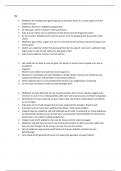
LSAT Questions and Answers, latest updated 2023
LSAT Questions and Answers, latest updated 2023 Assumption Strategy: Unstated premise Put your answer with the other premises and see if it matches or follows Assumption Strategy: Shift in the Language Identify shifts in the language: If the author provides evidence about one thing, and a conclusion about something else, that author has assumed there's a connection between those two things. Assumption Strategy: Logical Negation (not) If cannot find answer, turn it into a weaken question and find the answer that will most weaken the argument. To negate conditional statement: show that the necessary condition is not necessary Assumption Answer Categories • Eliminates an alternate cause for the effect Shows that when the cause occurs, the effect occurs Shows that hwen the cuase does not occur, the effect does not occur Eliminates the possibility that the stated relationship is reversed Shows that the data used to make the causal statement are accurate or eliminates possible problems with the data Assumption Question Characteristics Can be a supporter or a defender Supporter: links together new or rogue elements in the stimulus or fill logical gapsi n the argument Defender: eliminate ideas or assertions that would ubdermine the conclusion e.g. another possible answer has been eliminated Assumption answer choices CANNOT CONTAIN EXTRANEOUS INFORMATION NO If Must Be True Characteristics NO info from outside stimulus Unless commensense info or umbrella info (eg. animals and zebras) Must be True Strategies Correct answer proven from facts in the stimulus Language of stimulus should match language of answer Be careful of those that switch around words (e.g. many people instead of some people) When stimulus gives opinions of othes, the answer must reference those opinions Main Point Question Characteristics Should not just repeat the premises Must identify the conclusion Conditional Reasoning Sufficient condition does not cause the necessary condition to cocur TAKE NOTICE IF THE QUESTION SHOWS THAT THE SUFFICIENT CONDITION HAS OCCURRED. If it hasn't...then... Either/Or Statements Means AT LEAST ONE OF THE TWO Example: either John or Jack will attend the party. But both can also attend still! But if something is unrealistic (e.g. being short and tall), can't be both. Double Arrow If and only if, if but only if Then and only then, when and only when, etc. REsolve the Paradox Question Characteristics The answer will not negate one premise, it will actually resolve the paradox that will allow both sides to be correct. Correct answer must conform to the specifics of the stimulus Weaken Question Characteristics Look at the conclusion Accept new information Weaken Question Strategies Incomplete info: fails to consider all of the possibilities Improper comparison: attempts to compare two things that are different Overly broad conclusion: draws a conclusion that is broader or more expansive than the premises are If something says market share, don't choose something that says profits and revenues! Weakening Causal Conclusions Find an alternate cause for the effect Show that even when the cause occurs, the effect does not Or that when the effect occurs, the cause did not Or that the relationship is REVERSED Or that there is a statistical problem Strengthen Question Characteristics Focus on conclusion and accept new information. Even if it strengthens the argument a little, it's okay If it says "most justifies," is still a strengthen question If you eliminate possible problems with the data in a strengthen question, this is strengthening Strengthen Except Question an answer that has no impact can be correct! Doesn't have to weaken the argument. Justify the Conclusion Characteristics Will always use the word if Justify the Conclusion Strategies Any new element in the Conclusion WILL appear in the correct answer Elements common to the conclusion and to one premise usually do not appear in the correct answer Formal Logic Characteristics All, none, some (at least some, at least one, a few, a number, several, part of, a portion, MANY) and most (includes all. Majority, more than half, almost all, usually, typically, likely) NO CONTRAPOSITIVE FOR MOST AND SOME Formal Logic Reversibile Relationships All and Most are not reversible (as in not all Bs are As if you reverse it) BUT None, Some and Double Arrows are Formal Logic Inherent Inferences All includes most which includes some If something says "if and only if" Then double arrow This includes Most going both ways and Some Formal Logic Some Train To make an inference with a some relationship, either an all arrow, a none arrow or double arrow leading away from the some relationship is required SOME OR MOST ARROW WILL NOT BE ENOUGH TO MAKE A LEAP Look at the weakest link Formal Logic Train Double Arrow and Negatives If it's a double not arrow, (not arrows are just double) Then, some are not (THIS IS ONLY WITH SOME AND MOST) A - some are not C If the second leg of the train has EF, ignore the negative, and just say D most are not F. Formal Logic: When Begins with Double NOt Arrow Go backwards. A none B all C Becomes C some A Formal Logic: When Two Mosts yield an inference Only when two mosts each lead away from the middle variable Method of Reasoning Tips1 If the answer mentions additional things that did not occur in the stimulus, is wrong DO NOT LET YOURSELF BE LULLEDI NTO A COMMENT OF 'WHAT'S MORE' INTO BELIEVING THAT SOMEONE AUTOMATICLALY SI IN AGREEMENT. READ CLOSELY Method of Reasoning Tips2 Don't forget that there are SUBCONCLUSIONS! May sometimes be deceptively before a conclusion indicator—be careful! I'd write out the conclusion and premises in these (or mark them) Flaw in the Reasoning Questions: Lack of Reasoning Lack of relevant evidence for the conclusion: e.g. irrelevant data e.g. giving information about how society has always been alienated even though tthis doesn't show that science is making it more alienated Example answers: it fails to give any reason for the judgment it reaches IRRELEVANT DATA means no reasoning Flaw in the Reasoning Questions: INternal Contradictions e.g. "the author makes irreconciiliable presuppositions" REASONS OR BELIEFS Flaw in the Reasoning Questions: Errors in assessing the Force of Evidence JUST BECAUSE NO EVIDENCE has been intoruced does not mean that the position is false Or that only SOME evidence against a position is taken to prove that position false. Can't just weaken the position! Flaw in the Reasoning Questions: Other Characteristics Source Argument Attacks the source instead of the argument Circular Reasoning "Presupposes what it sets out to prove" When premise and conclusion are equivalent Straw Man Refashions the argument to make it easier to break down Appeal Fallacies Uses the opinion of an authority who may not have relevant knowledge Appeal to Popular opoiniion/numbers Appeal to Emotion Survey Errors If respondents give false answers to survey uestions, results are skewed Uncertain use of a Term or Concept When there is a shift in definition of a key term "equivocates with resect to a central concept" False Analogy "treats two very different cases as if they are similar" "treats two things that differ in critical respects as if they do not differ" Time Shift Error When the author assumes that because something was true in the past, it's true now Flaw in the Reasoning Questions: Errors of Conditional Reasoning Mistaken negation or reversal Just because necessary occurs, doesn't mean that sufficient has to! Or Mistakes a necessary condition for as ufficient condition Flaw in the Reasoning Questions: Errors in Composiiton and Division Assuming that something I true of each of the parts of a whole IS TRUE OF THE WHOLE ITSELF Error of division: when author attributes a characteristic of a whole to a part of the group e.g. all Americans are wealth because America is wealthy Flaw in the Reasoning Questions: False Dilemma Makes it seem like there are only two options when there are more • BUT SOMETIMES THE AUTHOR WILL ESTABLISH THAT THERE ARE TRULY ONLY TWO OPTIONS if an answer says that someone is incidentally going toward the pursuit of truth, this means that they are not never advancing the pursuit of truth Parallel Reasoning Questions Characteristics The order of the stimuls and the answer (e.g. premises and conclusion) do not need to be parallel Valid arguments have to match, method of reasoning has to match (e.g. causal or conditional reasoning), conclusion DEGREE has to match Controlling modifiers (some, most) have to MATCH SAME IN PREMISES, wording has to match! Also—if both premises independently prove the conclusion, that's a structural thing that should match! if the stimulus doesn't indicate that she knows about a premise (a character in the stimulus), then you can't assume that he/she knows Numbers and Percentages ERrors Misconception: Increasing percentages leads to increasing numbers Same with decreasing Misconception: increasing numbers leads to increasing percentages (same with decreasing) Misconception: large numbers automatically mean large percentages Misconception: large percentages means large numbers Without at least two percentage/number elements present, you cannot make a definite judgment about what is occurring with another element Figure out which percentages are holding steady (e.g. 85% obese children question)
Written for
- Institution
- LSAT
- Course
- LSAT
Document information
- Uploaded on
- July 14, 2023
- Number of pages
- 7
- Written in
- 2022/2023
- Type
- Exam (elaborations)
- Contains
- Questions & answers
Subjects
- latest updated 2023
-
lsat questions and answers
-
assumption strategy unstated premise put your ans
-
assumption answer categories • eliminates an alter
-
must be true characteristics no info from outside

Also available in package deal