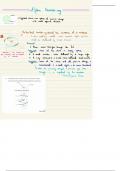
Alpha Scattering
-
suggested atoms were
spheres of positive charge
with small electrons.
negative
Rutherford scattering showed the existence of a nucleus.
I
plum pudding model
if was correct
alpha particles
would be deflected by small amount.
Instead:
vacuum
I in the chamber, so
1. Mostwentstraight
systs:mostof the
through
atom is
thefoil
empty space
deflected
that a
by
particles won'tb eabsorbed
molecules
2. A small number were
by large
a
angle
reflected
air
3. A amount (in 10000) backwards.
tiny
wave
of all
and
positive change is
the
sets: most mass
concentrated in small the centre (nucleus
region
a in
↳ when the
positively charged a
particle get close
enough
it is
repelledcreatemucus.
force
-
-
I
-
, Nuclear Radius
L
The where
angle & I is m ini
at
ee
el
Sing
I-drGrogle war e
·
=
~relative intensity
-> minutese
a
high energy ↑
I have wave like
properties.
M
-
-.........
Electrons
·
are diffracted
through a nucleus. i in
⑦ of diffractions
angle
1 mr.
=
The
speed of
high energy I is close to a.
1
=
.E mc
=
=
me
=
E
=
a
=
E
=
, Nuclear
Decay
-
heavy mek:(a lotof N and 2)
rich
Anucleus
neutron
& is unstable if ithas:
·
too neutrons
many
rich
eproton
·
too few
neutrons
too
·
many
muchous (it's too
heavy)
too much
energy
·
The nucleus is under the influence of the
strong nuclear force holding and the
together
it
electromagnetic
↳ affect
force
pushing them
apart.
only protons (charged)
For nucleus forces
be stable
electromagnetic
·
a to
strong
b
every nuclear
decay tries to increase the
magnitude of the strong interaction
compared to the
electromagnetic interaction.
1) Alpha (Id)
decay
These nuclei have the force
to
many protons
so
electromagnetic
is too
large.
To and decrease the and emitted.
increase the
strong
force
electromagnetic force neutrons
protons are
The radius of the nucleus decreases and
strong
force increases
(short-range force
2) Beta
ve)
decay (n -p p + +
Neutron rich (large radius of the nucleus
3) Best ve)
decay
+
(p > n
B
+
+
Proton rich
large electromagnetic force)
-
suggested atoms were
spheres of positive charge
with small electrons.
negative
Rutherford scattering showed the existence of a nucleus.
I
plum pudding model
if was correct
alpha particles
would be deflected by small amount.
Instead:
vacuum
I in the chamber, so
1. Mostwentstraight
systs:mostof the
through
atom is
thefoil
empty space
deflected
that a
by
particles won'tb eabsorbed
molecules
2. A small number were
by large
a
angle
reflected
air
3. A amount (in 10000) backwards.
tiny
wave
of all
and
positive change is
the
sets: most mass
concentrated in small the centre (nucleus
region
a in
↳ when the
positively charged a
particle get close
enough
it is
repelledcreatemucus.
force
-
-
I
-
, Nuclear Radius
L
The where
angle & I is m ini
at
ee
el
Sing
I-drGrogle war e
·
=
~relative intensity
-> minutese
a
high energy ↑
I have wave like
properties.
M
-
-.........
Electrons
·
are diffracted
through a nucleus. i in
⑦ of diffractions
angle
1 mr.
=
The
speed of
high energy I is close to a.
1
=
.E mc
=
=
me
=
E
=
a
=
E
=
, Nuclear
Decay
-
heavy mek:(a lotof N and 2)
rich
Anucleus
neutron
& is unstable if ithas:
·
too neutrons
many
rich
eproton
·
too few
neutrons
too
·
many
muchous (it's too
heavy)
too much
energy
·
The nucleus is under the influence of the
strong nuclear force holding and the
together
it
electromagnetic
↳ affect
force
pushing them
apart.
only protons (charged)
For nucleus forces
be stable
electromagnetic
·
a to
strong
b
every nuclear
decay tries to increase the
magnitude of the strong interaction
compared to the
electromagnetic interaction.
1) Alpha (Id)
decay
These nuclei have the force
to
many protons
so
electromagnetic
is too
large.
To and decrease the and emitted.
increase the
strong
force
electromagnetic force neutrons
protons are
The radius of the nucleus decreases and
strong
force increases
(short-range force
2) Beta
ve)
decay (n -p p + +
Neutron rich (large radius of the nucleus
3) Best ve)
decay
+
(p > n
B
+
+
Proton rich
large electromagnetic force)