NR 228: Exam 1 Latest Update Graded A+
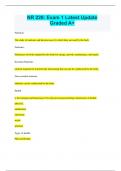
NR 228: Exam 1 Latest Update Graded A+ Nutrition- The study of nutrients and the processes by which they are used by the body Nutrients- Substances in foods required by the body for energy, growth, maintenance, and repair. Essential Nutrients- nutrient required for normal body functioning that can not be synthesized by the body. Non-essential nutrients- nutrients can be synthesized by the body Health- is the merging and balancing of five physical and psychologic dimensions of health: physical, intellectual, emotional social spiritual. Types of health: Physical Health- The efficiency of the body to function appropriately, to maintain immunity to disease, and to meet daily energy requirements Types of health: intellectual health- The use of intellectual abilities to learn and to adapt to changes in one's environment Types of health: Emotional health- The capacity to easily express or suppress emotions appropriately Types of health: Social health- The ability to interact with people in an acceptable manner and sustain relationships with family members, friends, and colleagues Types of health: Spiritual health The cultural beliefs that give purpose to human existence, found through faith in the teachings of organized religions, in an understanding of nature or science, or in an acceptance of the humanistic view of life Types of health: Environmental health- The external factors that affect our health and well-being, including the physical context within which one lives and works as affected by determinants of ethnicity, education, income, and occupation; and extending to the larger environment of safeguarding natural resources to reduce exposure to preventable hazards. Wellness- is a lifestyle that enhances our level of health health promotion- consists of strategies used to increase the level of health of individuals, families, groups, and communities. --Knowledge --Techniques --Community supports disease prevention- is the recognition of a danger to health that could be reduced or alleviated through specific actions or changes in lifestyle behaviors. Primary, secondary, and tertiary prevention Role of nutrition Functions of Essential Nutrients in the Body- Providing energy Regulating body processes Aiding growth and repair of body tissues Kcal value- Protein-- 4 Kcal value- Carbs 4 Kcalvalue- Lipids(fats) 9 Kcal Value- Alcohol 7 Carbohydrates- organic compounds composed of carbon, hydrogen, and oxygen in the form of simple carbohydrates or sugars Source of energy, sweetness, and dietary fiber ------------------------------------------------ Major source of energy and dietary fiber Simple carbohydrates found in fruits, milk, and sweeteners Complex carbohydrates found in cereals, grains, fruits, and vegetables All except dietary fiber broken down to units of glucose Glucose: most efficient form of energy for body food source of carbs- Primarily from plants •Divided into two categories •Simple carbohydrates •Complex carbohydrates •Three sizes: •Monosaccharides (Simple) •Disaccharides (Simple) •Polysaccharides (Complex) Monosaccharides: Single carbohydrate units. Examples are glucose, fructose and galactose Disaccharides: Two single carbohydrates bound together. Examples are Sucrose, maltose, and lactose Polysaccharides: Many units of monosaccharides joined together. Starch, Fiber and glycogen carb function in body- Provides energy •Dietary fiber•Naturally occurring sweeteners (sucrose and fructose) •Brain and nerve tissues require CHO (glucose) as fuel.•Protein-sparing effect Carbs- digestion: Digestive process begins in mouth: Amylase•Breakdown to monosaccharides•Mechanical digestion•Chemical digestion function of enzymes Carbs-absorption: Active transport process of glucose •Liver conversion of fructose and galactose to glucose lactose intolerant carbs-metabolism Blood glucose: source of energy to all cells Metabolism: primarily maintenance of blood glucose homeostasis at 70 to 100 mg/dL Glycogen: storage form of CHO in liver and muscles Glycogenesis: process of converting glucose to glycogen glycogenolysis- Glycogen is coverted back to glucose Gluconeogenesis: Producing glucose from fat blood glucose regulation- Hormonal system controls glucose metabolism and blood glucose level regulation Insulin: pancreatic hormone that regulates blood glucose uptake Glucagon: pancreatic hormone that releases glycogen from liver Somatostatin: pancreatic and hypothalamus hormone that inhibits insulin and glucagons Glycemic Index and Glycemic Load- Glycemic index: level to which food raises blood glucose levels in comparison with reference food; highest ranking is 100 Factors affecting glycemic index Glycemic load: total glycemic index; effect of mixed meal or dietary plan Health effects Proteins- Provide energy and perform extensive functions in body Composed of 20 amino acids ---Nine essential amino acids found in animal and plant sources Consumption of excess protein Lipids(fats) Provide densest form of energy and other functions in the body and in foods Three categories of lipids: triglycerides, phospholipids, and sterols Relationship between consumption of lipids and risk for diet-related diseases vitamins- Compounds that indirectly assist other nutrients through processes of digestion, absorption, metabolism, and excretion Thirteen vitamins, each with specific function Fat-soluble vitamins and water-soluble vitamins Found in many foods, especially fruits and vegetables Minerals- Serve structural purposes in body and found in body fluids Sixteen essential minerals, categorized as major and trace minerals Found in fruits, vegetables, dairy, meats, and legumes Water- Functions as major part of every tissue in body --Fluid in which substances can break down and re-form --As blood constituent, provides transportation for nutrients Equivalent of 9 to 13 cups water a day consumed from foods and beverages dietary standards- are a guide to adequate nutrient intake levels against which to compare nutrient values of foods consumed. To provide adequate amounts of vitamins and minerals - consume a variety of foods. Dietary Reference Intakes (DRIs)- Based on: -Review of available scientific data -Assessment of nutrient function to reduce risk of chronic and other diseases -Evaluation of nutrient consumption levels among U.S. and Canadian populations Applicable to various individuals and population groups Dietary Reference Intakes: Terms- Estimated Average Requirement (EAR) Recommended Dietary Allowance (RDA) Adequate Intake (AI) Tolerable Upper Intake Level (UL) Acceptable Macronutrient Distribution Range (AMDR) Use of Dietary Reference Intakes- Planning for large groups, such as the military Creating dietary standards for governmental food assistance programs Interpreting food consumption information on individuals and populations Developing new food products, such as imitation products nutrition facts- Adequate Eating Patterns- Assortment Balance Nutrient density Imbalanced Dietary Intake- Unernutrition Overnutrition Malnutrition Toward a Positive Nutrition Lifestyle- Self-efficacy- is the perception of people's ability to have power over their lives and behaviors. Positive self-efficacy Negative self-efficacy Role in Wellness- The decisions that individuals make about the food they eat determine their health and wellness. Personal Nutrition- Food selection -Food preferences -Genetic factors -Environmental effects -The media Food choice Food liking Community nutrition Public health nutrition Nutritional status of communities: a reflection of individual nutritional health -Nutrient deficiency -Nutrient excess -Dietary recommendations from government agencies and associations Guidelines from U.S. Department of Agriculture (USDA) and U.S. Department of Health and Human Services (HHS) For healthy Americans older than 2 years Foundation of federal nutrition policy and education food guides- Translate nutrient recommendations into food to eat MyPlate food guidance system Purpose: to implement Dietary Guidelines and DRIs Web-based interactive recommendations based on age, sex, and activity level Four themes Variety, proportionality, moderation, activity Criteria for Future Recommendations- Consider the source of nutrition advice. Assess the comprehensiveness of recommendations. Evaluate the basis of recommendations. Estimate the ease of application. Consumer Information and Wellness: Food Labeling - Nutrition Facts panel must list per serving: Energy (kcal) Fat Total food energy Food energy from fat Total fat Saturated fat, including trans fat Sodium Total carbohydrates Dietary fiber Sugars Protein Vitamins A and C Calcium Iron Organic food standards and labels Definition: -Animal derived foods such as meat, poultry, eggs, and dairy products are labeled organic if no antibiotics or growth hormones are used in the rearing of the animals. -Produce grown without the use of conventional pesticides, synthetic fertilizers, bioengineering, or radiation Natural- Signifies that the ingredients of a product are less processed and more wholesome but does not address how the ingredients were grown or the animals reared. Examples: Potassium is related to reduced risk of high blood pressure (hypertension). Whole grains are related to reduced risk of heart disease and certain cancers. A diet with enough calcium is related to a lower risk of osteoporosis. The digestive system- responsible for processing foods, relies on nutrient intake for its maintenance- Organs of the Digestive Tract Gastrointestinal (GI) tract Digestive system Digestion Processes completed by digestive system Chemical and mechanical digestion Processes of digestion, absorption, and metabolism work together to provide all body cells with energy and nutrients. the mouth Function of salivary glands Secretes saliva Parotid Submandibular Sublingual Function of teeth and tongue Formation and movement of bolus The Esophagus- A muscular tube through which bolus travels from mouth to stomach Peristalsis Segmentation Cardiac sphincter Stomach Functions- Holding food for partial digestion Producing gastric juice Providing muscular action that helps with mixing and tearing food Secretion of Intrinsic factor Releasing gastrin Assisting in the destruction of pathogenic bacteria that may be inadvertently consumed. the stomach Consists of fundus, body, and pylorus Gastric secretions -Cephalic phase -Gastric phase -Intestinal phase Gastric motility --Chyme formation Pyloric sphincter small intestine- Consists of duodenum, jejunum, and ileum Passage through takes about 5 hours Major organ of digestion and most absorption Villi and microvilli function of hormones- Secretions from small intestine, liver, and pancreas include: Secretin Bile Cholecystokinin (CCK) Function of ileocecal valve (sphincter) Large intestine- Consists of cecum, colon, and rectum Passage through takes about 9 to 16 hours Site of final absorption of water and some minerals Bacteria in colon produce several vitamins Formation of feces and excretion from colon through anus (sphincter) Absorption- Process by which substances pass through the intestinal mucosa into the blood or lymph Transport processes Passive diffusion Facilitated diffusion Active Transport Pinocytosis Determinants of vitamin and mineral absorption Nutrients such as fats, carbohydrates, and protein easily absorbed regardless of level of need Structure of small intestine allows for efficient absorption to occur Villi and microvilli Nutrient transport systems General circulatory (blood) system Lymphatic system Liver elimination- Expulsion of feces or body waste products called defecation Residue may include: Undigested materials such as cellulose and other dietary fibers Undigested fats may combine with dietary minerals such as calcium and magnesium to form residue Additional residue may include water, bacteria, pigments, and mucus digestive process across lifespan- Immature GI tract of young infants Middle years include gallbladder disease and peptic ulcers Age-related lactose intolerance Older years associated with constipation and diverticulosis metabolism- Set of processes through which absorbed nutrients are used by body for energy and to form and maintain body structures and functions Catabolism Anabolism Functions of nutrients Form new cell structures Create new substances such as hormones and enzymes Assist in use of other nutrients in cell Act as catalysts or coenzymes in transforming and using of carbohydrates, proteins, and lipids Provides energy metabolism waste products- Excreted through lungs, kidneys, or large intestine metabolism across lifespan- Lowered metabolic rates Nutrient needs remain constant contracting- a specific agreement with yourself or between you and a friend, spouse, or other relative Agreement represents willingness to attempt to change a health-related behavior Goal or behavior change clearly defined and observable
Written for
- Institution
- NR 228:
- Course
- NR 228:
Document information
- Uploaded on
- July 19, 2023
- Number of pages
- 19
- Written in
- 2022/2023
- Type
- Exam (elaborations)
- Contains
- Questions & answers
Subjects
-
nr 228 exam 1 latest update graded a
-
nutrition the study of nutrients and the processe

Also available in package deal