Chapter 6 BSG Questions with correct Answers 2023
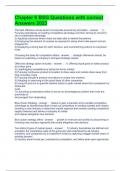
Chapter 6 BSG Questions with correct Answers 2023 The best offensive moves tend to incorporate several key principles: 1) Focusing relentlessly on building competitive advantage and then striving to convert it into a sustainable advantage 2) Applying resources where rivals are least able to defend themselves 3) Employing the element of surprise as opposed to doing what rivals expect and are prepared for 4) Displaying a strong bias for swift, decisive, and overwhelming actions to overpower rivals Choosing the basis for competitive attack strategic offensives should, be based on exploiting a company's strongest strategic assets. Offensive strategy option includes: 1) Offering equal good or better product at a lower price 2) Leapfrogging competitors by being the first to market 3) Pursuing continuous product innovation to draw sales and market share away from less innovative rivals 4) Pursuing disruptive product innovations to create new markers 5) Adopting or improving on the good ideas of other companies 6) Using hit-and-run or guerrilla warfare tactics to grab market share from complacent or distracted rivals 7) Launching a preemptive strike to secure an advantageous position that rivals are prevented or discouraged from duplicating. Blue Ocean Strategy Seeks to gain a dramatic and a durable competitive advantage by abandoning effort to beat out competitors in existing markets and instead inventing a new industry or distinctive market segment that renders existing competitors largely irrelevant and allows a company to create and capture altogether new demand. Blue ocean strategy offers growth in revenues and profits by discovering or inventing new industry segments that create altogether new demand Two distinct types of market space: 1) Industry boundaries are defined and accepted, the competitive rules of the game are well understood by all industry members, and companies try to outperform rivals by capturing a bigger market share of existing demand 2) Industry doesn't exist yet, untainted by competition, and offers wide open opportunity for profitable and rapid growth if a company can come up with a product offering and strategy that allows it to create new demand rather than fight over existing demand Defensive strategies counter offensive strategies by: 1) Lowering the risk of being attacked 2) Weakening the impact of any attacks that occurs 3) Influencing challengers to aim their attacks at other rivals Because of first-mover advantages & disadvantages competitive advantage can spring from when a move is made as well as from what move is made 5 conditions first-movers have an advantage: 1) When pioneering helps build a firm's reputation with buyers and creates brand loyalty 2) When a first mover's customers will thereafter face significant switching costs 3) When property rights protections thwart rapid imitation of the initial move. 4) When an early lead enables the first mover to move down the learning curve ahead of rivals 5) When a first mover can set the technical standard for the industry Potential late-mover advantages 1) When pioneering is more costly than imitative following, and only negligible learning-curve benefits accrue to the leader—a condition that allows a follower to end up with lower costs than the first-mover. 2) When the products of an innovator are somewhat primitive and do not live up to buyer expectations, thus allowing a follower with better-performing products to win disenchanted buyers away from the leader. 3) When rapid market evolution (due to fast-paced changes in either technology or buyer needs) gives second-movers the opening to leapfrog a first-mover's products with more attractive next-version products. 4) When market uncertainties make it difficult to ascertain what will eventually succeed The scope of the firm refers to the range of activities which the firms performs internally, the breadth of its product/service offerings, the extent of its geographic marker presence, and its mix of business. Two primary dimensions are: 1) Horizontal scope 2) Vertical scope Horizontal scope is the range of product/service segments that a firm serves within it focal market. Vertical scope is the extent to which a firm's internal activities encompass one, some, many, or all of the activities that make up an industry's entire value chain system, ranging from raw material production to final sales Merger is the combining of two or more companies into a single corporate entity, Acquistion is a combination in which one company, the acquirer, purchases and absorbs the operation of another Horizontal acquisition/merger are driven by strategies to achieve one of the following 1) Creating a more cost-efficient operation out of the combined companies 2) Expanding a company's geographic coverage. 3) Extend a company's business into new product categories. 4) Gaining quick access to new technologies or complementary resources and capabilities. 5) Leading the convergence of industries whose boundaries are being blurred by changing technologies and new market opportunities. Vertical integration extends a firm's competitive and operating scope within the same industry. It involves expanding the firm's range of activities backward into sources of supply and/or forward toward end users 2 reasons for vertical integration 1) To strengthen the firm's competitive position 2) boost its profitability, A vertically integrated firm is one that performs value chain activities along more than one stage of an industry's value chain system. For backward integration to be a viable and profitable strategy, a company must be able to: 1) Achieve the same scale economies as outside suppliers. 2) Match or beat suppliers production efficiency with no drop-off in quality. Backward integration involves performing industry value chain activities previously performed by suppliers or other enterprises engaged in earlier stages of the industry value chain; forward integration involves involves performing industry value chain activities closer to the end user. Outsourcing involves farming out certain value chain activities to outside vendors Strategic alliances and cooperative partnerships provide one way to gain some of the benefits offered by vertical integration, outsourcing, and horizontal mergers and acquisitions while minimizing the associated problems. Strategic alliance is a formal agreement between two or more separate companies in which they agree to work cooperatively toward some common objective. joint venture is a type of strategic alliance in which the partners set up an independent corporate entity that they own and control jointly, sharing in its revenues and expenses
Written for
- Institution
- BSG
- Course
- BSG
Document information
- Uploaded on
- July 28, 2023
- Number of pages
- 4
- Written in
- 2022/2023
- Type
- Exam (elaborations)
- Contains
- Questions & answers
Subjects
-
chapter 6 bsg questions with correct answers 2023
-
the best offensive moves tend to incorporate sever
-
offensive strategy option includes 1 offering eq
-
blue ocean strategy seeks to gain a dramatic and

Also available in package deal