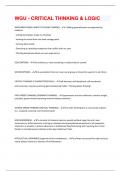
WGU - CRITICAL THINKING & LOGIC | Questions and Answers with complete solution
IMPEDIMENTS/BAD HABITS TO SOUND THINKING: - - Making generalizations unsupported by evidence - Letting stereotypes shape our thinking - Viewing the world from one fixed vantage point - Forming false beliefs - Dismissing or attacking viewpoints that conflict with our own - Thinking deceptively about our own experiences EGOCENTRISM: - the tendency to view everything in relationship to oneself. SOCIOCENTRISM: - the assumption that one's own social group is inherently superior to all others. CRITICAL THINKING IS CHARACTERISTICALLY: - self-directed; self-disciplined; self-monitored; self-corrective; requires practicing good intellectual habits; "thinking about thinking". FIRST-ORDER THINKING (ORDINARY THINKING): - spontaneous and non-reflective; contains insight, prejudice, good and bad reasoning indiscriminately combined SECOND-ORDER THINKING (CRITICAL THINKING): - first-order thinking that is consciously realized (i.e., analyzed, assessed, and reconstructed). FAIR-MINDEDNESS: - to consider all relevant opinions equally without regard to one's own sentiments or selfish interests; to bring an unbiased and unprejudiced perspective to all viewpoints relevant to a situation. Involves adherence to Intellectual Standards along with requiring the critical thinker to simultaneously embody certain key Intellectual Traits. INTELLECTUAL UNFAIRNESS (opposite of fair-mindedness): - to always see yourself as right and just; nearly always involves an element of self-deception.TRAITS/VIRTUES of a CRITICAL THINKER: *terms used by Paul & Elder (all relate fundamentally to fair-mindedness) - -INTELLECTUAL AUTONOMY=thinking for oneself while adhering to standards of rationality. -INTELLECTUAL COURAGE=to develop the courage to challenge popular beliefs; confronting ideas, views, beliefs with fairness, even when painful; examine beliefs that one has negative feelings toward and has been dismissive of. -INTELLECTUAL EMPATHY=to routinely inhabit the perspectives of others in order to genuinely understand them. -INTELLECTUAL HUMILITY=commitment to discovering the extent of one's own ignorance. Recognition that one does not/cannot know everything. To be conscious of one's biases and prejudices. -INTELLECTUAL INTEGRITY=striving to be true to one's own disciplined thinking and holding oneself to the same standards that one expects others to meet. -INTELLECTUAL PERSEVERANCE= the act of working one's way through intellectual complexities despite frustrations inherent in doing so. -CONFIDENCE IN REASON=encourages people to come to their own conclusions through the use of their own rational faculties; to use good reasoning as the fundamental criterion by which to judge whether to accept or reject any belief or position. STRONG-SENSE CRITICAL THINKERS: - to behave in ways that do not exploit or otherwise harm others; work to empathize with the viewpoints of others; consistent pursuit of fair and just; willing to listen to arguments they do not necessarily hold; change their views when faced with better reasoning. Rather than using their thinking to manipulate others and to hide from the truth (in a weak-sense way), they use thinking in an ethical, reasonable manner.
Written for
- Institution
- WGU - CRITICAL THINKING & LOGIC
- Course
- WGU - CRITICAL THINKING & LOGIC
Document information
- Uploaded on
- July 30, 2023
- Number of pages
- 8
- Written in
- 2022/2023
- Type
- Exam (elaborations)
- Contains
- Questions & answers
Subjects
-
wgu critical thinking amp logic

Also available in package deal