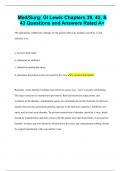
Med/Surg: GI Lewis Chapters 39, 42, & 43 Questions and Answers Rated A+
Med/Surg: GI Lewis Chapters 39, 42, & 43 Questions and Answers Rated A+ The appropriate collaborative therapy for the patient with acute diarrhea caused by a viral infection is to: a. increase fluid intake b. administer an antibiotic c. administer antimotality drugs d. quarantine the patient to prevent spread of the virus a. increase fluid intake Rationale: Acute diarrhea resulting from infectious causes (e.g., virus) is usually self-limiting. The major concerns are transmission prevention, fluid and electrolyte replacement, and resolution of the diarrhea. Antidiarrheal agents are contraindicated in the treatment of infectious diarrhea because they potentially prolong exposure to the infectious organism. Antibiotics are rarely used to treat acute diarrhea. To prevent transmission of diarrhea caused by a virus, hands should be washed before and after contact with the patient and when body fluids of any kind are handled. Vomitus and stool should be flushed down the toilet, and contaminated clothing should be washed immediately with soap and hot water. When a 35-year-old female patient is admitted to the emergency department with acute abdominal pain, which possible diagnosis should you consider that may be the cause of her pain (select all that apply)? a. Gastroenteritis b. Ectopic pregnancy c. GI bleeding d. Irritable bowel syndrome e. Inflammatory bowel disease a, b, c, d & e Rationale: All these conditions could cause acute abdominal pain. Assessment findings suggestive of peritonitis include a. rebound abdominal pain b. a soft, distended abdomen c. dull, continuous abdominal pain d. observing that the patient is restless a. rebound abdominal pain Rationale: With peritoneal irritation, the abdomen is hard, like a board, and the patient has severe abdominal pain that is worse with any sudden movement. The patient lies very still. Palpating the abdomen and releasing the hands suddenly causes sudden movement within the abdomen and severe pain. This is called rebound tenderness. In planning care for the patient with Crohn's disease, the nurse recognizes that a major difference between ulcerative colitis and Crohn's disease is that Crohn's disease: a. frequently results in toxic megacolon b. causes fever nutritional deficiencies than ulcerative colitis
Geschreven voor
- Instelling
- Med/Surg: GI
- Vak
- Med/Surg: GI
Documentinformatie
- Geüpload op
- 31 juli 2023
- Aantal pagina's
- 83
- Geschreven in
- 2022/2023
- Type
- Tentamen (uitwerkingen)
- Bevat
- Vragen en antwoorden
Onderwerpen
- 42
-
medsurg gi lewis chapters 39
-
amp 43 questions

Ook beschikbaar in voordeelbundel