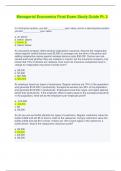
Managerial Economics Final Exam Study Guide Pt. 2 - Chs. 13 - 22 EOC MC Questions
Managerial Economics Final Exam Study Guide Pt. 2 In a first-price auction, you bid ____________ your value, and in a second-price auction you bid ____________ your value. a. at; above b. below; above c. below; at d. below; below An insurance company offers doctors malpractice insurance. Assume the malpractice claims against careful doctors cost $5,000 on average over the term of the policy and settling malpractice claims against reckless doctors costs $30,000. Doctors are risk-neutral and know whether they are reckless or careful, but the insurance company only knows that 10% of doctors are reckless. How much do insurance companies have to charge for malpractice insurance to break even? a. $5,000 b. $7,500 c. $27,500 d. $30,000 An employer faces two types of employees. Regular workers are 70% of the population and generate $100,000 in productivity. Exceptional workers are 30% of the population, and generate $120,000 in productivity. Employees know their types, and reject salaries below their productivity. If the employer offers a salary equal to the average productivity in the population, what will be the employer's per-employee profit? a. -$10,000 b. -$6,000 c. $0 d. $4,000 An all-you-can-eat buffet attracts two types of customers. Regular customers value the buffet at $20 and eat $5 of food in costs to the restaurant. Hungry customers value the buffet at $40 and eat $10 of food. If there are 100 of each types in the market for a buffet dinner, what is the restaurant's maximum profit? a. $2,500 b. $3,000 c. $4,500 d. $6,500 To combat the problem of adverse selection, _____________ informed parties can employ ______________ techniques a. more; signaling b. less; signaling c. equally; screening d. equally; signaling Which of the following can be an example of a signal? a. An air-conditioning manufacturer offers a 50-year warranty b. A lawyer offers to be paid only if the client wins c. A student pursues an MBA d. All of the above Which of the following is not an example of adverse selection? a. A business bets the proceeds of a bank loan on the next NFL game. b. An accident-prone driver buys auto insurance. c. A patient suffering from a terminal disease buys life insurance. d. A really hungry person decides to go to the all-you-can-eat buffet for dinner. The demand for insurance arises primarily from people who are a. risk-seeking b. risk-averse c. risk-neutral d. None of the above Which of the following is a potential solution to the adverse selection problem faced by insurance companies? a. Offer plans with different deductibles so that higher-risk customers accept higher deductibles b. Create a national database of customers that allows companies to look up each person's historical risk c. Mandate that every person purchase insurance d. All of the above An insurance company suffers from adverse selection if a. safe customers are less likely to insure than risky customers b. customers know their willingness to pay for insurance but the company does not c. a customer takes on much greater risk because he is insured d. its customers are risk averse Which of the following is an example of adverse selection? a. A safe driver taking greater risk in a rental car than his own car. b. A terminally ill person purchasing life insurance. c. An employment contract encourages little effort on the part of their employees. d. All of the above. Which of the following is an example of moral hazard? a. Reckless drivers are the ones most likely to buy automobile insurance. b. Retail stores located in high-crime areas tend to buy theft insurance more often than stores located in low-crime areas. c. Drivers who have many accidents prefer to buy cars with air bags. d. Employees recently covered by the company health plan start going to the doctor every time they get a cold. In a bad economy, a CEO has a 4% chance of meeting earnings estimates at regular effort, and a 5% chance at extraordinary effort. Extraordinary effort costs the CEO $10,000. How large a bonus should the CEO be paid for meeting estimates to encourage extraordinary effort? a. $100,000 b. $200,000 c. $250,000 d. $1,000,000 A salesperson can put in regular effort (resulting in a 40% chance of sale) or high effort (60% chance of sale). If high effort costs the salesperson $20 more than regular effort, how large a per-sale bonus is required to encourage high effort? a. $12 b. $20 c. $33.33 d. $100 Which of the following is not an example of a process designed to combat moral hazard problems? a. Banks include restrictive covenants in loan agreements. b. Universities have students complete evaluations of professor performance at the end of a class. c. Insurance companies require applicants to provide medical history information as part of the application process. d. Employers regularly monitor employee performance. Which of the following is an example of moral hazard?
Written for
- Institution
- Managerial Economics
- Course
- Managerial Economics
Document information
- Uploaded on
- August 20, 2023
- Number of pages
- 16
- Written in
- 2023/2024
- Type
- Exam (elaborations)
- Contains
- Questions & answers
Subjects
- managerial economics
-
managerial economics final exam study guide pt 2
-
managerial economics final exam study guide
-
managerial economics final exam
-
managerial economics final
Also available in package deal