Colorado Licensure Test Questions with Correct Solutions Rated A+
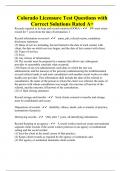
Records required to be kept and record retention (DORA) - SW must retain record for 7 years from the date of termination. I Record information on record - name, phi, referral reason, mandatory disclosure statement. (5) Dates of service including, but not limited to the date of each contact with client, the date on which services began, and the date of last contact with client; (6) Types of service; (7) Fees; (8) Any release of information; (9) The records must be prepared in a manner that allows any subsequent provider to reasonably conclude what occurred; (10) Name of any test administered, each date on which the test was administered, and the name(s) of the person(s) administering the testInformation on each referral made to and each consultation with another social worker or other health care provider. This information shall include the date of the referral or consultation, the name of the person to whom the client was referred, the name of the person with whom consultation was sought, the outcome (if known) of the referral, and the outcome (if known) of the consultation; (12) A final closing statement Record storage and transfer - Need clients consent to transfer and storage must be confidentail and secure Disposition of records - disability, illness, death, sale or transfer of practice, termination of practice Destroying records - Only after 7 years, all identifying information Record Keeping in an agency - A social worker need not create and maintain separate client records if the social worker practices in an agency or institutional setting and the social worker: (1) Sees the client in the usual course of that practice; (2) Keeps client records as required by the agency or institution; and (3) The agency or institution maintains client records. Reporting child abuse - reasonable cause to know or suspect that a child has been subjected to abuse or neglect or who has observed the child being subjected to circumstances or conditions that would reasonably result in abuse or neglect shall immediately upon receiving such information report or cause a report to be made of such fact to the county department, the local law enforcement agency, or through the child abuse reporting hotline system as set forth in section Exceptions to reporting abuse - Learn of the suspected abuse or neglect until after the alleged victim of the suspected abuse or neglect is eighteen years of age or older; and (II) Have reasonable cause to know or suspect that the perpetrator of the suspected abuse or neglect: (A) Has subjected any other child currently under eighteen years of age to abuse or neglect or to circumstances or conditions that would likely result in abuse or neglect; or (B) Is currently in a position of trust, as defined in section 18-3-401 (3.5), C.R.S., with regard to any child currently under eighteen years of age. Elderly abuse reporting - n and after July 1, 2016, a person specified in paragraph (b) of this subsection (1) who observes the mistreatment of an at-risk elder or an at-risk adult with IDD, or who has reasonable cause to believe that an at-risk elder or an at-risk adult with IDD has been mistreated or is at imminent risk of mistreatment, shall report such fact to a law enforcement agency not more than twenty-four hours after making the observation or discovery. Information to know in the report for elderly abuse - The name, age, address, and contact information of the at-risk elder or at-risk adult with IDD; (II) The name, age, address, and contact information of the person making the report; (III) The name, age, address, and contact information of the caretaker of the at-risk elder or at-risk adult with IDD, if any; (IV) The name of the alleged perpetrator; (V) The nature and extent of any injury, whether physical or financial, to the at-risk elder or at-risk adult with IDD; (VI) The nature and extent of the condition that required the report to be made; and (VII) Any other pertinent information. Consent for BH for minors - Notwithstanding any other provision of law, a minor who is fifteen years of age or older, whether with or without the consent of a parent or legal guardian, may consent to receive mental health services to be rendered by a facility or by a professional person or mental health professional licensed pursuant to part 3, 4, 5, 6, or 8 of article 43 of title 12, C.R.S., in any practice setting The need for continuing hospitalization of all voluntary patients who are minors shall be formally reviewed at least every two months. Imminent danger to self or others - the following persons may act as intervening professionals to effect a seventy-two-hour hold as provided in subsection (1)(a)(I) of this section: (A) A certified peace officer; (B) A professional person; (C) A registered professional nurse as defined in section 12-38-103 (11), C.R.S., who by reason of postgraduate education and additional nursing preparation has gained knowledge, judgment, and skill in psychiatric or mental health nursing; (D) A licensed marriage and family therapist, licensed professional counselor, or addiction counselor licensed under part 5, 6, or 8 of article 43 of title 12, C.R.S., who by reason of postgraduate education and additional preparation has gained knowledge, judgment, and skill in psychiatric or clinical mental health therapy, forensic psychotherapy, or the evaluation of mental disorders; or (E) A licensed clinical social worker licensed under the provisions of part 4 of article 43 of title 12, C.R.S. (I) When any person appears to have a mental health disorder and, as a result of such mental health disorder, appears to be an imminent danger to others or to himself or herself or appears to be gravely disabled, then an intervening professional, as specified in subsection (1)(a)(II) of this section, upon probable cause and with such assistance as may be required, may take the person into custody, or cause the person to be taken into custody, and placed in a facility designated or approved by the executive director for a seventy-two-hour treatment and evaluation. Electronic psychotherapy - It is recommended that the initial therapeutic contact be in person and adequate to provide a conclusive diagnosis and therapeutic treatment plan prior to implementing any psychotherapy through electronic means. The mental health professional is expected to establish an ongoing therapeutic relationship including face-to-face visits on a periodic basis thereafter Disclosure of Confidential information - A licensee, registrant, or certificate holder shall not disclose, without the consent of the client, any confidential communications made by the client, or advice given to the client, in the course of professional employment. A licensee's, registrant's, or certificate holder's employee or associate, whether clerical or professional, shall not disclose any knowledge of said communications acquired in such capacity. Any person who has participated in any therapy conducted under the supervision of a licensee, registrant, or certificate holder, including group therapy sessions, shall not disclose any knowledge gained during the course of such therapy without the consent of the person to whom the knowledge relates. Disclosure of confidential info part 2 - Subsection (1) of this section does not apply when: (a) A client or the heirs, executors, or administrators of a client file suit or a complaint against a licensee, registrant, or certificate holder on any cause of action arising out of or connected with the care or treatment of the client by the licensee, registrant, or certificate holder; (b) A licensee, registrant, or certificate holder was in consultation with a physician, registered professional nurse, licensee, registrant, or certificate holder against whom a suit or complaint was filed based on the case out of which said suit or complaint arises; (c) A review of services of a licensee, registrant, or certificate holder is conducted by any of the following: (I) A board or a person or group authorized by the board to make an investigation on its behalf; (II) The governing board of a hospital licensed pursuant to part 1 of article 3 of title 25, C.R.S., where the licensee, registrant, or certificate holder practices or the medical staff of such hospital if the medical staff operates pursuant to written bylaws approved by the governing board of the hospital; or (III) A professional review committee established pursuant to section 12-43-203 (11) if said person has signed a release authorizing such review; (d) (I) A client, regardless of age: (A) Makes an articulable and significant threat against a school or the occupants of a school; or (B) Exhibits behaviors that, in the reasonable judgment of the licensee, registrant, or certificate holder, create an articulable and significant threat to the health or safety of students, teachers, administrators, or other school personnel. (II) A licensee, registrant, or certificate holder who discloses information under this paragraph (d) shall limit the disclosure to appropriate school or school district personnel and law enforcement agencies. School or school district personnel to whom the information is disclosed shall maintain confidentiality of the disclosed information, regardless of whether the information constitutes an education record subject to FERPA, consistent with the requirements of FERPA and regulations and applicable guidelines adopted under FERPA, but may disclose information in accordance with section 1232g (b)(1) of FERPA and 34 CFR 99.36 if necessary to protect the health or safety of students or other persons. (III) A licensee, registrant, or certificate holder who discloses or fails to disclose a confidential communication with a client in accordance with this paragraph (d) is not liable for damages in any civil action for disclosing or not disclosing the communication. This subparagraph (III) does not rescind any statutory duty to warn and protect specified in, and does not eliminate any potential civil liability for failure to comply with, section 13-21-117, C.R.S.
Written for
- Institution
- Colorado Licensure
- Module
- Colorado Licensure
Document information
- Uploaded on
- August 29, 2023
- Number of pages
- 24
- Written in
- 2023/2024
- Type
- Exam (elaborations)
- Contains
- Questions & answers
Subjects
-
colorado licensure test questions with correct sol

Also available in package deal