MGMT 3000 EXAM 3 LYONS|UPDATED&VERIFIED|100% SOLVED|GUARANTEED SUCCESS
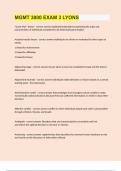
"Great Man" theory explained leadership by examining the traits and characteristics of individuals considered to be historically great leaders Acquired needs theory Individuals are driven or motivated by three types of needs: 1) Need for Achievement 2) Need for Affiliation 3) Need for Power Adjourning stage Occurs when a team has completed its task and the team is disbanded Adjustment heuristic Individuals make estimates or choices based on a certain starting point - first impression. Administrative model Acknowledges that managers may be unable to make economically rational decisions because they lack sufficient information on which to base their decisions Affective conflict conflict in which individuals attack each other's personalities through criticism, threats, and insults Ambiguity Situations that are characterized by uncertainty and risk and where the optimal decision is not clear or obvious Anchoring cognitive bias that describes the common human tendency to rely too heavily on the first piece of information offered Appropriateness framework the process of making decisions based on societal norms or expectations Arbitrator An individual who listens to both sides of a disagreement and makes a final decision based on the arguments Availability heuristic Individuals assess the frequency, probability, or likely cause of an event by the degree to which instances or occurrences of that event are readily available in memory Bargaining zone The range of settlements within which it is better for both parties to agree than not to agree Best alternative to a negotiated agreement (BATNA) The course of action that a person will take if a negotiation ends in an impasse Blocking behaviors Behaviors that inhibit the team and its members from achieving their objectives Body language Use of posture, body movement, hand and arm gestures, facial expressions, and eye contact to convey meaning to messages Boundary manager Determines how the team will work with clients, upper management, and others who have an interest in the team's product Bounded rationality A set of boundaries or constraints that tend to complicate the rational decision-making process Character The core values and fundamental beliefs that drive behavior in variable situations Charismatic leaders Individuals who arouse strong followership through inspirational visions or compelling personal attributes Claiming value The process by which a negotiator attempts to gain benefits or concessions for his or her position Classical model Seeks to maximize economic or other outcomes using a rational decision-making process Coalitions Individuals and/or groups that have common interests and perspectives Coercive power Power that gives someone the ability to punish another for his or her behavior Cognitive conflict Conflict that results from disagreements over work-related issues such as meeting schedules, work assignments, processes, or the task itself
Written for
- Institution
- MGMT
- Course
- MGMT
Document information
- Uploaded on
- August 31, 2023
- Number of pages
- 18
- Written in
- 2023/2024
- Type
- Exam (elaborations)
- Contains
- Questions & answers
Subjects
-
mgmt 3000 exam 3 lyonsupdatedverified100 solve

Also available in package deal