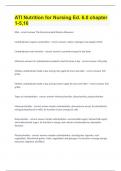
ATI Nutrition for Nursing Ed. 6.0 chapter 1-5,16 EXAM with complete solutions
RDA The Recommended Dietary Allowance Carbohydrates organic composition carbon, hydrogen and oxygen (CHO) Carbohydrates main function to provide energy for the body Minimum amount of carbohydrates needed to fuel the brain a day 130 g/day Median carbohydrate intake a day among men aged 20 years and older 296 g/day Median carbohydrate intake a day among women aged 20 years and older 256 g/day Types of carbohydrates Monosaccharides, disaccharides, polysaccharides Monosaccharides simple carbohydrates. glucose(corn syrup), fructose(fruits), and galactose(found in milk). Its function is basic energy for cells. Disaccharides simple carbohydrates. sucrose(table sugar), lactose(milk sugar), and maltose(malt sugar). Its function is energy, aids calcium and phosphorus absorption (lactose). Polysaccharides complex carbohydrates. starch(grains, legumes, root vegetables), fiber(whole grains, fruits, vegetables) and glycogen. Its function is energy storage (starches), digestive aid (fiber). The liver converts fructose and galactose into glucose, which is then released in the bloodstream. Within how long does the body digests 95% of starch? Within 1 to 4 hr after ingestion Where does digestion mainly occur? in the small intestine using pancreatic amylase. Glycogen is the stored carbohydrate energy source found in the liver and muscles. It is a vital source of backup energy, but is only available in limited supply. Dietary fiber is the substance in plant foods that is indigestible. Types are pectin, gum, cellulose, and oligosaccharides. Why is fiber so important for proper bowel elimination? It adds bulk to the feces and stimulates peristalsis to ease elimination. AI Adequate Intake Total fiber AI for a women in a day 25 g/day Total fiber AI for a men in a day 38 g/day Proteins provided by plant and animal sources. They are formed by linking amino acids in various combinations for specific use by the body. What are the three types of proteins? Complete, incomplete and complementary. what are complete proteins composed of? from animal sources and soy, contain sufficient amounts of all nine essential amino acids. what are incomplete proteins composed of? generally from plant sources, contain all nine essential amino acids. However, one or more of the amino acids is not adequate for protein synthesis. what are complementary proteins composed of? from food sources that are incomplete proteins eaten alone, but together are equivalent to a complete protein. What is the RDA of protein for healthy adults? 0.8 g/kg Protein's acceptable macronutrient distribution range (AMDR) for adults 10% to 35% of total calories Under consumption of protein can lead to Kwashiorkor and marasmus. disorders caused by extreme PEM. PEM Protein Energy Malnutrition Vegan diets can lack vitamin B12 How many calories of energy does protein provide? 4 cal/g of energy Lipids sources Dark meat, poultry skin, dairy foods, added oils Fat is an essential nutrient for the body. It serves as a concentrated form of stored energy for the body and supplies important tissue needs; hormone production, structural material for cell walls, protective padding for vital organs, insulation to maintain body temp, covering for nerve fibers, aid in the absorption of fat-soluble vitamins. Types of Fats triglycerides, phospholipids, and sterols. Triglycerides Total 98% of fat in food. They combine with glycerol to supply energy to the body, allow fat-soluble vitamin transport, and form adipose tissue that protects internal organs. Monounsaturated fatty acids is part of the unsaturated fatty acids. include; olives, canola oil, avocado, peanuts and other nuts. Saturated fatty acids are solid at room temp. found primarily in animal sources polyunsaturated fatty acids part of the unsaturated fatty acids. include; corn, wheat germ, soybean, safflower, sunflower, and fish. Essential fatty acids made from broken down fats, must be supplied by the diet. Essential fatty acids, including omega-3 and omega-6, are used to support blood clotting, blood pressure, inflammatory responses, and many other metabolic processes. Cholesterol daily intake 200 to 300 mg/day Very-low density lipoproteins (VLDL) carry triglycerides to the cells Low-density lipoproteins (LDL) carry cholesterol to the tissue cells High-density lipoproteins (HDL) remove excess cholesterol from the cells, and transport it to the liver for disposal How many essential vitamins? 13 water-soluble vitamins vitamins C and B-complex fat-soluble vitamins vitamins A, D, E and K vitamin C foods oranges, lemons, tomatoes, peppers, green leafy vegetables, and strawberries. Stress, illness and cigarette smoker patients are advised to increase their calcium intake by? 35 mg/day Severe calcium deficiency causes scurvy, a hemorrhagic disease with diffuse tissue bleeding, painful limbs/joints, weak bones, and swollen gums/loose teeth.
Written for
- Institution
- ATI Nutrition
- Course
- ATI Nutrition
Document information
- Uploaded on
- September 4, 2023
- Number of pages
- 13
- Written in
- 2023/2024
- Type
- Exam (elaborations)
- Contains
- Questions & answers
Subjects
-
ati nutrition for nursing ed 60 chapter 1 516

Also available in package deal