Marketing analysis - chapter 21
21.1 Elasticity of demand
● Marketing decisions have to be based on up-to-date and relevant information
as possible
● Marketing departments try to assess the impact on demand of these 3
variables:
○ The price of the product
○ Promotional spending
○ Consumer income levels
● The elasticity of demand is a form of measurement that was developed to
help assess these variables
Price elasticity of demand
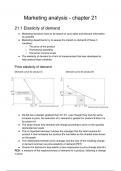
Demand curve for product A Demand curve for product B
● D2-D2 has a steeper gradient than D1-D1, even though they had the same
increase in price, the reduction of in demand is greater for product B than it is
for product A
● The slope shows how demand will change according to price vs the quantity
demanded per week
● This is important because it shows the manager that the total revenue for
product A has increased but product B’s has fallen as the shaded area shows
on the graph
● This relationship between price changes and the size of the resulting change
in demand is known as price elasticity of demand (PET)
● Product A’s demand is less elastic or less responsive to price change than B’s
PED: a measure of the responsiveness of demand for a product, following a change
in price
, PED: a measure of the responsiveness of demand for a product, following a change
in price
Interpreting price elasticity results
0:
● Perfectly inelastic demand
● The same amount is demanded, no matter what the price is
● In reality, no product has this
Between 0 and 1:
● Inelastic demand
● The percentage change in demand is less than the percentage change in
price
● If a product has this price elasticity of demand, a price increase will lead to a
smaller proportionate change in demand and revenue will rise
● However, if the price continues to rise, the demand will become more elastic
Unitary:
● Unit elasticity
● The percentage change in demand is equal and opposite to the percentage
change in price
● Any price change will lead to an equal change in demand and the total
revenue will remain constant
● When PED equals 1, sales revenue will be maximised
Between 1 and infinity
● Elastic demand
● The percentage change in demand is greater than the percentage change in
price
● If the price is reduced, there will be a greater proportionate increase in
demand and revenue will increase
Infinity
● Perfectly elastic demand
● An infinitely large amount is demanded at one price and then demand falls to
0 once the price is raised
● There is no product that would have this PED
● The value of PED is usually negative because a fall in price usually results in
a rise in demand, this is called an inverse relationship
21.1 Elasticity of demand
● Marketing decisions have to be based on up-to-date and relevant information
as possible
● Marketing departments try to assess the impact on demand of these 3
variables:
○ The price of the product
○ Promotional spending
○ Consumer income levels
● The elasticity of demand is a form of measurement that was developed to
help assess these variables
Price elasticity of demand
Demand curve for product A Demand curve for product B
● D2-D2 has a steeper gradient than D1-D1, even though they had the same
increase in price, the reduction of in demand is greater for product B than it is
for product A
● The slope shows how demand will change according to price vs the quantity
demanded per week
● This is important because it shows the manager that the total revenue for
product A has increased but product B’s has fallen as the shaded area shows
on the graph
● This relationship between price changes and the size of the resulting change
in demand is known as price elasticity of demand (PET)
● Product A’s demand is less elastic or less responsive to price change than B’s
PED: a measure of the responsiveness of demand for a product, following a change
in price
, PED: a measure of the responsiveness of demand for a product, following a change
in price
Interpreting price elasticity results
0:
● Perfectly inelastic demand
● The same amount is demanded, no matter what the price is
● In reality, no product has this
Between 0 and 1:
● Inelastic demand
● The percentage change in demand is less than the percentage change in
price
● If a product has this price elasticity of demand, a price increase will lead to a
smaller proportionate change in demand and revenue will rise
● However, if the price continues to rise, the demand will become more elastic
Unitary:
● Unit elasticity
● The percentage change in demand is equal and opposite to the percentage
change in price
● Any price change will lead to an equal change in demand and the total
revenue will remain constant
● When PED equals 1, sales revenue will be maximised
Between 1 and infinity
● Elastic demand
● The percentage change in demand is greater than the percentage change in
price
● If the price is reduced, there will be a greater proportionate increase in
demand and revenue will increase
Infinity
● Perfectly elastic demand
● An infinitely large amount is demanded at one price and then demand falls to
0 once the price is raised
● There is no product that would have this PED
● The value of PED is usually negative because a fall in price usually results in
a rise in demand, this is called an inverse relationship