CBT exam
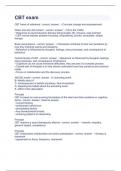
CBT frame of reference - correct answer • Concrete change and empowerment
When and why did it arise? - correct answer • US in the 1940s
• Response to psychodynamic therapy being lengthy ($), intrusive, past oriented
• CBT moved towards problem focussed, empowering, shorter, accessible, simple
therapy
Basic assumptions - correct answer • Individuals contribute to their own problems by
how they interpret events and situations
• Behaviour is influenced by thoughts, feelings, phys processes, and consequence of
behaviour
Central tenets of CBT - correct answer • Behaviour is influenced by thoughts, feelings,
phys processes, and consequence of behaviour
• Cognitions do not cause emotional difficulties, they are part of a complex process
• Central task of therapist is to help clients understand how they construct and construe
reality
• Focus on collaboration and the discovery process
ABCDE model - correct answer A- activating event
B- beliefs about A
C- consequences of beliefs (emotions, lack of emotions
D- disputing the beliefs about the activating event
E- effect of the disputation
Principle
CBT is based on ever-evolving formulation of the client and their problems in cognitive
terms - correct answer Need to assess:
• current thinking
• problematic behaviours
• precipitating factors
• key developmental events
• enduring patterns of interpreting
Principle
CBT requires a sound therapeutic alliance - correct answer • warmth, empathy,
genuine regard, competence
Principle
CBT emphasises collaboration and active participation - correct answer • therapy is
teamwork
• agreement on focus, frequency, homework
CBT frame of reference - correct answer • Concrete change and empowerment
When and why did it arise? - correct answer • US in the 1940s
• Response to psychodynamic therapy being lengthy ($), intrusive, past oriented
• CBT moved towards problem focussed, empowering, shorter, accessible, simple
therapy
Basic assumptions - correct answer • Individuals contribute to their own problems by
how they interpret events and situations
• Behaviour is influenced by thoughts, feelings, phys processes, and consequence of
behaviour
Central tenets of CBT - correct answer • Behaviour is influenced by thoughts, feelings,
phys processes, and consequence of behaviour
• Cognitions do not cause emotional difficulties, they are part of a complex process
• Central task of therapist is to help clients understand how they construct and construe
reality
• Focus on collaboration and the discovery process
ABCDE model - correct answer A- activating event
B- beliefs about A
C- consequences of beliefs (emotions, lack of emotions
D- disputing the beliefs about the activating event
E- effect of the disputation
Principle
CBT is based on ever-evolving formulation of the client and their problems in cognitive
terms - correct answer Need to assess:
• current thinking
• problematic behaviours
• precipitating factors
• key developmental events
• enduring patterns of interpreting
Principle
CBT requires a sound therapeutic alliance - correct answer • warmth, empathy,
genuine regard, competence
Principle
CBT emphasises collaboration and active participation - correct answer • therapy is
teamwork
• agreement on focus, frequency, homework