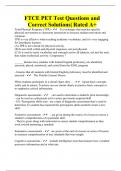
FTCE PET Test Questions and Correct Solutions| Rated A+
Total Physical Response (TPR) - Is a technique that matches specific physical movements to classroom instruction to increase student motivation and retention. TPR is very effective when teaching academic vocabulary, and it is very engaging for kinesthetic learners. (A) TPR is not a break for physical activity. (B) It uses both verbal and physical responses, not just physical. (C) It is used to teach vocabulary and concepts across all subjects, not just the ones that relate to physical activity. Competency 7 ______ dictates how students with limited English proficiency are identified, assessed, placed, monitored, and exited from the ESOL program - Ensures that all students with limited English proficiency must be identified and assessed - The Florida Consent Decree When students participate in a choral chant, they ... - repeat basic concepts orally and in unison. Teachers can use choral chants to practice basic concepts or to emphasize critical information. Diagnostic assessments - - are used to determine a student's prior knowledge. - can be used as a placement test to assess previously acquired skill - EX: Prerequisite skills tests - are a type of diagnostic assessment that is used to determine if a student has mastered the prerequisite skills needed to learn a new skill. Formative assessments - - are given during the course of a lesson to assess a student's comprehension of a particular skill. - They're given along with instruction to assess student comprehension as they work toward mastering a standard. Summative assessments - are given at the end of a lesson or series of lessons to measure comprehension of any standards that were taught. Cognitive assessments - include intelligence tests that measure how a student processes information and at what rate. - ex: IQ tests measure working memory. - when measuring a cognitive objective it has three main components: the condition, the behavior, and the degree. Criterion-referenced tests - are used to assess if a student has mastered a list of standards. - is used to test mastery of specific benchmark standards. EX: FCAT and PARCC Performance test - is an assessment that requires a student to perform (e.g., playing a piece of music in band) or create a product. Norm-referenced tests - Are used to compare student performance to the "norm" or average student. - Students are given stanine scores that indicate their performance compared to the group. -- A stanine score of 3 means the student is performing below level, since he or she only scored better than 30 percent of the group. -- A stanine score of 8 would indicate that the student is performing above level, scoring higher than 80 percent of the students. Deductive thinking - - Start with a generalized principle, then apply it to specific situations. - This is generally a more teacher-centered approach to learning. Inductive thinking - - Occurs when a student takes specific observations and uses them to come to a generalized conclusion. - Could be more student-centered Cooperative learning groups - - Should be heterogeneous. - Students who participate in cooperative learning work together to reach a common goal. - Is a critical component of a student-centered classroom. - Teachers play a critical role in cooperative learning. They are responsible of facilitating the process, clarifying misconceptions, and monitoring the interactions that go on in the group. - It requires interaction between group members. - The groups should also be changed regularly. Usually groups will last no more than a few weeks. This will help promote an atmosphere of inclusion in the classroom, since students will have ample time to interact with a majority of their classmates. _____ are made up of groups of teachers who meet regularly to reflect on instructional methods. It is common for them to analyze student data, share strategies for intervention, and discuss new ways to meet the needs of the students. - Reflective learning communities - They're also called Professional Learning Communities (PLCs). What is the difference between an accommodation and a modification? - - An accommodation is a change in the way a child learns. - A modification is a change in what a child learns. -- A student would not receive a modification unless he or she is incapable of doing grade-level work despite receiving accommodations to the way they learn. --Students who have a modified curriculum are not eligible for a regular high-school diploma. ( What document is used to identify English language learners when they initially enroll in a Florida school? - The Home Language Survey Example of divergent questions are ... - Essay Questions - Divergent test questions can have a multitude of answers, thus, evoking higher-order thinking skills --Ex. "why do you think..?" or "What if..?" Examples of convergent questions are... - Multiple-choice, fill-in-the-blank, and true/false questions. - Convergent questions "converge," or close in on, one correct answer. - simple, short answer and requires the use of lower-order thinking skills Graphic organizers examples.. - - Venn diagram - 5 W's chart - Fishbone diagram - Concept map - Anticipation chart - inverted triangle Venn diagram - used to compare and contrast two topics. - are used to compare similarities and differences Concept Map - Are effective for developing ideas and categorizing information.
Written for
- Institution
- FTCE PET
- Module
- FTCE PET
Document information
- Uploaded on
- September 14, 2023
- Number of pages
- 13
- Written in
- 2023/2024
- Type
- Exam (elaborations)
- Contains
- Questions & answers
Subjects
- ftce pet test
- ftce pet
- ftce
-
ftce pet test questions and correct solutions

Also available in package deal