6020 MidTerm exam questions and answers
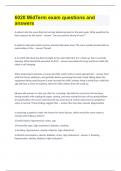
A patient tells the nurse that she has had abdominal pain for the past week. What would be the best response by the nurse? "Can you point to where it hurts?" A patient's laboratory data reveal an elevated thyroxine level. The nurse would proceed with an examination of the: Thyroid A 6-month-old infant has been brought to the well-child clinic for a check-up. She is currently sleeping. What should the examiner do first? Auscultate the lungs and heart while the infant is still sleeping When preparing to examine a 6-year-old child, which action is most appropriate? Start with the thorax, abdomen, and genitalia before examining the head. Avoid talking about the equipment being used because it may increase the child's anxiety. Keep in mind that a child this age will have a sense of modesty. Have the child undress from the waist up. 68-year-old woman is in the eye clinic for a checkup. She tells the nurse that she has been having trouble with reading the paper, sewing, and even seeing the faces of her grandchildren. On examination, the nurse notes that she has some loss of central vision but her peripheral vision is normal. These findings suggest that: She may have macular degeneration In assessing a patient's major risk factors for heart disease, which would the nurse want to include when taking a history? 1.Family history, hypertension, stress, age 2.Personality type, high cholesterol, diabetes, smoking 3.Smoking, hypertension, obesity, diabetes, high cholesterol 4.Alcohol consumption, obesity, diabetes, stress, high cholesterol 3. Smoking, hypertension, obesity, diabetes, high cholesterol A teenage patient comes to the emergency department with complaints of an inability to breathe and a sharp pain in the left side of his chest. The assessment findings include cyanosis, tachypnea, tracheal deviation to the right, decreased tactile fremitus on the left, hyperresonance on the left, and decreased breath sounds on the left. The nurse interprets that these assessment findings are consistent with: a pneumothorax During a hearing assessment the nurse practitioner finds that sound lateralizes to the patient's left ear with the Weber test. What can the nurse practitioner conclude from this? The patient has a conductive hearing loss in the right ear. Lateralization is a normal finding with the Weber test. The patient could have either a sensorineural or a conductive loss. A mistake has occurred; the test must be repeated. The most important reason to share information and offer brief teaching while performing the physical examination is to help: examiner feel more comfortable and gain control of the situation. rapport and increase the patient's confidence in the examiner. patient understand his or her disease process and treatment modalities. patient identify questions about his or her disease and potential areas of patient education. 2. build rapport and increase the patient's confidence in the examiner. In assessing the sclera of a black patient, which of the following would be an expected finding? The presence of small brown macules on the sclera During an examination, the nurse knows that the best way to palpate the lymph nodes in the neck is described by which statement? Using gentle pressure, palpate with both hands to compare the two sides. The nurse is obtaining a history from a 30-year-old male patient and is concerned about health promotion activities. Which of the following questions would be appropriate to use to assess health promotion activities for this patient? 1. "Do you perform testicular self-exams?" 2. "Have you ever noticed any pain in your testicles?" 3. "Have you had any problems with passing your urine?" 4. "Do you have any history of sexually transmitted disease?" 1. "Do you perform testicular self-exams?" When examining a 16-year-old male teenager, the examiner should: provide feedback that his body is developing normally and discuss the wide variation among teenagers on the rate of growth and development. Which of the following statements regarding the aging adult and abdominal assessment is true? the abdominal musculature is thinner In recording the childhood illnesses of a patient who denies having had any, which of the following notes by the nurse would be most accurate? 1. Patient denies usual childhood illnesses. 2. Patient states he was a "very healthy" child. 3. Patient states sister had measles, but he didn't. 4. Patient denies measles, mumps, rubella, chickenpox, pertussis, or strep throat. 4. Patient denies measles, mumps, rubella, chickenpox, pertussis, or strep throat. A patient's thyroid is enlarged, and the nurse is preparing to auscultate the thyroid for the presence of a bruit. A bruit is a: soft, whooshing, pulsatile sound best heard with the bell of the stethoscope. During an examination, the nurse knows that Paget's disease would be indicated by which of the following findings? Paget's disease occurs more often in males and is characterized by bowed, long bones, sudden fractures, and enlarging skull bones that press on cranial nerves causing symptoms of headache, vertigo, tinnitus, and progressive deafness. A patient is unable to read the 20/100 line on the Snellen chart. The nurse practitioner would refer the patient to an ophthalmologist or optometrist for further evaluation. Which technique of assessment is used to determine the presence of crepitus, swelling, and pulsations? Palpation During a cardiac assessment on an adult patient in the hospital for "chest pain," the nurse finds the following: jugular vein pulsations 4 cm above sternal angle when he is elevated at 45 degrees, BP 98/60, HR 130; ankle edema; difficulty in breathing when supine; and an S3 on auscultation. Which of the following best explains the cause of these findings? 1.Fluid overload 2.Atrial septal defect 3.Myocardial infarction 4.Heart failure 4. heart failure Primary muscles of respiration include: diaphragm & intercostals A patient comes into the clinic complaining of pain in her right eye. On examination, the nurse sees a pustule at the lid margin that is painful to touch, red, and swollen. The nurse recognizes that this is a hordeolum (stye). During an examination of a patient's abdomen, the nurse practitioner notes that the abdomen is rounded and firm to the touch. During percussion, the nurse practitioner notes a drum-like quality of the sound across the quadrants. This type of sound indicates: air-filled areas. In preforming auscultation of heart sunds, which sequence would the nurse use? aortic area -- pulmonic area -- erb's point -- tricuspid -- mitral A patient comes into the emergency department after an accident at work. A machine blew dust into his eyes and he was not wearing safety glasses. The nurse examines his corneas by shining a light from the side across the cornea. What findings would suggest that he has suffered a corneal abrasion? A shattered look to the light rays reflecting off the cornea During a hearing assessment the nurse practitioner finds that sound lateralizes to the patient's left ear with the Weber test. What can the nurse practitioner conclude from this? The patient could have either a sensorineural or a conductive loss. During an examination of a female patient, the nurse practitioner notes lymphadenopathy and suspects an acute infection. Acutely infected lymph nodes would be: firm but freely moveable Which of the following statements best describes the purpose of a health history? The purpose of the health history is to collect subjective data—what the person says about him or herself. The physician reports that a patient has a tracheal shift. The nurse practitioner is aware that this means that the patient's trachea is: The trachea is pushed to the unaffected side with an aortic aneurysm, a tumor, unilateral thyroid lobe enlargement, and pneumothorax. The nurse practitioner is examining a 2-year-old child and asks, "May I listen to your heart now?" Which critique of her technique is most accurate? Children at this age like to say "No." The examiner should not offer a choice when there is none. A patient tells the nurse practitioner that he is very nervous, that he is nauseated, and that he "feels hot." This type of data would be: Subjective During a hearing assessment the nurse practitioner finds that sound lateralizes to the patient's left ear with the Weber test. What can the nurse practitioner conclude from this? the patient has conductive hearing loss in the right ear During an admission assessment, the nurse practitioner notices that a male patient has an enlarged and rather thick skull. The nurse practitioner suspects acromegaly and would further assess for coarse facial features While performing a well-child assessment on a 5-year-old, the nurse practitioner notes the presence of palpable, bilateral, cervical, and inguinal lymph nodes. They are approximately 0.5 cm in size, round, mobile, and nontender. The nurse practitioner suspects that this: normal finding During an examination of a patient in her third trimester of pregnancy, the nurse practitioner notices that the patient's thyroid gland is slightly enlarged. No enlargement had been noted previously. The nurse practitioner suspects that The thyroid gland enlarges slightly during pregnancy owing to hyperplasia of the tissue and increased vascularity. What is responsible for the inspiratory splitting of S2? Closure of aortic, then pulmonic valves A 25-year-old optical technician comes to your clinic for evaluation of fatigue. As part of your physical examination, you listen to her heart and hear a murmur only at the cardiac apex. Which valve is most likely to be involved, based on the location of the murmur? Mitral A 58-year-old teacher presents to your clinic with a complaint of breathlessness with activity. The patient has no chronic conditions and does not take any medications, herbs, or supplements. Which of the following symptoms is appropriate to ask about in the cardiovascular review of systems? Orthopnea You are screening people at the mall as part of a health fair. The first person who comes for screening has a blood pressure of 132/85. How would you categorize this? Prehypertension You are evaluating a 40-year-old banker for coronary heart disease risk factors. He has a history of hypertension, which is well-controlled on his current medications. He does not smoke; he does 45 minutes of aerobic exercise five times weekly. You are calculating his 10-year coronary heart disease risk. Which of the following conditions is considered to be a coronary heart disease risk equivalent? Peripheral arterial disease You are conducting a workshop on the measurement of jugular venous pulsation. As part of your instruction, you tell the students to make sure that they can distinguish between the jugular venous pulsation and the carotid pulse. Which one of the following characteristics is typical of the carotid pulse? Palpable A 68-year-old mechanic presents to the emergency room for shortness of breath. You are concerned about a cardiac cause and measure his jugular venous pressure (JVP). It is elevated. Which one of the following conditions is a potential cause of elevated JVP? Constrictive pericarditis You are palpating the apical impulse in a patient with heart disease and find that the amplitude is diffuse and increased. Which of the following conditions could be a potential cause of an increase in the amplitude of the impulse? Aortic stenosis, with pressure overload of the left ventricle
Written for
- Institution
-
Columbia University
- Course
-
NSG 6020
Document information
- Uploaded on
- September 15, 2023
- Number of pages
- 11
- Written in
- 2023/2024
- Type
- Exam (elaborations)
- Contains
- Questions & answers
Subjects
- 6020
-
6020 midterm exam questions and answers

Also available in package deal