WGU C959 (2023/2024) – Complete and Accurate
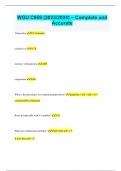
WGU C959 (2023/2024) – Complete and Accurate Proposition T/F statement exclusive or AꚚB inclusive or/disjunction AꓦB conjunction AꓥB What is the precedence for compound propositions? quantifier not and or conditional/bi-conditional Rows in truth table with N variables? 2^N When are conditionals true/false? If p(T) then q(T) = T If p(T) then q(F) = F If p(F) then q(T) = T If p(F) then q(F) = T Biconditional iff, ↔ tautology compound proposition that is always true regardless of TV. contradiction compound proposition that is always false, regardless of TV converse Proposition: if p then q " ": if q then p contrapositive proposition: if p then q " ": if not q then not p. inverse proposition: if p then q " ": if not p then not q logical equivalence Two compound propositions have the same TV regardless of TVs of individual propositions. ≡ . De Morgan's Laws ¬( p ꓦ q) ≡ (¬p ꓥ ¬q) (¬p ꓥ ¬q) ≡¬( p ꓦ q) Idempotent Laws p ꓦ p ≡ p p ꓥ p ≡ p Associative Laws (p ꓦ q) ꓦ r ≡ p ꓦ (q ꓦ r) (p ꓥ q) ꓥ r ≡ p ꓥ (q ꓥ r) Commutative Laws p ꓦ q ≡ q ꓦ p p ꓥ q ≡ q ꓥ p Distributive Laws p ꓦ (q ꓥ r) ≡ (p ꓦ q) ꓥ (p ꓦ r) p ꓥ (q ꓦ r) ≡ (p ꓥ q) ꓦ (p ꓥ r) identity laws p ꓦ F ≡ p p ꓥ T ≡ p Domination laws p ꓥ F ≡ F p ꓦ T ≡ T double negation laws ¬¬p≡ p complement laws p ꓥ ¬p ≡ F p ꓦ ¬p ≡ T ¬T ≡ F ¬F ≡ T De Morgan's laws ¬(p ꓦ q) ≡ ¬p ꓥ ¬q ¬(p ꓥ q) ≡ ¬p ꓦ ¬q Absorption Laws p ꓦ (p ꓥ q) ≡ p p ꓥ (p ꓦ q) ≡ p conditional identities p → q ≡ ¬p ∨ q p ↔ q ≡ ( p → q ) ∧ ( q → p ) predicate proposition with functional TV ꓯ universal quantifier where ꓯx P(x) is a universally quantified statement. A proposition. UQS Counterexample an element in the domain for which the predicate is false. ꓱ Existential quantifier/existentially quantified statement. ꓱx P(x) : 'there exists an x, such that P(x)' asserts truth for at least one possible value in the domain. A proposition. free variable any value in domain Bound variable attached to quantifier De Morgan's Law for Quantifiers ¬ꓯx P(x) ≡ ꓱx ¬P(x) ¬ꓱx P(x) ≡ ꓯx ¬P(x) ꓯxꓯy M(x,y) for every pair of x and y, M(x,y) is true. ꓱx ꓱy M(x,y) there exists at least one pair of x and y such that M(x,y) is true ꓱx ꓯy M(x,y) there exists at least one x that pairs with ALL y, such that M(x,y) is true ꓯx ꓱy M(x,y) For each x, there is at least one y, such that M(x,y) is true. De Morgan's Law for Nested Quantifiers ¬ ꓯx ꓯy P(x, y) ≡ ꓱx ꓱy ¬P(x, y) ¬ ꓯx ꓱy P(x, y) ≡ ꓱx ꓯy ¬P(x, y) ¬ ꓱx ꓯy P(x, y) ≡ ꓯx ꓱy ¬P(x, y) ¬ ꓱx ꓱy P(x, y) ≡ ꓯx ꓯy ¬P(x, y) modus ponens p p - q ∴ q modus tollens ¬q p → q ∴ ¬p addition p ∴ p v q simplification p ꓥ q ∴ p Inference: Conjunction p q ∴ p ꓥ q hypothetical syllogism p - q q - r ∴ p - r disjunctive syllogism p v q ¬p ∴ q resolution p v q ¬p v r ∴ q v r
Written for
- Institution
- WGU C959
- Course
- WGU C959
Document information
- Uploaded on
- September 17, 2023
- Number of pages
- 8
- Written in
- 2023/2024
- Type
- Exam (elaborations)
- Contains
- Questions & answers
Subjects
-
wgu c complete and accurate

Also available in package deal