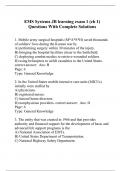
EMS Systems JB learning exam 1 (ch 1) Questions With Complete Solutions
1. Mobile army surgical hospitals (M*A*S*H) saved thousands of soldiers' lives during the Korean war by A) performing surgery within 30 minutes of the injury. B) bringing the hospital facilities closer to the battlefield. C) deploying combat medics to retrieve wounded soldiers. D) using helicopters to airlift casualties to the United States. correct answer: Ans: B Page: 6 Type: General Knowledge 2. In the United States mobile intensive care units (MICUs) initially were staffed by A) physicians. B) registered nurses. C) funeral home directors. D) nonphysician providers. correct answer: Ans: D Page: 6 Type: General Knowledge 3. The entity that was created in 1966 and that provides authority and financial support for the development of basic and advanced life support programs is the: A) National Association of EMTs. B) United States Department of Transportation. C) National Highway Safety Department. D) Centers for Disease Control and Prevention. correct answer: Ans: B Page: 6 Type: General Knowledge 4. Which of the following is NOT a critical point addressed by the "White Paper" written in 1966 that was entitled "Accidental Death and Disability: The Neglected Disease of Modern Society"? A) Ensuring that paramedics responded to every call B) Participating in community-based prevention efforts C) Allocating adequate resources for medical direction D) Developing and pursuing a national EMS research agenda correct answer: Ans: A Page: 7 Type: General Knowledge 5. The first EMT textbook Emergency Care and Transportation of the Sick and Injured was published in 1971 by the: A) National Association of EMS Educators (NAEMSE). B) American College of Emergency Physicians (ACEP). C) American Academy of Orthopaedic Surgeons (AAOS). D) American Association of Critical Care Nurses (AACN). correct answer: Ans: C Page: 6 Type: General Knowledge 6. Dr. Eugene Nagel advanced emergency medical treatment in 1969 by: A) training paramedics to administer certain medications directly through the chest wall and into the left ventricle. B) developing and implementing closed-chest cardiac massage (CPR) in order to pump blood in a patient without a pulse. C) implementing the "golden hour" which dramatically increased survival rates of patients who experienced severe trauma. D) developing a telemetry system that enabled fire fighters to transmit a patient's electrocardiogram to the physician at the hospital. correct answer: Ans: D Page: 6 Type: General Knowledge 7. Which of the following was NOT a required component identified by the Emergency Medical Services System Act of 1973? A) EMS research B) Mutual aid agreements C) National EMS certification D) Integration of health services correct answer: Ans: C Page: 7 Type: General Knowledge 8. Which of the following is one of the 10 system elements developed by the National Highway Traffic Safety Administration (NHTSA) in an effort to sustain EMS systems? A) Medical direction B) Fully enhanced 9-1-1 C) Paramedic supervisors D) Continued federal funding correct answer: Ans: A Page: 7 Type: General Knowledge 9. The EMS network begins: A) by educating dispatchers. B) with citizen involvement. C) when an injury has occurred. D) when paramedics are notified. correct answer: Ans: B Page: 10 Type: General Knowledge 10. Which of the following statements regarding the EMS system is correct? A) The paramedic is usually the public's f
Written for
- Institution
- EMS Systems JB learning
- Course
- EMS Systems JB learning
Document information
- Uploaded on
- September 28, 2023
- Number of pages
- 27
- Written in
- 2023/2024
- Type
- Exam (elaborations)
- Contains
- Questions & answers
Subjects
-
ems systems jb learning exam 1 ch 1 questions w

Document also available in package deal