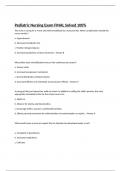
Pediatric Nursing Exam FINAL Solved 100%
The nurse is caring for a 4-year-old child immobilized by a fractured hip. Which complications should the nurse monitor? a. Hypocalcemia b. Decreased metabolic rate c. Positive nitrogen balance d. Increased production of stress hormones - Answer B What effect does immobilization have on the cardiovascular system? a. Venous stasis b. Increased vasopressor mechanism c. Normal distribution of blood volume d. Increased efficiency of orthostatic neurovascular reflexes - Answer A A young girl has just injured her ankle at school. In addition to calling the child's parents, the most appropriate immediate action by the school nurse is to: a. Apply ice. b. Observe for edema and discoloration. c. Encourage child to assume a comfortable position. d. Obtain parental permission for administration of acetaminophen or aspirin. - Answer A What would cause a nurse to suspect that an infection has developed under a cast? a. Complaint of paresthesia b. Increased respirations c. Cold toes d. "Hot spots" felt on cast surface - Answer D The nurse is teaching the parents of a 7-year-old child who has just had a cast applied for a fractured arm with the wrist and elbow immobilized. Which instructions should be included in the teaching? a. Swelling of the fingers is to be expected for the next 48 hours. b. Immobilize the shoulder to decrease pain in the arm. c. Allow the affected limb to hang down for 1 hour each day. d. Elevate casted arm when resting and when sitting up. - Answer D The nurse is teaching a family how to care for their infant in a Pavlik harness to treat developmental dysplasia of the hip. What should be included? a. Apply lotion or powder to minimize skin irritation. b. Remove the harness several times a day to prevent contractures. c. Return to the clinic every 1 to 2 weeks. d. Place a diaper over harness, preferably using a superabsorbent disposable diaper that is relatively thin. - Answer C The primary method of treating osteomyelitis is: a. Joint replacement. b. Bracing and casting. c. Intravenous antibiotic therapy. d. Long-term corticosteroid therapy. - Answer C Which medication is usually tried first when a child is diagnosed with juvenile idiopathic arthritis (JIA)? a. Aspirin b. Corticosteroids c. Cytotoxic drugs such as methotrexate d. Nonsteroidal antiinflammatory drugs (NSAIDs) - Answer D What is most descriptive of the therapeutic management of osteosarcoma? a. Treatment usually consists of surgery and chemotherapy. b. Amputation of the affected extremity is rarely necessary. c. Intensive irradiation is the primary treatment. d. Bone marrow transplantation offers the best chance of long-term survival. - Answer A An important nursing consideration when caring for a child with juvenile idiopathic arthritis (JIA) is to: a. Apply ice packs to relieve stiffness and pain. b. Administer acetaminophen to reduce inflammation. c. Teach child and family the correct administration of medications. d. Encourage range-of-motion exercises during periods of inflammation. - Answer c Which interaction is part of the discharge plan for a school-age child with osteomyelitis who is receiving home antibiotic therapy? a. Instructions for a low-calorie diet b. Arrangements for tutoring and schoolwork c. Instructions for a high-fat, low-protein diet d. Instructions for the parent to return the child to team sports immediately - Answer B Discharge planning for the child with juvenile arthritis includes the need for: a. Routine ophthalmologic examinations to assess for visual problems. b. A low-calorie diet to decrease or control weight in the less mobile child. c. Avoiding the use of aspirin to decrease gastric irritation. d. Immobilizing the painful joints, which are the result of the inflammatory process. - Answer A When assessing the child with osteogenesis imperfecta, the nurse should expect to observe: a. Discolored teeth. b. Below-normal intelligence. c. Increased muscle tone. d. Above-average stature. - Answer A Kristin, age 10 years, sustained a fracture in the epiphyseal plate of her right fibula when she fell off of a tree. When discussing this injury with her parents, the nurse should consider which statement? a. Healing is usually delayed in this type of fracture. b. Growth can be affected by this type of fracture. c. This is an unusual fracture site in young children. d. This type of fracture is inconsistent with a fall. - Answer B A nurse is conducting discharge teaching for parents of an infant with osteogenesis imperfecta (OI). Further teaching is indicated if the parents make which statement? a. "We will be very careful handling the baby." b. "We will lift the baby by the buttocks when diapering." c. "We're glad there is a cure for this disorder." d. "We will schedule follow-up appointments as instructed." - Answer C The nurse is caring for an infant with developmental dysplasia of the hip. Which clinical manifestations should the nurse expect to observe (Select all that apply)? a. Positive Ortolani sign b. Unequal gluteal folds c. Negative Babinski's sign d. Trendelenburg's sign e. Telescoping of the affected limb f. Lordosis - Answer A,B A clinic nurse is conducting a staff in-service for other clinic staff regarding the signs and symptoms of a rhabdomyosarcoma tumor. Which should be included in the teaching session (Select all that apply)? a. Bone fractures b. Abdominal mass c. Sore throat and ear pain d. Headache e. Ecchymosis of conjunctiva - Answer B,C,E The nurse is caring for a preschool child with a cast applied recently for a fractured tibia. Which assessment findings indicate possible compartment syndrome (Select all that apply)? a. Palpable distal pulse b. Capillary refill to extremity of <3 seconds c. Severe pain not relieved by analgesics d. Tingling of extremity e. Inability to move extremity - Answer C,D,E Which of the following is a physiologic effect of immobilization on children? a. Metabolic rate increases. b. Increased joint mobility can lead to contractures in a short time. c. Bone calcium increases, releasing excess calcium into the body (hypercalcemia). d. Venous stasis can lead to thrombi or emboli formation. - Answer D Which statement is true concerning osteogenesis imperfecta? A. It is easily treated. B. It is an inherited disorder. C. Later-onset disease usually runs a more difficult course. D. Braces and exercises are of no therapeutic value. - Answer B An appropriate nursing intervention when caring for the child with chronic osteomyelitis is to: A. provide active range-of-motion exercises for the affected extremity. B. administer antibiotics with meals. C. encourage frequent ambulation. D. move and turn the child carefully and gently to minimize pain. - Answer D Major goals of the therapeutic management of juvenile idiopathic arthritis are to: A. prevent joint discomfort and regain proper alignment. B. prevent loss of joint function and achieve cure. C. prevent physical deformity and preserve joint function. D. prevent skin breakdown and relieve symptoms. - Answer C Spastic cerebral palsy is characterized by: a. Hypertonicity and poor control of posture, balance, and coordinated motion. b. Athetosis and dystonic movements. c. Wide-based gait and poor performance of rapid, repetitive movements. d. Tremors and lack of active movement. - Answer A The most common problem of children born with a myelomeningocele is: a. Neurogenic bladder. b. Intellectual impairment. c. Respiratory compromise. d. Cranioschisis. - Answer A Which problem is most often associated with myelomeningocele? a. Hydrocephalus b. Biliary atresia c. Craniosynotosis d. Esophageal atresia - Answer A A current recommendation to prevent neural tube defects is the supplementation of: a. Vitamin A throughout pregnancy. b. Multivitamin preparations as soon as pregnancy is suspected. c. Folic acid for all women of childbearing age. d. Folic acid during the first and second trimesters of pregnancy. - Answer C How much folic acid is recommended for women of childbearing age? a. 0.1 mg b. 0.4 mg c. 1.5 mg d. 2 mg - Answer B The nurse is caring for a neonate born with a myelomeningocele. Surgery to repair the defect is scheduled the next day. The most appropriate way to position and feed this neonate is to place him: a. Prone and tube feed. b. Prone, turn head to side, and nipple feed. c. Supine in infant carrier and nipple feed. d. Supine, with defect supported with rolled blankets, and nipple feed. - Answer B The nurse is talking to a parent with a child who has a latex allergy. Which statement by the parent would indicate a correct understanding of the teaching? a. "My child will have an allergic reaction if he comes in contact with yeast products." b. "My child may have an upset stomach if he eats a food made with wheat or barley." c. "My child will probably develop an allergy to peanuts." d. "My child should not eat bananas or kiwis." - Answer D Latex allergy is suspected in a child with spina bifida. Appropriate nursing interventions include: a. Avoiding using any latex product. b. Using only nonallergenic latex products. c. Administering medication for long-term desensitization. d. Teaching the family about long-term management of asthma. - Answer A Which finding should cause the nurse to suspect a diagnosis of spastic cerebral palsy? a. Tremulous movements at rest and with activity b. Sudden jerking movement caused by stimuli c. Writhing, uncontrolled, involuntary movements d. Clumsy, uncoordinated movements - Answer B Therapeutic management of a child with tetanus includes the administration of: a. Nonsteroidal antiinflammatory drugs (NSAIDs) to reduce inflammation. b. Muscle stimulants to counteract muscle weakness. c. Bronchodilators to prevent respiratory complications. d. Antibiotics to control bacterial proliferation at the site of injury. - Answer D What is the most appropriate nursing response to the father of a newborn infant with myelomeningocele who asks about the cause of this condition? a. "One of the parents carries a defective gene that causes myelomeningocele." b. "A deficiency in folic acid in the father is the most likely cause." c. "Offspring of parents who have a spinal abnormality are at greater risk for myelomeningocele." d. "There may be no definitive cause identified." - Answer D The nurse is preparing to admit a newborn with myelomeningocele to the neonatal intensive care nursery. Which describes this newborn's defect? a. Fissure in the spinal column that leaves the meninges and the spinal cord exposed b. Herniation of the brain and meninges through a defect in the skull c. Hernial protrusion of a saclike cyst of meninges with spinal fluid but no neural elements d. Visible defect with an external saclike protrusion containing meninges, spinal fluid, and nerves - Answer D The nurse is admitting a child with Werdnig-Hoffmann disease (spinal muscular atrophy type 1). Which signs and symptoms are associated with this disease? a. Spinal muscular atrophy b. Neural atrophy of muscles c. Progressive weakness and wasting of skeletal muscle d. Pseudohypertrophy of certain muscle groups - Answer C The nurse is caring for an infant with myelomeningocele scheduled for surgical closure in the morning. Which interventions should the nurse plan for the care of the myelomeningocele sac? a. Open to air b. Covered with a sterile, moist, nonadherent dressing c. Reinforcement of the original dressing if drainage noted d. A diaper secured over the dressing - Answer B The nurse is admitting a school-age child with suspected Guillain-Barré syndrome (GBS). Which nursing intervention is a priority in the care for this child? a. Monitoring intake and output b. Assessing respiratory efforts c. Placing on a telemetry monitor d. Obtaining laboratory studies - Answer B Which statement best describes the infant's physical development? a. Anterior fontanel closes by age 6 to 10 months. b. Binocularity is well established by age 8 months. c. Birth weight doubles by age 5 months and triples by age 1 year. d. Maternal iron stores persist during the first 12 months of life. - Answer C
Written for
- Institution
- Pediatric Nursing
- Course
- Pediatric Nursing
Document information
- Uploaded on
- October 5, 2023
- Number of pages
- 38
- Written in
- 2023/2024
- Type
- Exam (elaborations)
- Contains
- Questions & answers
Subjects
- pediatric nursing stuvia
-
pediatric nursing exam final solved 100
-
the nurse is caring for a 4 year old child immobil

Also available in package deal