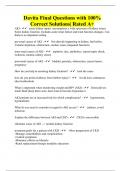
Davita Final Questions with 100% Correct Solutions| Rated A+
AKI - acute kidney injury: encompasses a wide spectrum of kidney issues. Some kidney function. Includes acute renal failure and renal function changes. Can dialyze in outpatient setting. pre-renal causes of AKI - Not directly happening in kidney, but before. Volume depletion, obstruction, cardiac issues (impaired function). intra-renal causes of AKI - nephritis, dye, antibiotics, sepsis/septic shock, ischemia, trauma, kidney stones post-renal causes of AKI - bladder, prostate, obstruction, cancer/tumor, pregnancy How do you help in restoring kidney fucntion? - treat the cause how do you protect kidneys from further injury? - Avoid toxic substances (dye/medication) What is important when monitoring weight and BP? (AKI) - Dont pull too much fluid (keep them wet), dont want to become hypotensive AKI patients are at increased risk for which complication? - hypotension, hypokalemia What do you need to consider in regard to AKI access? - catheter, avoid infection Explain the difference between AKI and CKD - CKD is irreversible eliminate cause of AKI -- normal kidney function treatment goals for a patient with CKD - -Slow progression of CKD -Manage comorbidities and complications -Control symptoms -Minimize effects on lifestyle -Renal replacement therapy modality education -Encourage patients to actively participate in healthcare Most common causes of CKD - Diabetes Hypertension Polycystic kidney disease why is it important to know what caused your patients CKD - monitor and treat (can't reverse) What is Kt/V - how well blood is cleaned what is K? - clearance (urea) what treatment factors decrease K? - Wrong size dialyzer, heparin, poor priming, cutting treatment, decreased BFR What treatment factors increase K? - Increased BFR, correct dialyzer, correct dialysate flow rate, correct target weight including amoutations What is T - time what factors influence T - longer blood/dialysate contact time, more frequent treatments or extra treatments staying for whole treatment and not missing any what is v - volume (of urea distribution, volume of body water) what factors influence V? - height, weight, sex, age, amputations needle gauge and suggested BFR - 17g = 200-250 16g= 250-350 15= 350-450 14= 450 procedure for post BUN lab draw - -turn off or decrease UF to 50 -decrease DFR to 300 or place machine in bypass -reduce BFR to 100 -wait 15s -obtain from arterial line lab mistakes that would falsely increase Kt/V - -drawing while BFR is at subscribed rate -Not waiting enough time before drawing -drawing from venous blood line lab mistakes that would falsely decrease Kt/V - -diluting pre-treatment BUN with saline -waiting too long between decreased speed and drawing Data collection - PCT facts, recorded #s, observations data assessment - nurse collect and interpret data - gives numbers and descriptions role of PCT prior to treatment initiation - machine set up, collect vitals, notify nurse with abnormal findings role of nurse prior to treatment initiation - assess abnormal findings, determine appropriate intervention or contact MD if needed
Written for
- Institution
- Davita
- Course
- Davita
Document information
- Uploaded on
- October 10, 2023
- Number of pages
- 29
- Written in
- 2023/2024
- Type
- Exam (elaborations)
- Contains
- Questions & answers
Subjects
- davita
-
davita final questions with 100 correct solutions

Also available in package deal