Health Care Professionals I Midterm Study Guide #2 Questions With Complete Solutions
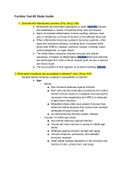
hapter Five: Health Care Professionals I 1. Differentiate the three types of primary care physicians. Internal Medicine: Focuses on problems associated with the bodies organs. They are trained to diagnose and treat common problems and diseases of the heart, blood, eyes, ears, skin, kidneys, and the digestive, respiratory and vascular systems. General and family practitioners: Diagnose and treat a wide variety of illnesses in patients of all ages. -Peditrician: Focused efforts on a particular group of patients 2. What are the different types of advance practice nurses, and what are their roles Nurse Practitioner (NP): Advanced practice nurse who provides basic primary health care. Clinical Nurse Specialist (CNS): An advanced practice nurse who specializes in a field such as oncology, neonatal care or mental health. Certified Nurse-Midwife (CNM): An advanced practice nurse who provides prenatal and postpartum care and delivers infants. Certified Registered Nurse Anesthetist (CRNA): An advanced practice nurse who specializes in anesthesia. 3. What report recommended the current model of medical education The Flexner Report: the recommended current model of medical education. Chapter Six: Health Care Professionals II 4. What is the MAJOR difference between a physician assistant and a nurse practitioner A physician assistant has to work under supervision and a nurse practitioner can work on their own. Working under the supervision of a physician, the PA provides health care services to patients. ( Pg 82) Nurse Practitioner provide basic primary health care, including diagnosis and treatment of common acute illness. They can order and interpret X-rays and other laboratory tests. NP's can prescribe medications in all 50 states. ( Pg. 71) 5. What are the roles of physical therapists, respiratory therapists, recreational therapists, speech-language pathologists, occupational therapists - Physical therapist help patients restore mobility and manage pain by implementing a treatment plan that utilizes exercise, massage and other therapies. ( Pg 86) - Respiratory therapists treat patients with breathing disorders. More than 80 percent work in hospitals in respiratory care, anesthesiology, or pulmonary medicine departments. ( Pg 87) - Recreational therapist includes techniques such as art and crafts, games, dance, drama, and music to improve the emotional and physical well being of patients. ( Pg 87) -Speech Language are also therapist. Speech language pathologists diagnose and treat a range of problems: speech, language, cognitive, communication, voice, and swallowing. (Pg 87) -Occupational therapists focus on improving patients ability to perform daily living and work skills. Occupational therapist may work in hospitals. Schools. Mental health centers. Or rehabilitation centers. ( Pg 87) 6. What is the area of focus for each: chiropractor, podiatrist, and ophthalmologist - Chiropractor has become increasingly accepted as a form of health care, and usually treatment is covered by insurance. The chiropractor's approach to health care is holistic, but the focus is on the spine. (Pg 91) - Podiatrist Provide specialized care for the foot. ( Pg 91) -Optometrist provide primary care. Although this includes prescribing corrective lenses, it also includes treating and managing diseases of the visual system, such as cataracts and macular degeneration. ( Pg 90)
Written for
- Institution
- Health Care Professionals I
- Course
- Health Care Professionals I
Document information
- Uploaded on
- October 15, 2023
- Number of pages
- 15
- Written in
- 2023/2024
- Type
- Exam (elaborations)
- Contains
- Questions & answers
Subjects
-
health care professionals i midterm study guide 2