ICD-10-CM 2023 Guidelines Questions With Verified Answers
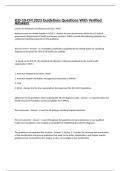
Centers for Medicare and Medicaid services ( CMS ) National center for Health Statistics ( NCHS ) - Answer Are two departments within the U.S federal governments department of health and human services ( DHHS ) provide the following guidelines for coding and reporting using ICD-10-CM guidelines The ICD-10-CM - Answer - Is a morbidity classification published by the United States for classifying diagnoses and reason for visits in all health care settings - is based on the ICD-10, the statistical classification of disease published by the world health organization ( WHO ) 1. American Hospital Association ( AHA ) 2. American Health Information Management Association ( AHIMA ) 3. CMS 4. NCHS - Answer Are the four organizations that approved the ICD-10-CM guidelines Adherence to the guidelines when assigning ICD-10-CM diagnosis codes - Answer - is required under the Health Insurance Portability and Accountability Act ( HIPAA ) Term encounter - Answer - is used for all settings, including hospital admission The term provider - Answer - is used throughout the guidelines to mean physicians or any qualified health care practitioner who is legally accountable for establishing the patients diagnosis The guidelines are organized into sections - Answer 1. Section 1 - includes the structure and conventions of the classification and general guidelines that apply to the entire classification, and chapter specific guidelines that correspond to the chapter as they are arranged in the classification 2. Section 11- includes guidelines for selection of principal diagnosis for non-outpatient settings 3. Section 111- includes guidelines for reporting additional diagnoses in non-outpatient settings 4. Section IV- is for outpatient coding and reporting The ICD-10-CM is divided into the - Answer 1. Alphabetic index 2. An alphabetical list of terms and their corresponding code 3. Tabular list - a structure list of codes divided into chapters based on body system or condition The alphabetic index consists of the following parts - Answer 1. Index of disease and injury 2. Index of external causes and injury 3. Table of neoplasm 4. Table of drugs and chemicals The tabular list contains - Answer 1. Categories 2. Subcategories 3. Codes Characters for categories, subcategories, and codes - Answer - Maybe either a letter or a number All categories are 3 characters A three character category that has no further subdivision - Answer - is equivalent to a code Codes maybe 3,4,5,6, or 7 characters Subcategories are either - Answer - 4 or 5 characters Each level of subdivision after a category - Answer - is a subcategory The final level of subdivision - Answer - is a code Codes that have applicable 7th characters - Answer - are still referred to as codes, not subcategories A code that has an applicable 7th character - Answer - Is considered invalid without the 7th character. The ICD-10-CM - Answer - uses an indented format for ease in reference For reporting purpose only codes are permissible, not categories, or subcategories and any applicable 7th character is required - Answer A placeholder character X - Answer - is used as a placeholder at certain codes to allow for future expansion An example of this is at the 1. Poisoning 2. Adverse effect 3. Under dosing codes Ex categories T36-T50 Where a placeholder exist - Answer - the X must be used in order for the code to be considered a valid code The applicable 7th character - Answer - is required for all codes within the category or as the notes in the tabular list instruct The 7th character - Answer - must always be the 7th character in the data field If a code that requires a 7th character is not a 6 characters - Answer - a placeholder X must be used to fill in the empty characters NEC - not elsewhere classifiable - Answer - it represents other specified in the alphabetic index - it represents other specified in tabular list When a specific code is not available for a condition, the alphabetic index directs the coder to the "other specified" code in the tabular list [ ] Brackets - Answer - are used in the tabular list to enclose 1. Synonyms 2. Alternative wordings or explanatory phrases - are used in the alphabetic index to identify manifestation codes NOS - not otherwise specified - Answer - it is the equivalent of unspecified ( ) Parenthesis - Answer - are used in both the alphabetic index and tabular list to enclose supplementary words that may be present in the statement of a disease or procedure without affecting the code number to which it is assigned The terms within the parentheses - Answer - are referred to as nonessential modifiers The nonessential modifiers in the alphabetic index to disease - Answer - apply to sub terms following a main term except when a nonessential modifier and a sub entry are mutually exclusive, the sub entry takes precedence Example Under the main term Enteritis Acute is a nonessential modifier and Chronic is a sub entry In this case, the nonessential modifier acute does not apply to the sub entry chronic : Colons - Answer - are used in the tabular list after an incomplete term which needs one or more of the modifiers following the colon to make it assignable time a given category Codes titled "Other" or "Other specified" - Answer - are for used when the information in the medical record provides detail for which a specific code does not exist Codes titled. "Unspecified" - Answer - are for used when the information in the medical record is insufficient to assign a more specific code For those categories for which an unspecified code is not provided - Answer - the "other specified" code maybe represent both other and unspecified Include notes - Answer - this notes appears immediately under a three character code title to further define, or give examples of, the content of the category Inclusion terms - Answer - this terms are the conditions for which that code is to be used - maybe synonyms of the code title, or in the case of "other specified" codes - are a list of the various conditions assigned to that code -are not necessarily exhaustive
École, étude et sujet
- Établissement
- ICD-10-CM
- Cours
- ICD-10-CM
Infos sur le Document
- Publié le
- 26 octobre 2023
- Nombre de pages
- 18
- Écrit en
- 2023/2024
- Type
- Examen
- Contient
- Questions et réponses
Sujets
- icd 10 cm stuvia
-
icd 10 cm 2023 guidelines questions with verified
-
centers for medicare and medicaid services cms
-
the icd 10 cm is a morbidity classification publ

Document également disponible en groupe