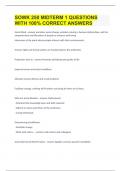
SOWK 250 MIDTERM 1 QUESTIONS WITH 100% CORRECT ANSWERS
Social Work promotes social change, problem solving in human relationships, and the empowerment and liberation of people to enhance well-being intervenes at the point where people interact with their environments. Human rights and human justice are fundamental to the profession. Profession aims to Promote well-being and quality of life Improve human and social conditions Alleviate human distress and social problems Facilitate change, working WITH others not doing for them or to them. Who are Social Workers Professionals -Mastered the knowledge base and skills required -Adhere to values and ethics of the profession -Caring individuals Empowering practitioners -Facilitate change -Work with others — partner with clients and colleagues Generalist Social Work Practice Applies common practice modalities Sees the potential for change at various levels Views human behavior in the social environment Integrates direct practice with social policy and research Generalist practitioners Are able to work with many systems Work with client systems at all levels Work with organizations Advocate for social change Refer clients to available and needed resources Research social work practice Purpose of SOWK "enhance human wellbeing and help meet the basic human needs of all people, with particular attention to the needs and empowerment of people who are vulnerable, oppressed, and living in poverty" (NASW Code of Ethics, 2008, p. 1). SOWK Goals/Purpose Enhance social functioning Link client systems with resources Improve the functioning of social service delivery Promote social justice by developing social policy Human strengths -Building blocks of social work practice. -Starting point for generating solutions Human needs -Motivation for social work activities Sources of needs and strengths Universal basic needs -Physical, intellectual, emotional, social, and spiritual growth. Motivational needs - Maslow's hierarchy of needs (1970) Personal development -Biological, physiological, interpersonal, social, and cultural factors. Life tasks - Life demands Physical environment - Space Social justice and human rights - equity, freedoms, rights World living - universal context, mutual dependence Cultural strengths - diversity from membership in multiple groups Identity Development Critical thinking: identity development -Erikson, Kohlberg, Levinson presume men and women have similar developmental needs through childhood. -But they determine maturity of men and women differently -Masculine: based on autonomy and individuation -Feminine: based on imitate relationships What do you think about this? As future social workers, researchers and theorists what do we need to consider? What do we need to do? Fields of Practice Family Services Child protective services Health care Occupational social work Gerontological social work School social work Criminal justice Information and referral Community organizing Mental health Policy Advocacy Social institutions address the needs of citizens and aim to resolve social problems. Social Welfare is a social institution -Provide services needed by all people at some point in their lives. -Provide supports that enable us to sustain or maintain social functioning. -Respond to the needs of members of society for health, education, economic, and social well-being. Social Welfare functions Residual view Institutional view: Social welfare benefits the total population, not only a specific group. ***ISSUE: Status and power/privilege allow some in society to define "needs" and how they should be addressed. residual view of social welfare Welfare applies only when other support systems break down. Institutional view of social welfare Welfare is an integrated part of a modern society that provides services to all who need them. Two sociological views Consensus/structural functionalist model conflict model Consensus/Structural Functionalist Model Seeks balance between society and its members. The goal is to "control disruptive citizens and reform dysfunctional social structures" (DuBois & Miley p. 20). Social workers resolve conflicts, re-socialize those considered deviant, and seek balance between people and their environment. Conflict model Focuses on power Lack of equality in the distribution of power and authority leads to social problems. Social workers using this model get involved in confronting injustice and advocating for the needs of oppressed and vulnerable groups. The goal is to change the way power and authority are distributed in society. Relationship btw social work and society Four possible relationships: -Agent of social control on behalf of society -A reformer of society -Separate from society -Intermediary between individuals and society (Cowger, 1977) Empowerment "The process of increasing personal, interpersonal, or political power so that individuals can take action to improve their situations" (Gutiérrez, 2001, p. 210). suggests individual determination and democratic participation. helping clients "gain access to power in themselves, in and with each other, and in the social, economic, and political environments" (Lee, 2001, p. 26) Social work as an empowering profession For empowerment to work people must have options—access to resources. ***Empowerment does not mean that power for one needs to decrease in order for power of another to increase. Common elements of Empowerment Focus on strengths Work collaboratively WITH clients, not for clients (they know best and will do what they want!) Reflect on structural systems and barriers to resources from their perspective Link personal and political power: -"Empowerment links two main sources of power---personal power and political power. -Personal power involves an individual's ability to control his/her destiny and influence his/her surroundings. -Political power is the ability to alter systems, redistribute resources, open up opportunity structures and reorganize society (Lee, 2001 as cited in Dubois and Miley, 2014, p. 25). Social Welfare history English poor laws — early model for American social welfare -The primary aim was to distinguish the "deserving" from the "undeserving" poor. -These laws established the responsibility of the government to provide for the poor. System continued to evolve as the colonies became a nation. -Population growth -Industry development Between the Civil War and WWI Three major economic and social changes in the US affected how we addressed poverty: -Industrialization -Urbanization -Immigration Response to the problems created by these changes brought about: -Settlement houses -Charity Organization Societies These two social and ideological movements were the foundation for social work practice. Charity Organization Societies Philosophy: Lack of morality caused poverty. -Charity corrupted character and decreased motivation. -Relief should be provided through private charities. Friendly visitors - models of moral character. Most of the work concentrated on problems of poverty among whites. Mary Richmond instrumental in shaping COS and social work profession Settlement Houses People wanting to help the poor "settled" in places where they could interact with them. -These "volunteers" were young, college educated, from wealthy families Combined advocacy and the provision of services to respond to issues of the time. Used an empowerment model - saw individuals, not as helpless victims, but as capable of improving their own conditions. Concerned with deplorable social conditions. Evolution - COS contribution to Social work: -Mary Richmond identified the first principles, theories, and methods of work with individuals. Books focused on understanding family relationships, emphasis on personal responsibility (self-determination), and concern for accountability in service delivery Evolution - Settlement house contribution to Social work -Employed empowerment strategies -Focus on individual functioning and impact of environmental factors and need for social reform through advocacy Evolution - Psychoanalytic movement - 1920s Promoted an "inward view" - unconscious motivation; Freud Psychiatric social work - Mary Cromwell Jarrett Mental hygiene movement & treatment of WWI veterans influenced social Evolution - Public Welfare movment - 1930s Grew as an aftermath of the Great Depression. Highlighted the socio-cultural, political, and economic dimensions of society. Structural view of poverty. Social workers began influencing social policy (Harry Hopkins and Frances Perkins). Evolution - Group work and community organization Gained acceptance as legitimate interventions in 1940s &1950s Dual perspective (1950s) - individual & social environment important aspects of social work - recaptured. -Bertha Capen Reynolds: social advocate -Hollis-Taylor report: SW as helping activity -Person-in-situation - Florence Hollis coined term Evolution - social reform - 1960s Social change, civil rights, war on poverty Whitney Young - activist; challenged the profession return to social reform roots. Profession was challenged to allow person-in-situation to shape interventions - moving toward generalist approach. Evolution - Ecosystems/Ecological Perspective 1970s Reciprocity between individual & environment - interconnected and multilayered. Evolution definition Continued call to respond to individual problems as well as social reform. International human rights and social justice SOWK as a profession? 1915, Flexner's Assessment: Is social work a profession? Used six attributes as "earmarks of a profession" He concluded SOWK was not a profession. 1957, Greenwood's reassessment - social work is a profession. 2000s, does social work have a monopoly in the provision of social services? -Licensure is affecting who can practice social work -Is the domain for social work activity defined? Professional organizations National Association of Social Workers (NASW) - practice Council on Social Work Education (CSWE) - education at BSW and MSW levels 9 CSWE Educational Policy and Accreditation Standards Demonstrate Ethical and Professional Behavior Engage Diversity and Difference in Practice Advance Human Rights and Social, Economic, and Environmental Justice Engage In Practice-informed Research and Research-informed Practice Engage in Policy Practice Engage with Individuals, Families, Groups, Organizations, and Communities Assess Individuals, Families, Groups, Organizations, and Communities Intervene with Individuals, Families, Groups, Organizations, and Communities Evaluate Practice with Individuals, Families, Groups, Organizations, and Communities Common base of SOWK practice Professional values -People -Society -Professional behavior Knowledge base -Liberal arts (UMBC's GEPs & SOWK requisites) -Philosophy & history (SOWK 250 & SOWK 260) -Fields of practice, theory, policy, research, diversity, & self Practice skills -From theory to practice -Planned change, and intervention at all levels -Relationships, communication, & cultural competence -Policy analysis, research, technology, & time management
Geschreven voor
- Instelling
-
Calvin College
- Vak
- Onbekend
Documentinformatie
- Geüpload op
- 29 oktober 2023
- Aantal pagina's
- 33
- Geschreven in
- 2023/2024
- Type
- Tentamen (uitwerkingen)
- Bevat
- Vragen en antwoorden
Onderwerpen

Ook beschikbaar in voordeelbundel