SOWK 260 CH. 10 WITH 100% CORRECT ANSWERS.
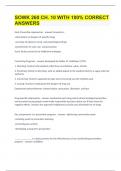
Early Prevention Approaches Focused on: -information on dangers of specific drugs -warnings of physical, social, and psychological drugs -punishments for sale, use, and possession Scare Tactics proved to be ineffective strategies Converting Programs developed by Walter M. Matthews (1975) 1. Directing: Teacher tells students what they must believe, value, and do 2. Preaching: Similar to directing, with an added appeal to the students duty to a vague external authority 3. Convincing: Teachers appealed to logic where lecturing was the method used 4. Scaring: Teachers emphasized the dangers of drug use Emphasized admonishment, indoctrination, persuasion, distortion, and fear Drug-Specific Approaches emphasized each drug and its pharmacological properties and assumed young people would make responsible decisions about use if they knew the negative effects, instead: the approach heightened curiosity and alleviated fear of drugs Key components of a prevention program: -addressing community needs -including youth in prevention planning -promoting pro-activity -developing a long-term perspective ______________ is a basic premise for the effectiveness of any alcohol/drug prevention program Credibility 17 Risk Factors for Substance Abuse -laws and norms -availability -extreme economic deprivation -neighborhood disorganization -physiological factors -family drug behavior -family management practices -family conflict -low bonding to family -early and persistent problem behaviors -academic failure -low commitment to school -peer rejection in elementary grades -association with drug using peers -alienation and rebelliousness -attitudes favorable to drug use -early onset of drug use Steven Wolin and Sybil Wolin - Challenge Model of Resiliency Def of resiliency: internal protective factor and the ability to bounce back Some children of Alcoholics grow up free of drinking because they... -build their own strengths -develop their own lifestyle and values, which are an improvement over those of their parents -establish healthy "rituals" in their own family Wolins' Resiliency Factors: 1. Insight 2. Independence 3. Relationships 4. Initiative 5. Creativity 6. Humor 7. Morality Insight the habit of asking tough questions that pierce the denial and confusion in troubled families Independence emotional and physical distancing from a troubled family, which keeps survivors out of harm's way Relationships fulfilling ties to others that provide the stability, nurturing, and love that troubled families do not give Initiative a push for mastery that combats the feelings of helplessness troubled families produce in their offspring Creativity representing one's inner pain and hurtful experiences in art forms; "building a new world on the ruins of the old" Humor the ability to minimize pain and troubles by laughing at oneself Emotional Intelligence Abilities (Daniel Goleman) -being able to motivate oneself and persist in the face of frustration -being able to control impulse and delay gratification -being able to regulate one's mood and keep distress from swamping the ability to think -being able to empathize and hope Alternatives are... acceptable attractive attainable actively pursed by the individual use mentors and role models integrate self-concepts Primary prevention assumes the individual has never tried drugs/alcohol and enforces a no-use norm by building self-esteem, developing good coping and refusal skills, and providing info on alcohol/drugs Secondary prevention assumes the individual is in the early stages of use but does not regularly use drugs; try to stop use by providing drug info, developing decision-making and refusal skills, and improving family communication; may include individual counseling Tertiary prevention assumes the individual is regularly using drugs but is not a habitual user yet; prevention/intervention includes counseling, drug education, and family therapy; fine line between tertiary level of prevention and intervention and treatment services During their first year of college, most students dramatically __________ their alcohol/drugs use increase Morality an informed conscience, which imbues the survivor surrounded by "badness" with a sense of his or her own "goodness" Empowerment -say no when that is what one feels and wants -establish the core aspects of a sense of self -be aware of what one feels and integrate and communicate those feelings to others in establishing goals and making decisions -establish and set boundaries, especially in interpersonal and intimate relationships -establish integrity in relationships and a healthy, nondestructive, non-sabotaging approach to life Goal Setting Model lesson includes: 1. setting goals 2. ranking priorities 3. making decisions in relation to the goals 4. persevering in the face of difficult situations 5. maintaining motivation (effort) until goals are attained or modified Programs Aimed at At-Risk Youth Special relationship with parent, family member, teacher, minister, coach, etc. Strong religious training Interpersonal Problem Solving --dealing with authority figures --developing empathy --standing up for one's rights --resisting peer pressure --improving behavior in school --getting along better with family members Prevention in People of Color and Other Minorities -community-based -emphasize a systematic strategy to uproot the factors in the system that oppress people of color, such as prejudice and racism -implement training in diversity and methods of accessing the system
Written for
- Institution
-
Liberty University
- Module
- Unknown
Document information
- Uploaded on
- October 29, 2023
- Number of pages
- 6
- Written in
- 2023/2024
- Type
- Exam (elaborations)
- Contains
- Questions & answers
Subjects

Also available in package deal