Notes on *SOME* of the lectures from the course (2023) Intelligence Communities, the Cold War,
and Decolonization. INCLUDES notes from lectures 1-5 (Total: 23 pages).
Intelligence Communities, the Cold War, and Decolonization *SOME*
Lecture Notes (Lectures 1-5)
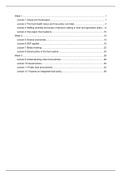
Table of Contents
Lecture 1: Introduction 1
Lecture 2: Maintaining Stability & Managing Crises 3
Lecture 3: Counterintelligence & Internal Security 8
Lecture 4: Managing Decolonisation & Post-Colonial Security Communities 14
Lecture 5: Covert Influence - Deniable Interventions & Proxies of Power 19
, 1
Lecture 1: Introduction
International organisation’s (IOs) performance:
● Realistic understanding of intelligence’s limits.
● Criticise anything short of omniscience.
● Intelligence officer’s function = know the outside world in (‘hidden BUT knowable secrets’).
The Cold War
The Cold War: Period of political tension & ideological rivalry between the US vs. USSR, following
WWII’s end (mid-1940s - early 1990s).
➔ Key features:
◆ Ideological conflict & economic competition = primarily a struggle between 2
contrasting ideologies (West’s capitalism/democracy vs. East’s communism)
◆ Absence of direct military confrontation = consisted of indirect confrontations,
espionage, propaganda & international proxy wars (e.g., Korea, Vietnam,
Afghanistan).
◆ Arms race & nuclear threat = massive arms race, accumulating vast stockpiles of
nuclear weapons (fear of nuclear conflict & the concept of mutually assured
destruction).
◆ Iron Curtain = division between the democratic nations of the West & the
communist-controlled countries of Eastern Europe (Churchill).
◆ Containment = US policy aimed to prevent communism’s spread & limit Soviet
influence.
◆ Space race = competition to achieve space exploration milestones became a symbol
of ideological superiority (e.g., USSR’s Sputnik satellite launch in 1957).
◆ Détente & periods of thawing relations = relaxing tensions where diplomatic efforts
were made to ease hostilities (e.g., 1970s Strategic Arms Limitation Talks).
◆ Cold War’s end = 1991 dissolution of the Soviet Union, marking the triumph of the
Western liberal democratic model & the collapse of communism in Eastern Europe.
➔ Intelligence communities:
◆ Prominent role for primary state actors (ideological & geopolitical rivalry):
● Both superpowers sought to gather information on each other's military
capabilities, political intentions & technological advancements to gain a
strategic advantage & prevent threats.
● Development of extensive espionage networks, advanced technology for
intelligence gathering & covert operations.
◆ Legacies:
● Expansion of intelligence agencies, increased funding & technological
advancements in surveillance & information gathering.
● Lasting focus on counterintelligence & espionage remained prominent
post-Cold War.
● Influenced the way intelligence agencies adapted to new challenges in the
post-Cold War era (e.g., terrorism, cyber warfare, geopolitical shifts).
Decolonisation
and Decolonization. INCLUDES notes from lectures 1-5 (Total: 23 pages).
Intelligence Communities, the Cold War, and Decolonization *SOME*
Lecture Notes (Lectures 1-5)
Table of Contents
Lecture 1: Introduction 1
Lecture 2: Maintaining Stability & Managing Crises 3
Lecture 3: Counterintelligence & Internal Security 8
Lecture 4: Managing Decolonisation & Post-Colonial Security Communities 14
Lecture 5: Covert Influence - Deniable Interventions & Proxies of Power 19
, 1
Lecture 1: Introduction
International organisation’s (IOs) performance:
● Realistic understanding of intelligence’s limits.
● Criticise anything short of omniscience.
● Intelligence officer’s function = know the outside world in (‘hidden BUT knowable secrets’).
The Cold War
The Cold War: Period of political tension & ideological rivalry between the US vs. USSR, following
WWII’s end (mid-1940s - early 1990s).
➔ Key features:
◆ Ideological conflict & economic competition = primarily a struggle between 2
contrasting ideologies (West’s capitalism/democracy vs. East’s communism)
◆ Absence of direct military confrontation = consisted of indirect confrontations,
espionage, propaganda & international proxy wars (e.g., Korea, Vietnam,
Afghanistan).
◆ Arms race & nuclear threat = massive arms race, accumulating vast stockpiles of
nuclear weapons (fear of nuclear conflict & the concept of mutually assured
destruction).
◆ Iron Curtain = division between the democratic nations of the West & the
communist-controlled countries of Eastern Europe (Churchill).
◆ Containment = US policy aimed to prevent communism’s spread & limit Soviet
influence.
◆ Space race = competition to achieve space exploration milestones became a symbol
of ideological superiority (e.g., USSR’s Sputnik satellite launch in 1957).
◆ Détente & periods of thawing relations = relaxing tensions where diplomatic efforts
were made to ease hostilities (e.g., 1970s Strategic Arms Limitation Talks).
◆ Cold War’s end = 1991 dissolution of the Soviet Union, marking the triumph of the
Western liberal democratic model & the collapse of communism in Eastern Europe.
➔ Intelligence communities:
◆ Prominent role for primary state actors (ideological & geopolitical rivalry):
● Both superpowers sought to gather information on each other's military
capabilities, political intentions & technological advancements to gain a
strategic advantage & prevent threats.
● Development of extensive espionage networks, advanced technology for
intelligence gathering & covert operations.
◆ Legacies:
● Expansion of intelligence agencies, increased funding & technological
advancements in surveillance & information gathering.
● Lasting focus on counterintelligence & espionage remained prominent
post-Cold War.
● Influenced the way intelligence agencies adapted to new challenges in the
post-Cold War era (e.g., terrorism, cyber warfare, geopolitical shifts).
Decolonisation