NTA Question Bank 1 (2023/2024) Rated A
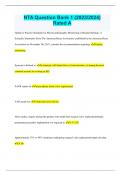
NTA Question Bank 1 (2023/2024) Rated A Update to Practice Standards for Electrocardiographic Monitoring in Hospital Settings: A Scientific Statements From The American Heart Association" published by the American Heart Association on November 7th, 2017, contains the recommendation regarding: Cardiac monitoring Syncope is defined as: a transient, self-limited loss of consciousness, is among the most common reasons for visiting an ED. TAVR stands for transcatheter aortic valve replacement VAD stands for: ventricular assist device After cardiac surgery among the patients who underwent surgical valve replacement/repair, permanent pacemaker implantation was required in: 1.5-7.2% Approximately 33% to 49% of patients undergoing surgical valve replacement/repair develop : A fib Most common arrhythmias after open heart surgery and CABG procedure is: A fib Regardless of the patient population, the need for monitoring should be reassessed every: 24 hours on the basis of clinical and diagnostic findings and response to therapy Which of the following drugs are known, with possible, and conditional risk for causing Torsade de pointes (TdP): Citalopram In neonates and infants, AHA/ACC update prefers using segment as a reference for the isoelectric line: TP segment The highest current recommendation for ischemia monitoring is: COR IIa Based on Update to Practice Standards for Electrocardiographic Monitoring in Hospital Settings: A Scientific Statements From The American Heart Association published by the American Heart Association on November 7th, 2017 the reason why COR I was transferred in COR IIa is that false alarm and nonactionable alarm signals will: all of the above The authors of the 2004 practice standards1gave a COR I recommendation for continuous ST-segment monitoring to 4 patient populations (early phase of ACS; chest pain or angina-equivalent symptoms in patients presenting to the ED; after nonurgent percutaneous coronary intervention (PCI) with suboptimal angiographic results; and possible variant angina caused by coronary vasospasm), all of whom were at significant risk of myocardial ischemia, which, if sustained, could result in acute MI. After considerable discussion resulting in consensus, the AHA/ACC 2017 has given these patients a: COR IIa recommendation The 2004 practice standards 1 recommended: 1-mm ST-segment deviation as clinically significant for patients in critical care units at high risk of ACS Which of the following Class of Recommendation is described as reasonable to perform continues cardiac monitoring: COR IIa For arrhythmia monitoring in pediatric population which of the following lead is commonly selected: II Updated Clinical Statements and Guidelines - AHA Scientific Statement, November 7, 2017 reiterates the importance of two key points when implementing continuous arrhythmia monitoring are: a and b only According to American Heart Association (AHA) scientific statement on practice standards for electrocardiographic monitoring in hospital settings published in 2004 indications for continues and intermittent cardiac monitoring are: All of the above Which of the following medication caries a risk of Torsade de Pointes (TdP) and inpatient electrocardiographic monitoring is required by the US Food and Drug Administration for 3 days during initiation because of the risk of QT prolongation and ventricular arrhythmias: Dofetilide For arrhythmia monitoring in adults, which of the following lead is commonly selected because of its helpfulness in distinguishing between VT and aberrancy V1
Escuela, estudio y materia
- Institución
- NTA
- Grado
- NTA
Información del documento
- Subido en
- 21 de noviembre de 2023
- Número de páginas
- 4
- Escrito en
- 2023/2024
- Tipo
- Examen
- Contiene
- Preguntas y respuestas
Temas
-
nta question bank rated a

Documento también disponible en un lote