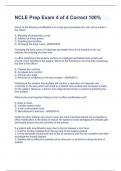
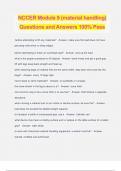
NCLE Prep Exam 4 of 4 Correct 100%
Which of the following modifications to a rigid gas permeable lens can not be made in the office? A. Blending of peripherals curves B. Addition of minus power C. Polishing lens surface D. Changing the base curve - ANSWER D. Changing the base curve of a rigid gas permeable lens is not possible to do, but requires the ordering of a new lens. In-office polishing of the anterior surface of a rigid gas permeable lens surface will provide many benefits to the patient. Which of the following is not a benefit of polishing the lens in the office? A. Cleaner lens surface B. Increased lens comfort C. Thinner lens edge D. Removal of scratches on the lens surface - ANSWER C. Polishing of the anterior lens surface will result in a reduction of a deposits and scratches on the lens which will result in a cleaner lens surface and increased comfort for the patient. However, a thinner lens edge should not be a product of polishing the lens surface What is the most important feature of an in-office modification unit? A. Easy to clean B. Variable speed motor C. It has a removable cover D. Manufacturer's warranty - ANSWER B. While the other features are nice to have, the most important feature for successful in-office modification is the ability to reduce the speed to avoid damaging the delicate gas permeable lenses that are currently on the market. If a patient with exophthalmic eyes due to thyroid disease a toric lens: 1. It will be forcibly expelled from the eye due to the bulging eyeball 2. It may dehydrate excessively due to the lid retraction and dry eye condition that often accompanies thyroid disease 3. Stability will be difficult to maintain since there are no lid forces to keep the lens in position 4. The "watermelon seed" principle will help to keep the lens in position A. 1 and 2 B. 2 and 3 C. 1, 2, 3, and 4 D. None of the above - ANSWER B. The "watermelon seed" principle relies on the pressure of the upper lids to maintain the correct orientation of a prism ballasted toric lens and keep it from rotating off axis. In an exophthalmic eye, the retracted lids are unable to grasp the edge of the lens to maintain its orientation. The lens will generally not be expelled forcibly buy may dehydrate, shrink and fall out spontaneously Which of the following is not characteristic of corneal edema? A. Smoky vision B. Spectacle Blur C. Increase in K readings D. Peripheral flare - ANSWER D. Reports of smoky vision and spectacle blur are common in patients with severe corneal edema. The contact lens professional may also notice a steepening of the keratometer readings for those patients Which of the following is not used when blending peripheral curves in the office? A. Slot gauge B. Radius tools C. Polishing compound D. Suction cups or a spinner tool - ANSWER A. Radius tools and an appropriate polishing compound will be the most critical tools required for the modification of peripheral curves on a rigid gas permeable lens. A suction cup or spinner tool is used to hold the lens in place while making the modifications. A slot gauge is used to determine diameter of the lens. The slit lamp illumination the gives an overall view of the cornea but limits detail is:
Written for
- Institution
- NCLE
- Course
- NCLE
Document information
- Uploaded on
- December 4, 2023
- Number of pages
- 14
- Written in
- 2023/2024
- Type
- Exam (elaborations)
- Contains
- Questions & answers
Subjects
- ncle
-
ncle prep exam 4 of 4 correct 100
-
which of the following modifications to a rigid ga
-
in office polishing of the anterior surface of a r
-
what is the most important feature of an in office

Also available in package deal