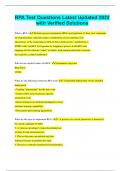
RPA Test Questions Latest Updated 2023 with Verified Solutions
What is RPA? "Robotic process automation (RPA) tools perform 'if, then, else' statements on structured data, typically using a combination of user interface (UI) interactions, or by connecting to APIs to drive client servers, mainframes or HTML code. An RPA tool operates by mapping a process in the RPA tool language for the software "robot" to follow, with runtime allocated to execute the script by a control dashboard" Who are the market leaders for RPA? Automation Anyware Blue Prism UiPath What are the differences between RPA tools • Unattended deployment versus attended deployment • Crafting "instructions" for the bot to run • Generic RPA tools or process-specific automation tools • Some limited or no artificial intelligence (AI) or machine-learning capabilities • Price point and licensing agreements What are the steps to implement RPA? 1. A process (or a set of processes) is deemed to be a good candidate for RPA 2. A "process developer" creates the detailed set of steps for the automation bot 3. The bot becomes operational and uses software licenses to perform the steps 4. The bot is centrally monitored for performance
Geschreven voor
- Instelling
- Rpa uipath
- Vak
- Rpa uipath
Documentinformatie
- Geüpload op
- 5 december 2023
- Aantal pagina's
- 5
- Geschreven in
- 2023/2024
- Type
- Tentamen (uitwerkingen)
- Bevat
- Vragen en antwoorden
Onderwerpen
- what is rpa
-
rpa test questions latest updated 2023 with verif
-
who are the market leaders for rpa
-
what are the differences between rpa tools
-
what are the steps to implement rpa

Ook beschikbaar in voordeelbundel