LPC Exam – Theories Complete Questions & Solutions(GRADED A+)
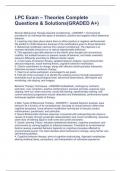
Skinner (Behavioral Therapy-Operant Conditioning) - ANSWER 1. Environmnet provides for an individual two types of situations: positive and negative which determine behavior. 2. Learning only takes place where there is either positive or negative reinforcement. We exhibit or inhibit behaviors because of the ramifications given to those behaviors. 3. Behavioral modification derives from operant conditioning. The objective is to increase desirable behaviors or to reduce objectionable behaviors. 4. This appreach pays little attention to the client's prior thought and unconscious conflicts, but instead focuses on present causes of behavior, and treats unwanted behavior differently according to different clients' needs. 5. 4 main types of behavior therapy: applied behavior analysis, neuro behavioristic stimulus-response, social learning theory, cognitive behavior modification. 6. Client's commitment to change, along with effective client/counselor interaction, determine success in behavior therapy. 7. Client is an active participant, encouraged to set goals. 8. First job of the counselor is to identify the existing concern through assessment techniques such as psychological tests, behavioral observations, self-reports and monitoring, role playing, and imagery. Behavior Therapy Techniques - ANSWER biofeedback ,contingency contracts, extinction, over correction, positive reinforcement, premack principle, response cost, shaping, time-out, token economy, social skill training, assertiveness training, self-control exercises (progressive muscle relaxation and biofeedback), performance based techniques applied outside of therapy. 4 Main Types of Behavioral Therapy - ANSWER 1. Applied behavior analysis: sees behavior as a function of its consequences, focusing on actual behavior rather than cognitive processes. Uses behavior modification techniques of stimulus control, reinforcement, punishment, and extinction. 2. Neuro Behavioristic stimulus-response: concerned with extinquishing the cause or causes of anxiety through systematic desensitization and covert conditioning. Assumes same laws of learning apply to both overt and covert processes. 3. Social Learning Theory: stresses mediational behaviors, cognitive processes, and environment as coming together to influence behavior. Treamtent for environmental factors causing unwanted behavior depends on cognitive processes affected by environmental events. The client decides which behaviors to change, using his/her own self-directing abilities. 4. Cognitive behavior therapy: aims at cognitive restructuring. Approach emphasizes altering irrational ideas, perceptions, and interpretation of individual experience. Jung (Analytic Psychology) - ANSWER 1. Stressed the significance of racial and historical influences on personality and believed that individuals were moving towards wholeness and individuation. Believe that culture has a great influence on personal development. 2. Therapy is a healing process. 3. stresses the ddynamic interplay between the conscious and unconscious minds which make up the human psyche and govern behavior. A keener awareness of the unconscious is key because the unconscious is seen as a means to conscious direction and creativity. 4. Instincts of hunger, thirst, sex, and aggression, as well as the need to achieve a whole, true self grounded in conscious and unconscious elements (individuation) are universal. What one does is influenced partly by present experience and partly by expectation of what the action will bring. 5. Unconscious forces are revealed through symbols which are guiding messages contained in dream and external reality which help the client resolve conflicts and overcome difficulties. 6. Making the client as aware as possible of unconscious influences and connections with behavior, present and future, is the touchstone of Analytical Therapy. After analyzing what the cllient experiences consiously, client and counselor explore unconscious messages, especially through thge interpretation of dreams, toward the client achieving a true, positive self. Analytic Techniques/Terms - ANSWER Introvert/extrovert, anima ( the femine side of men), animus ( the masculine side of women), archetypes (response pattern occurring universally), collective unconscious (determined by the evolution of the human species, Individuation, Mask Persona, Public mask, Shadow (negative side of an individual) Adler (Individual Psychology) - ANSWER 1. Individuals need to be viewed in the context of their social relationships. 2. Psychopathology occurs when the individual develops inappropriate strategies to overcompensate for feelings of inferiority. 3. Birth order influences the development of life style. 4. Life-style developed in childhood to compensate for inferiortiy and weakness. Established by age 4 or 5, a style of life is the principle that explains the uniqueness of the individual. No two people have the same style of life. By creating a goal and the means to its achievement, creative self gives meaning to life. 5. Superiority results from striving to overcome inferiority. Term "inferiority complex" refers to a sense of inadequacy. Theorized that every person has a sense of inferiority and strives for superiority. 6. Primary therapeutic approach is encouragement. 7. Humans have inborn social interests and are motivated by their social urges. 8. Goals of individual counseling: (1) identify and explore faulty assumptions and mistaken goals. (2) reeducation of clients to
Written for
- Institution
- NCE/LPC
- Course
- NCE/LPC
Document information
- Uploaded on
- December 7, 2023
- Number of pages
- 14
- Written in
- 2023/2024
- Type
- Exam (elaborations)
- Contains
- Questions & answers
Subjects
- lpc exam
-
lpc exam theories complete questions solutions
-
skinner behavioral therapy operant conditioning
-
behavior therapy techniques answer biofeedback
-
4 main types of behavioral therapy answer

Also available in package deal