RNC OB Exam (more Exam Questions)
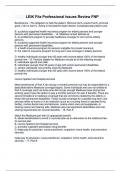
During the birthing process, the patient frequently experiences chills during a. stage 2 b. stage 3 c. stage 4 C. Stage 4: from the delivery of the placenta through the first 1-4 hours after birth. By day 2 after delivery, the uterus should normally descend at the rate of a. 0.5 cm per day b. 1 cm per day c. 2 cm per day B. By day 2 after delivery, the uterus should normally descend at the rate of 1 cm per day. During the second trimester, an ultrasound may be used to estimate gestational age through measurement of the a. crown-rump length b. fetal heart rate c. biparietal diameter C. During the second trimester, and ultrasound may be used to estimate gestational age through measurement of the biparietal diameter, femur length, and abdominal circumference. A series of measurements over time are more accurate than a single measurement. (the crown-rump length is used to estimate gestational age during the first trimester) When using vibroacoustic stimulation, the stimulator should be placed over the area of the a. fetal trunk b. uterine fundus c. fetal head C. When using vibroacoustic stimulation, the simulator should be placed over the area of the fetal head. Acoustic Stim is contraindicated in the presence of oligohydramnios, at less than 32 weeks gestation, and with non-reassuring fetal heart rate or pattern.The components of CARE principle include Communicating, Advocacy, Respecting, and a. evaluating b. educating c. enabling C. Enabling/Empowering - providing info, resources, and opportunities to enable the patient to make decisions In the maternal serum screen, if the alpha-fetoprotein (AFP), human chorionic gonadotropin (hCG), and unconjugated estriol (uE3) are all decreased, this is an indication of a. neural tube defect b. trisomy 21 (Down Syndrome) c. trisomy 18 (Edwards syndrome) C. Trisomy 18 (Edwards Syndrome) Neural tube defects are indicated only by an increase in AFP. A fourth marker, inhibin A, may be added to the screening to improve accuracy in screening for trisomy 21 (Down Syndrome). *Maternal samples should be obtained between weeks 16-18 of gestation A lecithin to sphingomyelin (L/S) ratio that confirms fetal lung maturity is a. 1:1 b. 2:1 c. 3:1 C. 3:1 During a uterine contraction, the usual response of the maternal cardiovascular system is to a. increase blood pressure and decrease pulse b. decrease blood pressure and increase pulse c. decrease blood pressure and decrease pulse A. Blood pressure to increase and pulse to decrease. During a contraction, blood flow to the placenta slows, temporarily increasing maternal blood volume by 10% - 25%, this is what causes the b/p to increase and the pulse to decrease.During a uterine contraction, the contractive force lies in the a. upper one-third of the uterus b. upper two-thirds of the uterus c. lower one-third of the uterus B. Upper two-thirds of the uterus. The ischial tuberosity diameter considered adequate for the diameter of the fetal head during delivery is a. 9.5 cm b. 11 cm c. 12.5 cm B. 11 cm The phase of the contraction cycle in which the contractions begin at the fundus and then spreads downward through the uterus is the s. decrement b. peak/acme c. increment C. Increment: The contraction begins at the fundus and then spreads downward through the uterus Peak/Acme: The point at which the contraction is the strongest and most intense. Decrement: The uterus begins to relax as the contraction decreases in intensity During normal singleton pregnancy, the patient should increase caloric intake over pre-pregnant needs by a. 200 kcal/day b. 300 kcal/day c. 500 kcal/day B. 300 kcal/day
École, étude et sujet
- Établissement
- OB women health
- Cours
- OB women health
Infos sur le Document
- Publié le
- 11 décembre 2023
- Nombre de pages
- 35
- Écrit en
- 2023/2024
- Type
- Examen
- Contient
- Questions et réponses
Sujets
- rnc ob exam
-
rnc ob exam more exam questions