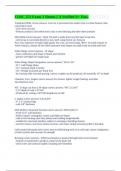
CDE Practice Exam Questions #3 and Answers 100% correct!!
What is the first step in the process of diabetes self management education? A. Assessment B. Goal setting C. Diagnosis D. Referral - ANSWER-A. Assessment Which of the following options is an outcome of personal record keeping in relation to physical activity, according to recent studies? A. Those who keep logs of physical activity are more adherent to other elements of therapy (ie diet, medication) B. Those who keep exercise logs are more likely to enroll in organized exercise programs (ie gym memberships, classes) C. Keeping a physical activity log is associated with a higher level of self efficacy D. The obligation of record keeping has been identified as a barrier to exercise by study participants - ANSWER-C. Keeping a physical activity log is associated with a higher level of self efficacy Consider the following pt: male, age 46, previously sedentary, mild HTN and hyperlipidemia (both adequately controlled with medications), T2DM, and a BMI of 26. If this pt wishes to begin a moderate-intensity exercise regimen, what additional assessment may be warranted? A. Stress test with ECG B. DEXA scan to assess bone density and strength C. Ankle-Brachial index to rule out peripheral arterial disease D. None, as BP and cholesterol are being controlled and exercise is only moderate intensity - ANSWER-A. Stress test with ECG A stress test with ECG may be warranted, as this person is over 40, previously sedentary, has risk factors for CVD, and is beginning a program that is more intense than brisk walking, which is mild intensity. In your role as a diabetes educator for a clinic, you both assess and instruct pts on a variety of self-care skills. Which teaching strategy provides the best opportunity to both assess and instruct on self-administration of insulin? A. A written quiz in which the patient puts insulin administration steps in order B. A demonstration and return demonstration of insulin administration C. A video that can be viewed and reviewed on proper insulin administration technique D. A printed handout with pictures depicting steps of insulin administration, followed by verbal acknowledgement of understanding - ANSWER-B. A demonstration and return demonstration of insulin administration The following policies are part of your DSME program: asking pts if there are any dietary preferences or restrictions; inviting family members to participate; and being sensitive to your rate of speech and tone of voice. These policies address which specific type of consideration? A. Readiness to change variation among your patients B. Potential low literacy/numeracy levels among your patients C. Cultural characteristics/barriers of your population D. Poor family and social support - ANSWER-C. Cultural characteristics/barriers of your population According to the ADA consensus statement on managing preexisting diabetes for pregnancy (2008), what is the optimal glycemic target for pregnant women with preexisting diabetes (assuming the target may be reached without excessive hypoglycemia)? A. Pre-meal/fasting glucose: 60 to 90 mg/dL; peak postprandial 120 mg/dL; A1C 5.5% B. Pre-meal/fasting glucose: 60 to 99 mg/dL; peak postprandial 129 mg/dL; A1C 6% C. Pre-meal/fasting glucose: 70 to 100 mg/dL; peak postprandial 120 mg/dL; A1C 6.5% D. Pre-meal/fasting glucose: 70 to 110 mg/dL; peak postprandial 140 mg/dL; A1C 7% - ANSWER-B. Pre-meal/fasting glucose: 60 to 99 mg/dL; peak postprandial 129 mg/dL; A1C 6% UPDATED 2019: Fasting 95 mg/dL; 1 hr post prandial 140 mg/dL; 2 hr post prandial 120 mg/dL; A1C 6% During the initial assessment process, your pt answers the question, "How important is it for you to make this change right now?" with a 9 our of 10 (very important) and answers the question, "How confident are you that you will be able to make this change?" with a 2 out of 10 (not very confident). In customizing hr DSME plan, what should your focus be? A. Providing materials and experiences to enhance her knowledge and skills B. Addressing psychosocial needs, such as accepting her diagnosis and managing stress levels C. Highlighting the benefits of good diabetes management as a way to encourage behavior change D. Explaingin the two questions further to confirm understanding, as it is very uncommon for a pt to rate the readiness to change elements this far apart - ANSWER-A. Providing materials and experiences to enhance her knowledge and skills It is important to assess potential barriers to self-monitoring of bg, especially for pts who are not adhering to their plan of care recommendations. Which of the following barriers was NOT one cited by patients in recent studies? A. Cost of testing supplies B. Discomfort of finger sticks C. Lack of instruction and support D. Misplacement of small items - ANSWER-D. Misplacement of small items When assessing for risk of hypoglycemia in relation to exercise, which element of the patient record is most important to consider? A. The patients typical signs and sympto
Geschreven voor
- Instelling
- CDE
- Vak
- CDE
Documentinformatie
- Geüpload op
- 12 december 2023
- Aantal pagina's
- 47
- Geschreven in
- 2023/2024
- Type
- Tentamen (uitwerkingen)
- Bevat
- Vragen en antwoorden
Onderwerpen
-
cde practice exam questions 3 and answers 100 co
-
cde practice exam stuvia 2023
-
what is the first step in the process of diabetes
-
which of the following options is an outcome of pe

Ook beschikbaar in voordeelbundel