WGU D265 Critical Thinking Test Questions and Answers Latest Verified Answers Graded A+
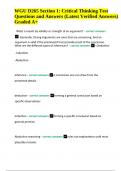
WGU D265 Critical Thinking Test Questions and Answers Latest Verified Answers Graded A+. What is meant by validity or strength of an argument? - correct answers Generally, Strong Arguments are ones that are convincing. And an argument is valid if the premises(if true) provide proof of the conclusion. What are the different types of inferences? - correct answers - Deduction - Induction -Abduction Inference - correct answers A conclusion one can draw from the presented details. deduction - correct answers forming a general conclusion based on specific observations Induction - correct answers forming a specific conclusion based on general premise. Abduction reasoning - correct answers rules out explanations until most plausible remains WGU D265 Section 1: Critical Thinking Test Questions and Answers (Latest Verified Answers) Graded A+ truth - correct answers A proposition that accurately represents reality. validity - correct answers In a good deductive argument structure, when true premises make the conclusion necessarily true. invalidity - correct answers One or two of the premises are false, thus making the conclusion false. Soundness - correct answers The deductive argument is valid, and all premises are true premises. Unsoundness - correct answers When the argument is invalid or the premises are false. How is truth connected to propositions? - correct answers The relationship that holds between a proposition and its corresponding fact. If a proposition is true, then the conclusion is true, but if it's false then it's false. valid argument form - correct answers an argument form in which every substitution instance is a valid (true) argument invalid argument form - correct answers an argument form that has some invalid (false) substitution instances Differentiate between truth, strength, and cogency. - correct answers - A strong argument can have a false conclusion even if it starts with true premises (strong arguments only make the conclusion probable, not certain). - cogent argument must have true premises. Cogency is strength plus true premises. Cogency: In a strong inductive argument, all premises are true. All True Premises + Strong Inductive Support = Cogency Argument Strength of an Argument - correct answers In the inductive argument, true premises make the conclusion probably true. (but not necessarily a guarantee, but the premises are supportive) Cogency - correct answers In a strong inductive argument, all premises are true. Fallacy - correct answers a type of bad argument. Formal Fallacy - correct answers a logical error that occurs in the form or structure of an argument; it is restricted to deductive arguments informal fallacy - correct answers a mistake in reasoning that occurs in ordinary language and is different from an error in the form or structure of arguments The Fallacy Fallacy - correct answers You presumed that because a claim has been poorly argued, or a fallacy has been made, that the claim itself must be wrong.
École, étude et sujet
Infos sur le Document
- Publié le
- 13 décembre 2023
- Nombre de pages
- 12
- Écrit en
- 2023/2024
- Type
- Examen
- Contient
- Questions et réponses
Sujets
- d265
- wgu d265
- latest update
- verified answers
- 2024
-
wgu d265 section 1 critical thinking
-
critical thinking test questions and answers

Document également disponible en groupe