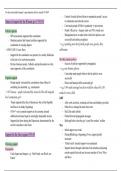
To what extent did Germany’s governments rule by consent 1918-89
- Control of media allowed them to manipulate people’s access
Nature of support for the Weimar gov’t 1918-33 to information and what they knew
- Convinced people of Hitler’s popularity w/ processions
Political parties - People’s Receiver - cheapest radio set (70% owned one)
- SPD consistently supported the constitution - Manipulated news to make believe that Nazi policies were
- Moderate parties that formed coalition supported the successful and enforce prejudices
constitution in varying degrees → e.g. spreading news that Jewish people were greedy, dirty
→ DVP, DDP, Centre Party subhumans
- Support for the constitution was present, hw, mainly failed due
to the lack of co-op between parties Broadly popular policies
- M/class business people, Catholics and professionals were the - Success of policies supported by propaganda
main supporters of the constitution → e.g. anti-Semitic policies
- Censorship made people believe that the policies were
Popular support successful
- People mainly welcomed the constitution when offered w/ - Prizes and financial offers motivated ppl
something less desirable, e.g. communism → e.g. 1000 mark marriage loan that would be reduced by 200
→ 1923 Saxony - people welcomed the removal of the self-imposed marks for every child
local communist gov’t KDF
- People supported the idea of democracy but not the Republic - After-work activities, weekend activities and holidays provided
itself due to its shaky beginnings - Often free or charged at much lower rate
- 1924-9 - rise in popular support as the economy seemed - Had 23m mark subsidy
stabilised and many began to earn higher disposable income - Pushed forward propaganda messages
- Support died down during the Depression, demonstrated by the - Made ppl believe that the gov’t cared for workers’ welfare
switch in loyalties to the Nazis War
- Initial support was weak
Support for the Nazi regime 1933-45 - During Blitzkrieg at beginning of war, support greatly
increased
Winning support - ‘Fuhrer myth’ ensured support was maintained
Propaganda - Support shown through collections from charities and joining
- Used slogans and images, e.g. ‘One People, one Reich, one murder squads that took part in mass mureder of Jews, Poles
Fuhrer’ and Slavs
- Control of media allowed them to manipulate people’s access
Nature of support for the Weimar gov’t 1918-33 to information and what they knew
- Convinced people of Hitler’s popularity w/ processions
Political parties - People’s Receiver - cheapest radio set (70% owned one)
- SPD consistently supported the constitution - Manipulated news to make believe that Nazi policies were
- Moderate parties that formed coalition supported the successful and enforce prejudices
constitution in varying degrees → e.g. spreading news that Jewish people were greedy, dirty
→ DVP, DDP, Centre Party subhumans
- Support for the constitution was present, hw, mainly failed due
to the lack of co-op between parties Broadly popular policies
- M/class business people, Catholics and professionals were the - Success of policies supported by propaganda
main supporters of the constitution → e.g. anti-Semitic policies
- Censorship made people believe that the policies were
Popular support successful
- People mainly welcomed the constitution when offered w/ - Prizes and financial offers motivated ppl
something less desirable, e.g. communism → e.g. 1000 mark marriage loan that would be reduced by 200
→ 1923 Saxony - people welcomed the removal of the self-imposed marks for every child
local communist gov’t KDF
- People supported the idea of democracy but not the Republic - After-work activities, weekend activities and holidays provided
itself due to its shaky beginnings - Often free or charged at much lower rate
- 1924-9 - rise in popular support as the economy seemed - Had 23m mark subsidy
stabilised and many began to earn higher disposable income - Pushed forward propaganda messages
- Support died down during the Depression, demonstrated by the - Made ppl believe that the gov’t cared for workers’ welfare
switch in loyalties to the Nazis War
- Initial support was weak
Support for the Nazi regime 1933-45 - During Blitzkrieg at beginning of war, support greatly
increased
Winning support - ‘Fuhrer myth’ ensured support was maintained
Propaganda - Support shown through collections from charities and joining
- Used slogans and images, e.g. ‘One People, one Reich, one murder squads that took part in mass mureder of Jews, Poles
Fuhrer’ and Slavs