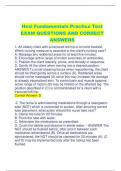
Hesi Fundamentals Practice Test EXAM QUESTIONS AND CORRECT ANSWERS
Hesi Fundamentals Practice Test EXAM QUESTIONS AND CORRECT ANSWERS 1. An elderly client with a fractured left hip is on strict bedrest. Which nursing measure is essential to the client's nursing care? A. Massage any reddened areas for at least five minutes. B. Encourage active range of motion exercises on extremities. C. Position the client laterally, prone, and dorsally in sequence. D. Gently lift the client when moving into a desired position. - ANSWER To avoid shearing forces when repositioning, the client should be lifted gently across a surface (D). Reddened areas should not be massaged (A) since this may increase the damage to already traumatized skin. To control pain and muscle spasms, active range of motion (B) may be limited on the affected leg. The position described in (C) is contraindicated for a client with a fractured left hip. Correct Answer: D 2. The nurse is administering medications through a nasogastric tube (NGT) which is connected to suction. After ensuring correct tube placement, what action should the nurse take next? A. Clamp the tube for 20 minutes. B. Flush the tube with water. C. Administer the medications as prescribed. D. Crush the tablets and dissolve in sterile water. - ANSWER The NGT should be flushed before, after and in between each medication administered (B). Once all medications are administered, the NGT should be clamped for 20 minutes (A). (C and D) may be implemented only after the tubing has been flushed. Correct Answer: B 3. A client who is in hospice care complains of increasing amounts of pain. The healthcare provider prescribes an analgesic every four hours as needed. Which action should the nurse implement? A. Give an around-the-clock schedule for administration of analgesics. B. Administer analgesic medication as needed when the pain is severe. C. Provide medication to keep the client sedated and unaware of stimuli. D. Offer a medication-free period so that the client can do daily activities. - ANSWER The most effective management of pain is achieved using an around-the-clock schedule that provides analgesic medications on a regular basis (A) and in a timely manner. Analgesics are less effective if pain persists until it is severe, so an analgesic medication should be administered before the client's pain peaks (B). Providing comfort is a priority for the client who is dying, but sedation that impairs the client's ability to interact and experience the time before life ends should be minimized (C). Offering a medication-free period allows the serum drug level to fall, which is not an effective method to manage chronic pain (D). Correct Answer: A 4. When assessing a client with wrist restraints, the nurse observes that the fingers on the right hand are blue. What action should the nurse implement first? A. Loosen the right wrist restraint. B. Apply a pulse oximeter to the right hand. C. Compare hand color bilaterally. D. Palpate the right radial pulse. - ANSWER The priority nursing action is to restore circulation by loosening the restraint (A), because blue fingers (cyanosis) indicates decreased circulation. (C and D) are also important nursing interventions, but do not have the priority of (A). Pulse oximetry (B) measures the saturation of hemoglobin with oxygen and is not indicated in situations where the cyanosis is related to mechanical compression (the restraints). Correct Answer: A 5. The nurse is assessing the nutritional status of several clients. Which client has the greatest nutritional need for additional intake of protein? A. A college-age track runner with a sprained ankle. B. A lactating woman nursing her 3-day-old infant. C. A school-aged child with Type 2 diabetes. D. An elderly man being treated for a peptic ulcer. - ANSWER A lactating woman (B) has the greatest need for additional protein intake. (A, C, and D) are all conditions that require protein, but do not have the increased metabolic protein demands of lactation. Correct Answer: B 6. A client is in the radiology department at 0900 when the prescription levofloxacin (Levaquin) 500 mg IV q24h is scheduled to be administered. The client returns to the unit at 1300. What is the best intervention for the nurse to implement? A. Contact the healthcare provider and complete a medication variance form. B. Administer the Levaquin at 1300 and resume the 0900 schedule in the morning. C. Notify the charge nurse and complete an incident report to explain the missed dose. D. Give the missed dose at 1300 and change the schedule to administer daily at 1300. - ANSWER To ensure that a therapeutic level of medication is maintained, the nurse should administer the missed dose as soon as possible, and revise the administration schedule accordingly to prevent dangerously increasing the level of the medication in the bloodstream (D). The nurse should document the reason for the late dose, but (A and C) are not warranted. (B) could result in increased blood levels of the drug. Correct Answer: D 7. While instructing a male client's wife in the performance of passive range-of-motion exercises to his contracted shoulder, the nurse observes that she is holding his arm above and below the elbow. What nursing action should the nurse implement? A. Acknowledge that she is supporting the arm correctly. B. Encourage her to keep the joint covered to maintain warmth. C. Reinforce the need to grip directly under the joint for better support. D. Instruct her to grip directly over the joint for better motion. - ANSWER The wife is performing the passive ROM correctly, therefore the nurse should acknowledge this fact (A). The joint that is being exercised should be uncovered (B) while the rest of the body should remain covered for warmth and privacy. (C and D) do not provide adequate support to the joint while still allowing for joint movement. Correct Answer: A
Written for
- Institution
- Hesi Fundamentals
- Course
- Hesi Fundamentals
Document information
- Uploaded on
- December 27, 2023
- Number of pages
- 35
- Written in
- 2023/2024
- Type
- Exam (elaborations)
- Contains
- Questions & answers
Subjects
- hesi fundamentals
- hesi
-
hesi fundamentals practice test exam questions

Also available in package deal