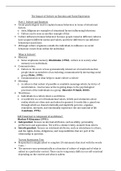
The Impact of Culture on Emotion and Facial Expression
Part 1- Culture and Emotion:
Social psychologists tend to explain human behaviour in terms of situational
factors.
o Asch, Milgram are examples of situational factors influencing behaviour.
o Culture can be seen as another example of this
Culture influences human behaviour because people raised in different cultures
have acquired different norms and values, and these differences can influence
behaviours much later.
Although culture originates outside the individual, its influence on social
behaviour comes from within the individual.
What is Culture?
Memory:
o Some emphasise memory. Kluckhohn (1954)- culture is to society what
memory is to individuals.
Communication:
o Culture is ‘the more or less systematically related set of constructions that
people share as members of an enduring, communicatively interacting social
group (Fiske, 1995).
o Communication is what helps to make culture a culture
Meaning:
o A culture is that subset of possible or available meanings which, by virtue of
enculturation… has become active in giving shape to the psychological
processes of the individuals in a group (Shweder & Haidt, 2000).
Worldview:
o Individuals in a culture share a worldview.
o A worldview is a set of fundamental values, beliefs and sentiments about
reality which are often tacit and taken for granted. It works like a giant lens
through which we characteristically and implicitly perceive, organise,
remember, interpret, and emotionally experience the raw material of life
(Landman, 1996).
Self-Construal: A component of worldview?
Markus & Kitayama (1991):
Independent: focuses on internal attributes, such as ability, personality,
preferences and aspirations. The self is a distinct entity, isolated from others.
Interdependent: focuses on relational attributes, such as relatedness to others,
and the rights, duties, obligations, and responsibilities that are part of the
relationship in question.
Twenty Statements Test:
Respondent is simply asked to complete 20 statements that start with the words
‘I am…’
The answers vary systematically as a function of culture of origin and of what is
salient in a particular context. There can be temporary shifts in our self-construal
depending on the context and what is salient.
Part 1- Culture and Emotion:
Social psychologists tend to explain human behaviour in terms of situational
factors.
o Asch, Milgram are examples of situational factors influencing behaviour.
o Culture can be seen as another example of this
Culture influences human behaviour because people raised in different cultures
have acquired different norms and values, and these differences can influence
behaviours much later.
Although culture originates outside the individual, its influence on social
behaviour comes from within the individual.
What is Culture?
Memory:
o Some emphasise memory. Kluckhohn (1954)- culture is to society what
memory is to individuals.
Communication:
o Culture is ‘the more or less systematically related set of constructions that
people share as members of an enduring, communicatively interacting social
group (Fiske, 1995).
o Communication is what helps to make culture a culture
Meaning:
o A culture is that subset of possible or available meanings which, by virtue of
enculturation… has become active in giving shape to the psychological
processes of the individuals in a group (Shweder & Haidt, 2000).
Worldview:
o Individuals in a culture share a worldview.
o A worldview is a set of fundamental values, beliefs and sentiments about
reality which are often tacit and taken for granted. It works like a giant lens
through which we characteristically and implicitly perceive, organise,
remember, interpret, and emotionally experience the raw material of life
(Landman, 1996).
Self-Construal: A component of worldview?
Markus & Kitayama (1991):
Independent: focuses on internal attributes, such as ability, personality,
preferences and aspirations. The self is a distinct entity, isolated from others.
Interdependent: focuses on relational attributes, such as relatedness to others,
and the rights, duties, obligations, and responsibilities that are part of the
relationship in question.
Twenty Statements Test:
Respondent is simply asked to complete 20 statements that start with the words
‘I am…’
The answers vary systematically as a function of culture of origin and of what is
salient in a particular context. There can be temporary shifts in our self-construal
depending on the context and what is salient.