BUSM 2024 CU Boulder Midterm Questions and Answers 100% Verified
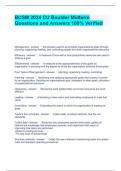
BUSM 2024 CU Boulder Midterm Questions and Answers 100% Verified Management the process used to accomplish organizational goals through planning, organizing, leading, and controlling people and other organizational resources Efficiency A measure of how well or how productively resources are used to achieve a goal Brainpower Read More Previous Play Next Rewind 10 seconds Move forward 10 seconds Unmute 0:03 / 0:15 Full screen Effectiveness A measure of the appropriateness of the goals an organization is pursuing and the degree to which the organization achieves those goals Four Tasks of Management planning, organizing, leading, controlling Planning Identifying and selecting appropriate goals and courses of action for an organization. Deciding on organizational goal, strategies to attain goals, allocation of organizational resources. Organizing Structuring work relationships so human resources are most effective Leading Articulating a clear vision and motivating employees to meet that vision Controlling Evaluating the extent to which the organization is meeting its goals Taylor's four principles Collect data, structure methods, hire fits, set standards Collect data Study the way employees perform their tasks, gather all informal job knowledge that employees possess, and experiment with ways of improving how tasks are performed -Observe existing process -Try new ways of doing things Structure methods Codify the new methods of performing tasks into written rules and standard operating procedures -Don't re-invent the wheel, standardize the routine Hire fits Carefully select employees so that they possess skills and abilities that match the needs of the task and train them to perform the task according to the established rules -Employees must be able to meet a minimum level of proficiency Set standards Establish a fair or acceptable level of performance for a task, and then develop a pay system that provides a reward for performance above the acceptable level -Create incentives for doing better (bonuses) Mary Parker Follett -Management must consider the human side -Employees should be involved in job analysis -Person with the knowledge should be in control of the work process regardless of position -Cross-functioning teams used to accomplish projects Max Weber Traditional organizational structure typified by a well-defined authority hierarchy and strict rules governing behavior Bureaucracy Highly routine operating tasks achieved through specialization Formalized rules and regulations Tasks that are grouped into functional departments Centralized authority Narrow spans of control Decision making that follows the chain of command Hawthorne effect Initiated as an attempt to investigate how characteristics of the work setting affect employee fatigue and performance Found that productivity increased regardless of whether illumination was raised or lowered Narcissism Degree of sense of self-importance and arrogance. Egotistical, self focuses, and vain. Openness to experience Tendency to be original, have broad interests, be open to a wide range of stimuli, be daring and take risks Conscientiousness Tendency to be careful, scrupulous, and persevering. Managers high in this trait are organized and self-disciplined. Extraversion The tendency to experience positive emotions and moods and to feel good about oneself and the rest of the world. Sociable, affectionate, outgoing and friendly Agreeableness Tendency to get along well with others. Likable, affectionate and care about others. Outward state Negative affectivity Tendency to experience negative emotions and moods, feel distressed, and be critical of oneself and others. Inner state; extent to which one is likely to experience negative moods and emotions (neuroticism) Toxoplasma invovles cats, fetus can be infected if a woman gets this disease during pregancy -protozoan diseases Increases negative affectivity Core self-evaluation Represents a broad personality trait comprising four positive individual traits: (1) self-efficacy, (2) self-esteem, (3) locus of control, and (4) emotional stability Locus of control The degree to which people believe they control their own fate (internal or external) Self-esteem A persons view of themselves, high or low; may be accurate or innaccurate Values Represent basic, enduring convictions that "a specific mode of conduct or end-state of existence is personally or socially preferable to an opposite or converse mode of conduct or end-state of existence." Terminal values Refers to desirable end-states of existence that a person would like to achieve during his or her lifetime Instrumental values Refers to preferable modes of behavior, or means of achieving the long term values Job satisfaction How happy and content a person is with their job Organizational commitment the degree to which an employee identifies with a particular organization and its goals and wishes to maintain membership in the organization Continuance commitment Organizational commitment based on the fact that an individual cannot afford to leave, already too deep into the commitment Affective commitment A desire to remain a member of an organization due to an emotional attachment to, and involvement with, that organization Normative commitment A desire to remain a member of an organization due to a feeling of obligation, immoral to leave Organizational citizenship behavior Engagement in job behaviors that are above one's job role duties Mood A feeling or state of mind. Personality traits and current circumstances often determine this Emotions Intense feelings that are directed at someone or something, specific cause Organizational culture Set of shared values, norms, and assumptions that guide people's behavior within a group, business or institution to achieve organizational goals. Founder (Attraction-Selection-Attrition Framework) These people tend to hire employees whose personalities that are to their own Organizational socialization The process by which newcomers learn an organization's values and norms and acquire the work behaviors necessary to perform jobs effectively Stories and languages Behaviors that are valued by the organization and practices that are frowned on such as how people dress, offices, cars, degree of formality Ceremonies and rites Formal events that recognize incidents of importance to the organization as a whole and to specific employees Rites of passage Determine how individuals enter(socialization), advance within, or leave the organization Rites of integration Build and reinforce common bonds among organizational members Rites of enhancement Let organizations publicly recognize and reward employees' contributions and thus strengthen their commitment to organizational values Emotinal intelligence The ability to perceive, understand, manage, and use emotions Groupthink A pattern of faulty and biased decision making that occurs in groups. Agreement among themselves at the expense of an accurate assessment. Devil's advocacy Analyzing the strengths and weaknesses of a preferred alternative before it's implemented Avoid Production Blocking Loss of productivity in brainstorming sessions due to its unstructured nature Delphi Technique Group members do not meet face-to-face but respond in writing to questions posed by the group leader- Ideal for geographically diverse groups Nominal Group Technique Group members write down ideas, read their suggestions to the whole group, and discuss and then individually rank the alternatives. Ideal for controversial decisions. 1-3-6ing Brainstorm as an individual, compare answers in a larger group, and then a larger group Decision making The process by which managers respond to opportunities and threats by analyzing options, and making determinations about specific organizational goals and courses of action.
Written for
- Institution
- BUSM
- Course
- BUSM
Document information
- Uploaded on
- January 11, 2024
- Number of pages
- 10
- Written in
- 2023/2024
- Type
- Exam (elaborations)
- Contains
- Questions & answers
Subjects
-
busm 2024 cu boulder midterm questions and answers
-
management the process used to accomplish organiza
-
planning identifying and selecting appropriate goa
-
collect data study the way employees perform th

Also available in package deal