Chapter 3 Receptors and Signaling: B and T-Cell Receptors Questions 2024.
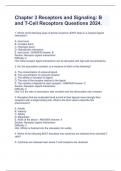
Chapter 3 Receptors and Signaling: B and T-Cell Receptors Questions 2024.1. Which of the following types of bonds would be LEAST likely in a receptor-ligand interaction? A. Ionic bond B. Covalent bond C. Hydrogen bond D. Hydrophobic interaction E. Ionic bond - ANSWER Answer: B Section: Receptor-Ligand Interactions Difficulty: 2 Hint: Most receptor ligand interactions can be disrupted with high salt concentrations. 2. Ka, the association constant, is a measure of which of the following? A. The concentration of unbound ligand B. The concentration of unbound receptor C. The affinity of receptor for ligand D. The size of the receptor relative to the ligand E. The number of ligands for each receptor - ANSWER Answer: C Section: Receptor-Ligand Interactions Difficulty: 2 Hint: It is the ratio of association rate constant over the dissociation rate constant. 3. Receptors that are multivalent tend to bind to their ligands more strongly than receptors with a single binding site. What is the term used to describe this phenomenon? A. Avidity B. Valency C. Affinity D. Magnetism E. None of the above - ANSWER Answer: A Section: Receptor-Ligand Interactions Difficulty: 2 Hint: Affinity is factored into the calculation for avidity. 4. Which of the following BEST describes how cytokines are released from activated T cells? A. Cytokines are released near where T-cell receptors are clustered.
Written for
- Institution
- MIP
- Course
- MIP
Document information
- Uploaded on
- January 15, 2024
- Number of pages
- 7
- Written in
- 2023/2024
- Type
- Exam (elaborations)
- Contains
- Questions & answers
Subjects
-
chapter 3 receptors and signaling b and t cell re
-
which of the following types of bonds would be lea
-
receptors that are multivalent tend to bind to th
-
portions of the cytoplasmic domains of many immun

Also available in package deal