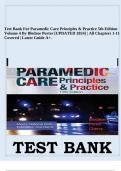
Test Bank For Paramedic Care Principles & Practice 5th Edition Volume 4 By Bledsoe Porter [UPDATED 2024] | All Chapters 1-11 Covered | Latest Guide A+.
Test Bank For Paramedic Care Principles & Practice 5th Edition Volume 4 By Bledsoe Porter [UPDATED 2024] | All Chapters 1-11 Covered | Latest Guide A+. Test Bank Paramedic Care: Principles & Practice V.4, 5e (Bledsoe) Volume 4: Trauma Emergencies Table of Contents Chapter 1: Trauma and Trauma Systems Chapter 2: Mechanism of Injury Chapter 3: Hemorrhage and Shock Chapter 4: Soft-Tissue Trauma Chapter 5: Burns Chapter 6: Head, Neck, and Spinal Trauma Chapter 7: Chest Trauma Chapter 8: Abdominal and Pelvic Trauma Chapter 9: Orthopedic Trauma Chapter 10: Environmental Trauma Chapter 11: Special Considerations in Trauma Paramedic Care: Principles & Practice V.4, 5e (Bledsoe) Volume 4: Trauma Emergencies Chapter 1: Trauma and Trauma Systems 1) The purpose of determining the mechanism of injury and the index of suspicion for the trauma patient at the same time is to allow you to: A) decide whether to transport the patient. B) identify comorbid factors. C) document a complete scene size-up. D) anticipate your patient's injuries. Answer: D Diff: 2 Page Ref: 9-10 Standard: Trauma (Trauma Overview) Objective: 7 2) Which of the following accounts for the highest number of trauma deaths in the United States of America? A) Motor vehicle crashes B) Falls C) Assaults D) Firearms injuries Answer: A Diff: 2 Page Ref: 3 Standard: Trauma (Trauma Overview) Objective: 2 3) Which of the following acts resulted in the development of modern EMS systems? A) Ryan White Act B) Highway Safety Act of 1966 C) Good Samaritan Act D) The Trauma Care Systems Planning and Development Act of 1990 Answer: B Diff: 2 Page Ref: 4 Standard: Trauma (Trauma Overview) Objective: 8 4) In addition to handling all types of specialty trauma, which level of trauma center provides continuing medical and public education programs? A) IV B) III C) I D) II Answer: C Diff: 2 Page Ref: 7-8 Standard: Trauma (Trauma Overview) Objective: 4 5) Upon arriving on a scene where the mechanism of injury indicates a potentially lifethreatening injury, you should employ which of the following interventions to best help deliver the care that is needed? A) Reevaluate the scene size-up. B) Initiate transport immediately, delaying more extensive care until you are en route. C) Ask a surgeon to respond to the scene. D) Call immediately for air medical transport to reduce the "Golden Period." Answer: B Diff: 2 Page Ref: 13 Standard: Trauma (Trauma Overview) Objective: 7 6) Which of the following physical findings indicates the need for immediate transport? A) Vital signs: systolic blood pressure 80, respiratory rate 8 B) Glasgow Coma Scale score of 15 C) Second-degree burns involving 9 percent of total body surface area in an adult patient D) Fractured right femur Answer: A Diff: 2 Page Ref: 11-12 Standard: Trauma (Trauma Overview) Objective: 7 7) Which of the following requires immediate transport to a trauma center? A) A 40-year-old who fell 12 feet from a garage roof with a radius fracture B) A 36-year-old woman in a motor vehicle crash who has a blood pressure of 100/60 C) A 22-year-old soccer player with lower leg pain D) A 47-year-old involved in a motor vehicle crash that resulted in the death of his passenger Answer: D Diff: 2 Page Ref: 12 Standard: Trauma (Trauma Overview) Objective: 7 8) As a paramedic, your role in trauma care consists of all of the following, EXCEPT: A) providing rapid transport to appropriate facilities. B) promoting injury prevention. C) providing care to seriously injured trauma patients. D) providing surgical interventions to stop hemorrhage. Answer: D Diff: 2 Page Ref: 3 Standard: Trauma (Trauma Overview) Objective: 3 9) Trauma triage criteria application, field skill performance, response times, patient assessment, patient care and transport are all monitored through which of the following? A) Quality improvement B) Trauma registry C) Centers for Disease Control and Prevention D) Public healthcare model Answer: A Diff: 2 Page Ref: 14 Standard: Trauma (Trauma Overview) Objective: 8 10) Which of the following is the best definition of the Golden Period? A) The ideal time it takes to assess a multi-system trauma patient B) The ideal timeframe from time of injury until surgery C) The ideal time from requesting a helicopter to it landing on scene D) The ideal timeframe from call dispatch to arrival on scene Answer: B Diff: 2 Page Ref: 11 Standard: Trauma (Trauma Overview) Objective: 1 11) Which of the following is NOT an example of trauma? A) An abrasion to the knee B) Chest pain C) Cerebral contusion D) A stab wound to the abdomen Answer: B Diff: 2 Page Ref: 3-4 Standard: Trauma (Trauma Overview) Objective: 1 12) Establishment of educational programs and improved auto technology are examples of which part of the public health model? A) Surveillance B) Risk identification C) Intervention D) Implementation Answer: C Diff: 2 Page Ref: 6 Standard: Trauma (Trauma Overview) Objective: 3 13) Which level of trauma facility has minimal surgical support but can stabilize before transferring to a higher-level trauma facility? A) III B) II C) IV D) I Answer: A Diff: 2 Page Ref: 7-8 Standard: Trauma (Trauma Overview) Objective: 4 14) Which of the following statements about trauma is FALSE? A) Life-threatening injuries may exist with little external evidence. B) Dramatic-appearing extremity injuries draw the paramedic's focus away from life-threatening injuries. C) Life-threatening injury occurs in less than 10 percent of trauma patients. D) Most patients with life-threatening trauma will have sustained external injury to the extremities (arms/legs). Answer: D Diff: 2 Page Ref: 4 Standard: Trauma (Trauma Overview) Objective: 2 15) The leading cause of death in people under age 44 is: A) heart attack. B) trauma. C) cancer. D) cardiovascular disease. Answer: B Diff: 2 Page Ref: 4 Standard: Trauma (Trauma Overview) Objective: 2 16) Which of the following patients is NOT a candidate for air medical transport? A) Combative trauma patient B) Seriously injured patient with cardiac tamponade C) Patient with prolonged extrication time D) Burn patient with over 50 percent second-degree burns Answer: A .
Written for
- Institution
- Paramedic Care Principles & Practice 5th Edition
- Course
- Paramedic Care Principles & Practice 5th Edition
Document information
- Uploaded on
- January 18, 2024
- Number of pages
- 133
- Written in
- 2023/2024
- Type
- Exam (elaborations)
- Contains
- Questions & answers
Subjects
-
test bank for paramedic care principles practice
-
paramedic care principles practice 5th edition
-
paramedic care principles 5th edition all chapters
-
paramedic care principles 5th edition latest guide

Also available in package deal