FISDAP TRAUMA 2024 QUESTIONS WITH COMPLETE SOLUTIONS GRADED A+
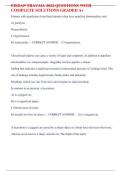
FISDAP TRAUMA 2024 QUESTIONS WITH COMPLETE SOLUTIONS GRADED A+ Patients with significant closed head injuries often have pupillary abnormalities and: A) paralysis. B) paresthesia. C) hypertension. D) tachycardia. - CORRECT ANSWER C) hypertension. Closed head injuries can cause a variety of signs and symptoms. In addition to pupillary abnormalities (ie, unequal pupils, sluggishly reactive pupils), a classic finding that indicates a significant increase in intracranial pressure is Cushing's triad. This trio of findings includes hypertension; bradycardia; and abnormal breathing, which can vary from slow and irregular to rapid and deep. In contrast to an incision, a laceration: A) is a jagged cut. B) is a superficial injury. C) bleeds more severely. D) usually involves an artery. - CORRECT ANSWER A) is a jagged cut. A laceration is a jagged cut caused by a sharp object or a blunt force that tears the tissue, whereas an incision is a sharp, smooth cut. The depth of the injury FISDAP TRAUMA 2024 QUESTIONS WITH COMPLETE SOLUTIONS GRADED A+ can vary; it can extend through the skin and subcutaneous tissue or into the underlying muscles and adjacent nerves and blood vessels. Lacerations and incisions can involve arteries, veins, or both, potentially resulting in severe bleeding. Which of the following clinical findings is consistent with decompensated shock? A) Diaphoresis and pallor B) Falling blood pressure C) Restlessness and anxiety D) Tachycardia and tachypnea - CORRECT ANSWER B) Falling blood pressure During shock, the compensatory mechanisms of the body attempt to maintain the blood pressure. This is accomplished by increasing the heart rate, shunting blood from the skin to more vital organs, and increasing the respiratory rate to increase the oxygen content of the blood. Once these compensatory mechanisms fail, the blood pressure will fall (hypotension). Hypotension signifies a state of decompensated shock. You must not rely on the patient's blood pressure as an indicator of overall perfusion. Restlessness, anxiety, tachycardia, tachypnea, and cool, clammy skin (diaphoresis) are earlier signs of shock and do not necessarily indicate a decompensated state. Which of the following injury mechanisms involves axial loading? A) skater slips and falls, landing on her outstretched arm. FISDAP TRAUMA 2024 QUESTIONS WITH COMPLETE SOLUTIONS GRADED A+ B) A construction worker falls off a roof and lands feet first. C) A woman's knees impact the dash during a frontal collision. D) A man's neck is forced laterally during a side impact collision. - CORRECT ANSWER B) A construction worker falls off a roof and lands feet first. Axial loading injuries occur when a sudden, excessive compression force drives the long axis of the body toward the head, or the head toward the feet. Common injuries that involve axial loading are heavy objects falling on a patient's head, diving head first into shallow water, and falls in which the patient lands feet first. All of these mechanisms cause compression of the spine, potentially resulting in serious injury. None of the other injury mechanisms described are consistent with axial loading. A man was stabbed in the cheek with a dinner fork, and the fork is still impaled in his cheek. He is conscious and alert, breathing adequately, and has blood in his oropharynx. You should: A) apply high-flow oxygen via a nonrebreathing mask, carefully remove the fork, and control any external bleeding. B) suction his oropharynx, control any external bleeding, stabilize the fork in place, and protect it with bulky dressings. FISDAP TRAUMA 2024 QUESTIONS WITH COMPLETE SOLUTIONS GRADED A+ C) carefully remove the fork, suction his oropharynx as needed, and pack the inside of his cheek with sterile gauze pads. D) suction his oropharynx, carefully cut the fork to make it shorter, control any external bleeding, and secure the fork in place. - CORRECT ANSWER B) suction his oropharynx, control any external bleeding, stabilize the fork in place, and protect it with bulky dressings. An impaled object in the cheek should be removed if it interferes with yo
Written for
- Institution
- FISDAP TRAUMA 2024
- Course
- FISDAP TRAUMA 2024
Document information
- Uploaded on
- January 26, 2024
- Number of pages
- 107
- Written in
- 2023/2024
- Type
- Exam (elaborations)
- Contains
- Questions & answers
Subjects
- fisdap trauma 2024
- fisdap
-
fisdap trauma 2024 questions with complete soluti
-
fisdap trauma 2024 questions with complete soluti
-
fisdap trauma 2024 questions with complete soluti

Also available in package deal