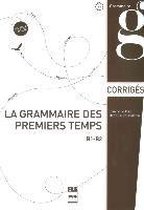
La grammaire des premiers
temps
Contenu : chapitre 1, 2, 3, 4, 5, 6, 7, 8, 9, 10, 12,
14
Le nom (zelfstandig naamwoord)
Le gendre : masculin, féminin
Règle : -ment = masculin
-té = féminin
-ion = féminin
-on = féminin
Un, une, le, la, les, des
De + le = du
De + les = des
A + le = au
A + les = aux
! Na een ontkenning verandert un/une in de, behalve na etre
Ex. L’homme a une femme? Non, il n‟a pas de femme.
Ce n’est pas une pipe.
Il ne fume pas de pipe.
! Als er in het Nederlands geen lidwoord (de/het/een) staat, gebruik je in het Frans het
delend lidwoord.
Ex. Wil je brood? Tu veux du pain?
Heef u kinderen? Vous avez des enfants?
! Na hoeveelheden of een ontkenning de
Ex. Je mange du pain >> je mange beaucoup de pain
Je mange du pain >> je ne mange pas de pain
,Déterminants
L’univers Une planète Cette planète Notre planète
Ma région Ma ville Mon village
In het Nederlands geen lidwoord ? Bepalend lidwoord in het Frans
Ex. Leraren houden van leerlingen > Les professeurs aiment les élèves.
Bier is goed voor de gezondheid > La bière est bonne pour la santé.
! Zo ook na de werkwoorden: aimer, préférer, adorer, détester
Ook bepalend lidwoord bij:
- Eigennamen
- Landen/ streken
Ex. Les Pays-Bas, La France
- Datum
Ex. Le 11 juillet
- Vaste dagen
Ex. Op woensdag/ ’s woensdags zwem ik Le mercredi je fais de la nataton
,Prépositions (voorzetsels)
Bij plaatsnamen : a ex. À Paris
- Bij landen-/streeknamen :
Vrouwelijk : en ex. En Espagne
Mannelijk : au ex. Au Portugal
Meervoud : aux ex. Aux États-Unis
Uitzonderingen !!
Je suis de Kerkrade (=ik kom uit Kerkrade/”ik ben van Kerkrade”)
Maastricht est la capitale du Limbourg (=Maastricht is de hoofdstad van Limburg).
Paris est la capitale de la France (=Parijs is de hoofdstad van Frankrijk).
Washington est la capitale des Etats-Unis.
nationalite biijoeeliik
pays capitale habitants in / naar ...
naamwoord)
la France Paris les Français française en France
l‟Aneleterre anelaise
Londres les Anelais en Aneleterre
l‟Espaene Madrid les Espaenols espaenole en Espaene
le Portueal portueaise
Lisbonne les Portueais au Portueal
Bruxelles les Belees en Beleique
la Beleique belee
les Neerlandais / les aux Pays-Bas /
les Pays-Bas / la Amsterdam neerlandaise /
Hollandais en Hollande
Hollande hollandaise
Luxembour
le Luxemboure les Luxemboureeois luxemboureeoise au Luxemboure
e
l‟Allemaene allemande
, Berlin les Allemands
en Allemaene
À Luxembourg = in/naar Luxemburg (stad)
Je suis de Luxembourg = ik kom uit L. (stad)
Je suis du Mans = ik kom uit Le Mans
Je suis du Luxembourg = ik kom uit L. (land)
Au Luxembourg = in/naar L.burg (land)
Au Mans = in/naar Le Mans
De la Haye = uit Den Haag
À la Haye = in/naar Den Haag
temps
Contenu : chapitre 1, 2, 3, 4, 5, 6, 7, 8, 9, 10, 12,
14
Le nom (zelfstandig naamwoord)
Le gendre : masculin, féminin
Règle : -ment = masculin
-té = féminin
-ion = féminin
-on = féminin
Un, une, le, la, les, des
De + le = du
De + les = des
A + le = au
A + les = aux
! Na een ontkenning verandert un/une in de, behalve na etre
Ex. L’homme a une femme? Non, il n‟a pas de femme.
Ce n’est pas une pipe.
Il ne fume pas de pipe.
! Als er in het Nederlands geen lidwoord (de/het/een) staat, gebruik je in het Frans het
delend lidwoord.
Ex. Wil je brood? Tu veux du pain?
Heef u kinderen? Vous avez des enfants?
! Na hoeveelheden of een ontkenning de
Ex. Je mange du pain >> je mange beaucoup de pain
Je mange du pain >> je ne mange pas de pain
,Déterminants
L’univers Une planète Cette planète Notre planète
Ma région Ma ville Mon village
In het Nederlands geen lidwoord ? Bepalend lidwoord in het Frans
Ex. Leraren houden van leerlingen > Les professeurs aiment les élèves.
Bier is goed voor de gezondheid > La bière est bonne pour la santé.
! Zo ook na de werkwoorden: aimer, préférer, adorer, détester
Ook bepalend lidwoord bij:
- Eigennamen
- Landen/ streken
Ex. Les Pays-Bas, La France
- Datum
Ex. Le 11 juillet
- Vaste dagen
Ex. Op woensdag/ ’s woensdags zwem ik Le mercredi je fais de la nataton
,Prépositions (voorzetsels)
Bij plaatsnamen : a ex. À Paris
- Bij landen-/streeknamen :
Vrouwelijk : en ex. En Espagne
Mannelijk : au ex. Au Portugal
Meervoud : aux ex. Aux États-Unis
Uitzonderingen !!
Je suis de Kerkrade (=ik kom uit Kerkrade/”ik ben van Kerkrade”)
Maastricht est la capitale du Limbourg (=Maastricht is de hoofdstad van Limburg).
Paris est la capitale de la France (=Parijs is de hoofdstad van Frankrijk).
Washington est la capitale des Etats-Unis.
nationalite biijoeeliik
pays capitale habitants in / naar ...
naamwoord)
la France Paris les Français française en France
l‟Aneleterre anelaise
Londres les Anelais en Aneleterre
l‟Espaene Madrid les Espaenols espaenole en Espaene
le Portueal portueaise
Lisbonne les Portueais au Portueal
Bruxelles les Belees en Beleique
la Beleique belee
les Neerlandais / les aux Pays-Bas /
les Pays-Bas / la Amsterdam neerlandaise /
Hollandais en Hollande
Hollande hollandaise
Luxembour
le Luxemboure les Luxemboureeois luxemboureeoise au Luxemboure
e
l‟Allemaene allemande
, Berlin les Allemands
en Allemaene
À Luxembourg = in/naar Luxemburg (stad)
Je suis de Luxembourg = ik kom uit L. (stad)
Je suis du Mans = ik kom uit Le Mans
Je suis du Luxembourg = ik kom uit L. (land)
Au Luxembourg = in/naar L.burg (land)
Au Mans = in/naar Le Mans
De la Haye = uit Den Haag
À la Haye = in/naar Den Haag