100% satisfaction guarantee Immediately available after payment Both online and in PDF No strings attached 4.6 TrustPilot
logo-home
Exam (elaborations)

UNDERSTANDING PATHOPHSIOLOGY 6TH EDITION TEST BANK BY SUE E.HUETHER;KATHRYN L MCCANCE

Rating
-
Sold
-
Pages
716
Grade
A+
Uploaded on
01-02-2024
Written in
2023/2024

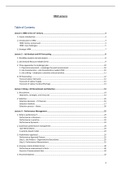
UNDERSTANDING PATHOPHSIOLOGY 6TH EDITION TEST BANK BY SUE E.HUETHER;KATHRYN L MCCANCE TEST BANKFOR Understanding Pathophysiology 6 th Edition By: Sue E. Huether;Kathryn L. McCance PART ONE: BASIC CONCEPTS OF PATHOPHYSIOLOGY Unit 1:The Cell Chapter1: Cellular Biology Chapter 2. Genes and Genetic Diseases Chapter 3.Epigeneticsand Disease (NEW) Chapter 4. Altered Cellular and Tissue Biology Chapter 5. Fluidsand Electrolytes, Acids and Bases Unit 2: Mechanisms of Self-Defense Chapter 6. Innate Immunity: Inflammation and Wound Healing Chapter 7. Adaptive Immunity Chapter 8. Infection and Defects in Mechanisms of Defense Chapter 9. Stress and Disease Unit 3: Cellular Proliferation: Cancer Chapter 10. Biology of Cancer Chapter11. CancerEpidemiology Chapter 12. Cancer in Children and Adolescents PARTTWO: BODY SYSTEMS AND DISEASES Unit 4:The Neurologic System Chapter13. Structure and Function of the Neurologic System Chapter 14. Pain,Temperature, Sleep, and Sensory Function Chapter15. Alterationsin Cognitive Systems, Cerebral Hemodynamicsand MotorFunction Chapter 16. Disorders of the Centraland Peripheral Nervous Systems and Neuromuscular Junction Chapter 17. Alterations of Neurologic Function in Children Unit 5:The Endocrine System Chapter18. Mechanisms of Hormonal Regulation Chapter 19. Alterations of Hormonal Regulation Unit 6: The Hematologic System Chapter 20. Structure and Function of the Hematologic System Chapter 21. Alterations in Hematologic Function Chapter 22. Alterations of Hematologic Function in Children Unit 7: The Cardiovascular and Lymphatic Systems Chapter 23. Structure and Function of the Cardiovascularand Lymphatic Systems Chapter 24. Alterations of CardiovascularFunction Chapter 25. Alterations of Cardiovascular Function in Children Unit 8: The Pulmonary System Chapter 26. Structure and Function of the Pulmonary System Chapter 27. Alterations of Pulmonary Function Chapter 28. Alterations of PulmonaryFunction in Children Unit 9: The Renal and Urologic Systems Chapter 29. Structure and Function of the Renaland Urologic Systems Chapter 30. Alterations of Renal and Urinary Tract Function Chapter 31. Alterations of Renaland UrinaryTract Function in Children Unit 10: The Reproductive Systems Chapter 32. Structure and Function of the Reproductive Systems Chapter 33. Alterations of the Female Reproductive System Chapter 34. Alterations of the Male Reproductive System Unit 11:The Digestive System Chapter 35. Structure and Function of the Digestive System Chapter 36. Alterations of Digestive Function Chapter 37. Alterations in Digestive Function in Children Unit 12:The Musculoskeletaland Integumentary Systems Chapter 38. Structure and Function of the Musculoskeletal System Chapter 39. Alterations of Musculoskeletal Function Chapter 40. Alterations of Musculoskeletal Function in Children Chapter 41. Structure, Function,and Disorders of the Integument Chapter 42. Alterations of the Integument in Children Chapter 01: Cellular Biology Huether & McCance: Understanding Pathophysiology, 6th Edition MULTIPLE CHOICE 1. A student isobservingacellunder the microscope. It is observed to havesupercoiled DNA with histones. Which of the following would also be observed by the student? a. A single circular chromosome b. A nucleus c. Free-floatingnuclear material d. No organelles ANS: B Thecelldescribed isaeukaryotic cell, so it hashistonesandasupercoiled DNAwithin its nucleus; thus, the nucleus should be observed. A single circular chromosome called a prokaryote contains free-floating nuclear material but has no organelles. REF:p. 2 2. A nurse is instructing the staff about cellular functions. Which cellular function is the nurse describing whenan isolatedcellabsorbs oxygenanduses it to transform nutrients toenergy? a. Metabolic absorption b. Communication c. Secretion d. Respiration ANS: D The cell’s abilityto absorboxygen is referredto as respiration while its communication ability involves maintenance of a steady dynamic state, metabolic absorption provides nutrition, and secretion allows for the synthesizing of new substances. REF:p. 2 3. A eukaryotic cell is undergoing DNA replication. In whichregionof the cell would most of the genetic information be contained? a. Mitochondria b. Ribosome c. Nucleolus d. Nucleus Cytoplasm ANS: C The region of the cell that contains genetic material, including a large amount of ribonucleic acid, most of the DNA, and DNA-binding proteins, is the nucleolus, which is located within the cell’s nucleus. Mitochondria is associated with cellular respiration, while ribosomes are involved with protein manufacturing. Cytoplasm is a fluid filling that is a component of the cell. REF:p. 2 4. Whichof the following canremove proteins attached tothe cell’s bilayer bydissolving the layer itself? a. Peripheral membraneproteins b. Integral membraneproteins c. Glycoproteins d. Celladhesion molecules ANS: B Proteinsdirectlyattachedto the membrane bilayer can be removed bythe actionof integral membrane proteins that dissolve the bilayer. Peripheral membrane proteins reside at the surface while cell adhesion molecules are on the outside of the membrane. Glycoprotein marks cells and does not float. REF:p. 7 5. Whichof the following canbind toplasma membrane receptors? a. Oxygen b. Ribosomes c. Amphipathic lipids d. Ligands ANS: D Ligands are theonlyspecific molecules that canbind with receptorsonthe cell membrane. REF:p. 9 6. A nurse is reviewing a report from a patient with metastatic cancer. What alternation in the Decreasedacellular mat fibronectinrix would support the diagnosis of metastatic cancer? b. Increasedcollagen c. Decreasedelastin d. Increasedglycoproteins ANS: A Onlya reducedamountof fibronectin is found insometypesofcancerouscells, allowing them to travel or metastasize. REF:p. 10 7. Whichform ofcellcommunication is used to relate toother cells indirect physicalcontact? a. Cell junction b. Gap junction c. Desmosome d. Tight junction ANS: A Cell junctions hold cells together andpermit molecules topass from cell to cell. Gap junctionsallow forcellularcommunicationbetweencells. Neitherdesmosomes nor tight junctions are associated with cellular communication. REF:p. 11 8. Pancreatic beta cells secrete insulin, which inhibits secretion of glucagon from neighboring alpha cells.This action is anexample of whichof the followingsignaling types? a. Paracrine b. Autocrine c. Neurohormonal d. Hormonal ANS: A Paracrinesignaling involves thereleaseof localchemical mediators that arequickly takenup, destroyed, or immobilized, as in the case of insulin and the inhibition of the secretion of glucagon. None of theother options involvesignaling that is associated witha localchemical mediator like insulin. REF:p. 12 9. Incellular metabolism, eachenzyme has a highaffinityfora: a. solute. b. substrate. c. receptor. d. ribosome. ANS: B Eachenzyme has a highaffinity for asubstrate,aspecific substance convertedto a productof the reaction. Cellular metabolism is not dependent on an attraction between an enzyme and any of the remaining options. REF:p. 16 10. Anathleteruns a marathon, after whichhis muscles feel fatiguedandunable tocontract.The athlete asks the nurse why this happened. The nurse’s response is based on the knowledge that the problem is result of a deficiency of: a. GTP b. AMP c. ATP d. GMP ANS: C When ATP isdeficient, impaired musclecontractionresults. Noneof theotheroptionsare involved in muscle contraction. REF:p. 16 11. Whichphase ofcatabolism produces the most ATP? a. Digestion b. Glycolysis c. Oxidation d. Citric acidcycle ANS: D Whilesome ATP isproducedduringtheoxidationandglycolysisphases, mostof the ATP is generated during the citric acid cycle. Digestion does not produce any ATP. REF:p. 16 12. A nurse is teaching thestaffabout thephasesofcellular catabolism. Whichphasesshould the nurse include? a. Digestion,glycolysis,oxidation,andthecitricacid cycle b. Diffusion,osmosis,and mediatedtransport c. S phase, G phase, and M phase d. Metabolicabsorption, respiration,andexcretion ANS: A Onlydigestion,glycolysis,oxidation,andthecitric acid cyclearethephasesofcellular catabolism. REF: p. 16 13. A runnerhasdepletedall theoxygenavailable for muscleenergy. Whichof the following will facilitate his continued muscle performance? a. Electron-transport chain b. Aerobicglycolysis c. Anaerobicglycolysis d. Oxidativephosphorylation ANS: C Whennooxygenisavailable, anaerobicglycolysis occurs.Theelectron-transportchain is part of the citric acid cycle. Aerobic glycolysis involves the presence of oxygen. Oxidative phosphorylation is the mechanism by which the energy produced from carbohydrates, fats, and proteins is transferred to ATP. It is not part of muscle performance. REF:p. 16 14. A faculty member asks astudent to identifythe appropriate term for the movement ofasolute from an area of greater to lesser concentration. Which answer indicates the nursing student understood the teaching? a. Osmosis b. Diffusion c. Hydrostaticpressure d. Activetransport ANS: B Diffusion is the movement ofa solute molecule from an area ofgreater solute concentration to an area of lesser solute concentration through a permeable membrane. Osmosis is the movement of water across a semipermeable membrane from a region of higher water concentration tooneof lowerconcentration. Hydrostaticpressure is the forceof fluidagainst a cell membrane. In active transport, molecules move up a concentration gradient. REF:p. 19 15. Whichdescriptionaccuratelydescribes electrolytes? a. Small lipid-soluble molecules b. Largeprotein molecules c. Micronutrientsused to produce ATP d. Electricallycharged molecules ANS: D Electrolytesareelectricallycharged molecules.Theyarenot lipidsoluble, theyarenot made up of protein, and theydo not play a role in ATP production. REF:p. 18 16. A nurse is readingachart andsees theterm oncotic pressure.Thenurserecalls that oncotic pressure (colloid osmotic pressure) is determined by: a. the concentration of sodium. b. plasmaproteins. c. hydrostaticpressure. d. the availabilityof membrane transporter proteins. ANS: B Oncotic pressure is determined by the effect of colloids or plasma proteins. The concentration of sodium plays a role in tonicity. Hydrostatic pressure is the force within a vessel. Membrane transporter proteins are involved in active transport within a concentration gradient. REF:p. 20 17. A patient has abodyfluid of 300 mOsm/kg.This labresult is measuring: a. osmolality. b. osmolarity. c. osmoticpressure. d. oncoticpressure. ANS: A Osmolality measures the number of milliosmoles per kilogram of water, or the concentration of molecules per weight of water, while osmolarity measures the number of milliosmoles per liter of solution, ortheconcentrationof molecules per volumeofsolution. Osmotic pressure is the amount of hydrostatic pressure required to oppose the osmotic movement of water. Oncoticpressure is from plasmaproteins, not bodyfluids. REF:p. 19 18. A nurse is discussing the movement of fluid across the arterial end of capillary membranes into the interstitial fluid surrounding the capillary. Which process of fluid movement is the nurse describing? a. Hydrostaticpressure b. Osmosis c. Diffusion d. Activetransport ANS: A Blood reaching the capillary bed has a hydrostatic pressure of 25–30 mm Hg, which is sufficient force to push water across the thin capillary membranes into the interstitial space. Osmosis involves the movement of fluid from an area of higher concentration to an area of lower concentration. Itdoesnot involve pressureor force. Diffusionis thepassive movement of a solute from an area of higher solute concentration to an area of lower solute concentration. Active transport involves movement up a concentration gradient. REF:p. 19 19. How arepotassium and sodium transportedacross plasma membranes? a. Bypassive electrolyte channels b. Bycoupled channels c. Byadenosinetriphosphateenzyme (ATPase) d. Bydiffusion ANS: C The transporter protein ATPase is directly related to sodium and potassium transport via active transport.Electrolyte movements requireenergyanddo not movepassively,norare they transported bydiffusion. Enzymes, not electrolytes, are passed via coupled channels. REF:p. 21 20. The iontransporter that moves Na+ and Ca2+ simultaneouslyinthesamedirectionis an example of which of the following types of transport? a. Biport b. Uniport c. Antiport d. Symport

Show more Read less
Institution
Course


Whoops! We can’t load your doc right now. Try again or contact support.

Written for

Institution
Course

Document information

Uploaded on
February 1, 2024
Number of pages
716
Written in
2023/2024
Type
Exam (elaborations)
Contains
Questions & answers

Subjects

Content preview

UNDERSTANDING PATHOPHSIOLOGY 6TH EDITION TEST BANK
BY SUE E.HUETHER;KATHRYN L MCCANCE

TEST BANK FOR
Understanding Pathophysiology 6th Edition
By: Sue E. Huether; Kathryn L. McCance

PART ONE: BASIC CONCEPTS OF PATHOPHYSIOLOGY
Unit 1: The Cell
Chapter 1: Cellular Biology
Chapter 2. Genes and Genetic Diseases
Chapter 3. Epigenetics and Disease
(NEW)
Chapter 4. Altered Cellular and Tissue Biology
Chapter 5. Fluids and Electrolytes, Acids and
Bases Unit 2: Mechanisms of Self-Defense
Chapter 6. Innate Immunity: Inflammation and Wound
Healing Chapter 7. Adaptive Immunity
Chapter 8. Infection and Defects in Mechanisms of
Defense Chapter 9. Stress and Disease
Unit 3: Cellular Proliferation: Cancer
Chapter 10. Biology of Cancer
Chapter 11. Cancer Epidemiology
Chapter 12. Cancer in Children and Adolescents

PART TWO: BODY SYSTEMS AND DISEASES
Unit 4: The Neurologic System
Chapter 13. Structure and Function of the Neurologic
System Chapter 14. Pain, Temperature, Sleep, and
Sensory Function
Chapter 15. Alterations in Cognitive Systems, Cerebral Hemodynamics and Motor Function
Chapter 16. Disorders of the Central and Peripheral Nervous Systems and Neuromuscular
Junction Chapter 17. Alterations of Neurologic Function in Children
Unit 5: The Endocrine System
Chapter 18. Mechanisms of Hormonal
Regulation Chapter 19. Alterations of Hormonal
Regulation Unit 6: The Hematologic System
Chapter 20. Structure and Function of the Hematologic

,System Chapter 21. Alterations in Hematologic Function
Chapter 22. Alterations of Hematologic Function in
Children Unit 7: The Cardiovascular and Lymphatic
Systems
Chapter 23. Structure and Function of the Cardiovascular and Lymphatic Systems

,Chapter 24. Alterations of Cardiovascular Function
Chapter 25. Alterations of Cardiovascular Function in
Children Unit 8: The Pulmonary System
Chapter 26. Structure and Function of the Pulmonary
System Chapter 27. Alterations of Pulmonary Function
Chapter 28. Alterations of Pulmonary Function in
Children Unit 9: The Renal and Urologic Systems
Chapter 29. Structure and Function of the Renal and Urologic
Systems Chapter 30. Alterations of Renal and Urinary Tract
Function
Chapter 31. Alterations of Renal and Urinary Tract Function in
Children Unit 10: The Reproductive Systems
Chapter 32. Structure and Function of the Reproductive
Systems Chapter 33. Alterations of the Female Reproductive
System Chapter 34. Alterations of the Male Reproductive
System
Unit 11: The Digestive System
Chapter 35. Structure and Function of the Digestive
System Chapter 36. Alterations of Digestive Function
Chapter 37. Alterations in Digestive Function in
Children Unit 12: The Musculoskeletal and
Integumentary Systems
Chapter 38. Structure and Function of the Musculoskeletal System
Chapter 39. Alterations of Musculoskeletal Function
Chapter 40. Alterations of Musculoskeletal Function in
Children Chapter 41. Structure, Function, and Disorders of
the Integument Chapter 42. Alterations of the Integument in
Children


Chapter 01: Cellular Biology Huether & McCance: Understanding Pathophysiology, 6th Edition


MULTIPLE CHOICE

1. A student is observing a cell under the microscope. It is observed to have supercoiled DNA with histones.
Which of the following would also be observed by the student?
a. A single circular chromosome
b. A nucleus
c. Free-floating nuclear material
d. No organelles

, ANS: B
The cell described is a eukaryotic cell, so it has histones and a supercoiled DNA within its nucleus;
thus, the nucleus should be observed. A single circular chromosome called a prokaryote contains
free-floating nuclear material but has no organelles.

REF: p. 2

2. A nurse is instructing the staff about cellular functions. Which cellular function is the nurse describing
when an isolated cell absorbs oxygen and uses it to transform nutrients to energy? a.
Metabolic absorption
b. Communication
c. Secretion
d. Respiration

$10.25
Get access to the full document:

100% satisfaction guarantee
Immediately available after payment
Both online and in PDF
No strings attached

Get to know the seller
Seller avatar
BestsPdf

Get to know the seller

Seller avatar
BestsPdf Teachme2-tutor
Follow You need to be logged in order to follow users or courses
Sold
1
Member since
1 year
Number of followers
0
Documents
65
Last sold
5 months ago

0.0

0 reviews

5
0
4
0
3
0
2
0
1
0

Recently viewed by you

Why students choose Stuvia

Created by fellow students, verified by reviews

Quality you can trust: written by students who passed their tests and reviewed by others who've used these notes.

Didn't get what you expected? Choose another document

No worries! You can instantly pick a different document that better fits what you're looking for.

Pay as you like, start learning right away

No subscription, no commitments. Pay the way you're used to via credit card and download your PDF document instantly.

Student with book image

“Bought, downloaded, and aced it. It really can be that simple.”

Alisha Student

Frequently asked questions