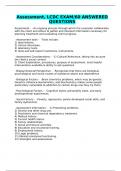
Assessment, LCDC EXAM/60 ANSWERED
QUESTIONS
Assessment - -An ongoing process through which the counselor collaborates
with the client and others to gather and interpret information necessary for
planning treatment and evaluating client progress.
-Assessment tools - -Tools include:
1) observations.
2) clinical interviews.
3) laboratory tests.
4) tests and self-report inventories, instruments.
-Assessment Considerations - -1) Cultural Relevance, taking into account
the client's social context.
2) Client Explanation, procedures, purpose of assessment, most helpful
interventions available & ability to ask questions.
-Biopsychosocial Perspective - -Recognizes that there are biological,
psychological and social causes of substance abuse and dependence.
-Biological Factors - -Brain chemistry problems, which may be genetic.
Genetics influence biochemistry, and biochemistry makes some people
particularly vulnerable to addiction to certain drugs one they try them.
-Psychological Factors - -Cognitive styles, personality traits, and early
developmental experiences.
-Social Factors - -Poverty, oppression, poorly developed social skills, and
family dysfunction.
-Assessment Information - -1) Presenting problems.
2) Alcohol and other drug use.
3) Psychiatric and chemical dependency treatment.
4) Medical history.
5) Current health status.
6) Family relationships.
7) Social and leisure activities.
8) Education and vocational training.
9) Employment history.
10) Legal problems.
11) Mental/ emotional functioning.
12) Strengths and weaknesses.
, -Immediate Medical Evaluation Needed - -Client's who present with:
Hallucinations, Severe tremors, Tachycardia, Confusion or delirium,
Uncontrollable agitation, or Ingested unknown substances or quantities of
substances.
-Tremors - -Involuntary fine movement of the body or limbs
-Tachycardia - -Abnormally rapid heartbeat, over 100 beats per minute.
-Withdrawal Risk Factors - -1) History of withdrawal.
2) History of seizures.
3) Dependence on multiple substances.
-Rapport - -A comfortable working relationship, which helps assure the
client's trust and cooperation.
-Person First Language - -Placement of the noun, individual or person,
before the descriptive phrase, with
disabilities, to conceptualize the whole person with many abilities and
disabilities rather than emphasizing disabilities.
-Motivational Interviewing - -A style of interacting with clients that is helpful
in reducing defensiveness. Respects the clients perception of the problem
and engages the client in a dialogue that promotes the client non-
defensively reexamining the situation and coming to determine that a
problem exists.
-Self Efficacy - -Refers to one's belief about one's ability to perform
behaviors that should lead to expected outcomes. those with high levels for
a particular task are more likely to succeed than those with low levels
-Stages of Change - -1) Pre-contemplation.
2) Contemplation.
3) Preparation.
4) Action.
5) Maintenance.
6) Termination.
-Pre-contemplation (Stages of Change) - -people do not think they have a
problem and have no intention of changing behavior
-Contemplation (Stages of Change) - -people know they have a problem and
are intending to take action within 6 months
-Preparation (Stages of Change) - -people plan to take action within a
month
QUESTIONS
Assessment - -An ongoing process through which the counselor collaborates
with the client and others to gather and interpret information necessary for
planning treatment and evaluating client progress.
-Assessment tools - -Tools include:
1) observations.
2) clinical interviews.
3) laboratory tests.
4) tests and self-report inventories, instruments.
-Assessment Considerations - -1) Cultural Relevance, taking into account
the client's social context.
2) Client Explanation, procedures, purpose of assessment, most helpful
interventions available & ability to ask questions.
-Biopsychosocial Perspective - -Recognizes that there are biological,
psychological and social causes of substance abuse and dependence.
-Biological Factors - -Brain chemistry problems, which may be genetic.
Genetics influence biochemistry, and biochemistry makes some people
particularly vulnerable to addiction to certain drugs one they try them.
-Psychological Factors - -Cognitive styles, personality traits, and early
developmental experiences.
-Social Factors - -Poverty, oppression, poorly developed social skills, and
family dysfunction.
-Assessment Information - -1) Presenting problems.
2) Alcohol and other drug use.
3) Psychiatric and chemical dependency treatment.
4) Medical history.
5) Current health status.
6) Family relationships.
7) Social and leisure activities.
8) Education and vocational training.
9) Employment history.
10) Legal problems.
11) Mental/ emotional functioning.
12) Strengths and weaknesses.
, -Immediate Medical Evaluation Needed - -Client's who present with:
Hallucinations, Severe tremors, Tachycardia, Confusion or delirium,
Uncontrollable agitation, or Ingested unknown substances or quantities of
substances.
-Tremors - -Involuntary fine movement of the body or limbs
-Tachycardia - -Abnormally rapid heartbeat, over 100 beats per minute.
-Withdrawal Risk Factors - -1) History of withdrawal.
2) History of seizures.
3) Dependence on multiple substances.
-Rapport - -A comfortable working relationship, which helps assure the
client's trust and cooperation.
-Person First Language - -Placement of the noun, individual or person,
before the descriptive phrase, with
disabilities, to conceptualize the whole person with many abilities and
disabilities rather than emphasizing disabilities.
-Motivational Interviewing - -A style of interacting with clients that is helpful
in reducing defensiveness. Respects the clients perception of the problem
and engages the client in a dialogue that promotes the client non-
defensively reexamining the situation and coming to determine that a
problem exists.
-Self Efficacy - -Refers to one's belief about one's ability to perform
behaviors that should lead to expected outcomes. those with high levels for
a particular task are more likely to succeed than those with low levels
-Stages of Change - -1) Pre-contemplation.
2) Contemplation.
3) Preparation.
4) Action.
5) Maintenance.
6) Termination.
-Pre-contemplation (Stages of Change) - -people do not think they have a
problem and have no intention of changing behavior
-Contemplation (Stages of Change) - -people know they have a problem and
are intending to take action within 6 months
-Preparation (Stages of Change) - -people plan to take action within a
month