PNB 2274 Final Exam Review 2024/2025 with complete solution
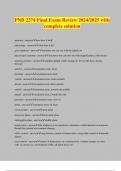
PNB 2274 Final Exam Review 2024/2025 with complete solution anatomy - answerhow does it look? physiology - answerwhat does it do? gross anatomy - answerstructures you can see with the naked eye microscopic anatomy - answerstructures you can only see with magnification, cells/ tissues anatomy position - answerstanding upright, palms facing out, feet on the floor, facing forward anterior - answerorientation term, front posterior - answerorientation term, back ventral - answerorientation term, front (animal) dorsal - answerorientation term, back (animal) medial - answerorientation term, towards the middle lateral - answerorientation term, towards the side proximal - answerorientation term, close to distal - answerorientation term, far from coronal plane - answerfrontal plane transverse plane - answerhorizontal plane midsaggital plane - answermiddle plane homeostasis - answerthe tendency of an organism to maintain a stable internal environment, though the external environment changes reflex control - answerlong distance control of homeostasis, using either neural or hormonal signals local control - answercontrol of homeostasis at a cellular level, isolated changes in a few cells or a tissue (i.e. environment of the cell, fluid level, etc) input, controller, output - answer3 major components of homeostatic mechanism input - answerthe signal of the homeostatic mechanism; something is changing and needs to be adjusted; stimulus detected by a sensor controller - answeraka integrating center, makes a decision about what to do about the stimulus, often the CNS output - answerin homeostatic mechanism, this signal is how the correction is made. Needs a target or effector set point - answerin homeostatic mechanisms, this range determines what is within healthy boundaries. A high enough error will result in an output. Can be modified (i.e. fever to combat infection) insulin - answerlowers blood glucose levels to maintain homeostasis glucagon - answerincreases blood glucose levels to maintain homeostasis negative feedback - answerfeedback loops that works to return the state of the organism back to the set point. Maintains homeostasis by counteracting disruption. Self terminating Positive feedback - answerfeedback loops that amplify the stimulus, output is fed back into the system to increase output. These do not shut themselves off, require outside factors positive feedback - answerHormone control during childbirth, lactation, and blood clotting are examples of this type of feedback negative feedback - answerglucose levels, heart rate, etc. are examples of this type of feedback phospholipid bilayer - answercomposed of hydrophobic tails and heads; fluid mosaic; forms the plasma membrane. Serves as a physical barrier, gateway for exchange, communication, and attachment site passive transport - answertransport that requires no extra energy; movement occurs randomly from areas of high concentration to low concentration active transport - answertransport that requires energy typically in the form of ATP; molecules are moved from areas of low concentration to high concentration, AGAINST concentration gradient simple diffusion - answerrandom motion of molecules in solution that results in spread of molecules from areas of high concentration to low concentration. Net movement until the concentrations are equal. Can occur in open system or across partition (plasma membrane) flux - answerhow much does a concentration
Written for
- Institution
- PNB
- Course
- PNB
Document information
- Uploaded on
- February 14, 2024
- Number of pages
- 24
- Written in
- 2023/2024
- Type
- Exam (elaborations)
- Contains
- Questions & answers
Subjects
-
pnb 2274 final exam review with complete

Also available in package deal