100% satisfaction guarantee Immediately available after payment Both online and in PDF No strings attached 4.6 TrustPilot
logo-home
Exam (elaborations)

Hartman's Nursing Assistant Care - Chapter 21 Already Graded A

Rating
-
Sold
-
Pages
3
Grade
A+
Uploaded on
17-02-2024
Written in
2023/2024

Hartman's Nursing Assistant Care - Chapter 21 Already Graded A Rehabilitation care given by specialists to help restore a person to highest possible level of function after an illness or injury. What rehabilitation involves psychosocial needs Restorative care all parts of the person's disability, including physical needs and care given after rehabilitation to keep the resident at the level achieved by rehabilitation. Guidelines for Restorative Care Be patient, positive, supportive. Focus on small tasks. Recognize setbacks, reassure. Be sensitive to needs. Encourage independence. Provide privacy. Involve resident in care. Problems with lack of Mobility loss of self-esteem, depression, pneumonia, urinary tract infections, constipation, blood clots, dulling of senses, reduced circulation (increased risk of pressure injuries) Benefits of regular exercise skin quality, circulation, strength, sleep/relaxation, mood, self esteem, appetite, elimination, blood flow, oxygen level Assistive or adaptive devices activities of daily living Supportive devices special equipment that helps a person who is ill or disabled perform Assist with ambulation (canes, walkers, crutches) Guidelines for alignment and positioning Observe principles of alignment (straight lines). Keep body parts in natural positions. Prevent external rotation of hips. Change positions often. Give back rubs as ordered. Prosthesis device that replaces a body part that is missing or deformed because of accident, injury, illness, birth defect. decrease or prevent contractures or atrophy, improve Benefits of range of motion exercises strength, increase circulation Range of motion (ROM) exercises that put a joint through its full arc of motion. Active range of motion (AROM) help. ROM exercises that are performed by the resident alone, without Active assisted range of motion (AAROM) some help. Passive range of motion (PROM) ROM exercises that are performed by resident with ROM exercises that are performed by a caregiver, without the resident's help. Abduction Adduction Extension Flexion Dorsiflexion Plantar flexion Rotation Pronation Supination moving a body part away from the midline of the body. moving a body part toward the midline of the body.

Show more Read less
Institution
Course

Content preview

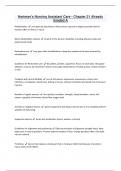
Hartman's Nursing Assistant Care - Chapter 21 Already
Graded A
Rehabilitation care given by specialists to help restore a person to highest possible level of
function after an illness or injury.


What rehabilitation involves all parts of the person's disability, including physical needs and
psychosocial needs


Restorative care care given after rehabilitation to keep the resident at the level achieved by
rehabilitation.


Guidelines for Restorative Care Be patient, positive, supportive. Focus on small tasks. Recognize
setbacks, reassure. Be sensitive to needs. Encourage independence. Provide privacy. Involve resident
in care.


Problems with lack of Mobility loss of self-esteem, depression, pneumonia, urinary tract
infections, constipation, blood clots, dulling of senses, reduced circulation (increased risk of pressure
injuries)


Benefits of regular exercise skin quality, circulation, strength, sleep/relaxation, mood, self-
esteem, appetite, elimination, blood flow, oxygen level


Assistive or adaptive devices special equipment that helps a person who is ill or disabled perform
activities of daily living


Supportive devices Assist with ambulation (canes, walkers, crutches)


Guidelines for alignment and positioning Observe principles of alignment (straight lines). Keep
body parts in natural positions. Prevent external rotation of hips. Change positions often. Give back
rubs as ordered.


Prosthesis device that replaces a body part that is missing or deformed because of accident,
injury, illness, birth defect.

Written for

Course

Document information

Uploaded on
February 17, 2024
Number of pages
3
Written in
2023/2024
Type
Exam (elaborations)
Contains
Questions & answers

Subjects

$12.99
Get access to the full document:

100% satisfaction guarantee
Immediately available after payment
Both online and in PDF
No strings attached


Also available in package deal

Get to know the seller

Seller avatar
Reputation scores are based on the amount of documents a seller has sold for a fee and the reviews they have received for those documents. There are three levels: Bronze, Silver and Gold. The better the reputation, the more your can rely on the quality of the sellers work.
CertifiedGrades Chamberlain College Of Nursing
Follow You need to be logged in order to follow users or courses
Sold
144
Member since
3 year
Number of followers
61
Documents
8740
Last sold
2 weeks ago
High Scores

Hi there! Welcome to my online tutoring store, your ultimate destination for A+ rated educational resources! My meticulously curated collection of documents is designed to support your learning journey. Each resource has been carefully revised and verified to ensure top-notch quality, empowering you to excel academically. Feel free to reach out to consult with me on any subject matter—I'm here to help you thrive!

3.9

38 reviews

5
21
4
6
3
2
2
3
1
6

Trending documents

Recently viewed by you

Why students choose Stuvia

Created by fellow students, verified by reviews

Quality you can trust: written by students who passed their tests and reviewed by others who've used these notes.

Didn't get what you expected? Choose another document

No worries! You can instantly pick a different document that better fits what you're looking for.

Pay as you like, start learning right away

No subscription, no commitments. Pay the way you're used to via credit card and download your PDF document instantly.

Student with book image

“Bought, downloaded, and aced it. It really can be that simple.”

Alisha Student

Frequently asked questions