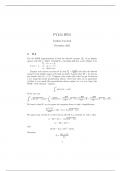
PY452 HW8
Guillem Cucurull
November 2021
1 9.1
Use the WKB approximation to find the allowed energies (En of an infinite
square well with a “shelf,” of height V0 , extending half-way across (Figure 7.3):
V0 0 < x < a2
V (x) = { 0, a2 < x < a
∞ otherwise
2
Express your answer in terms of V0 and En0 = (nπh̄)
2ma2 and (the nth allowed
energy for the infinite square well with no shelf). Assume that E10 > V0 , but do
not assume that En ≫ V0 . Compare your result with what we got in Section
7.1.2, using first-order perturbation theory. Note that they are in agreement
if either is very small (the perturbation theory regime) or n is very large (the
WKB—semi-classical—regime).
Z a
|p(x)| dx = nπh̄
0
So for our case
Z a2 p √ √ √
Z a √ a 2m p a 2m √ a 2m p √
2m(E − V0 ) dx+ 2mE dx = E − V0 + E= ( E − V0 + E)
0 a
2
2 2 2
We want to find E, so we square the equation above to find a simplification
2n2 π 2 h̄2 p
= 2E − V 0 + 2 E(E − V0 )
ma2
We again want to find E, so the term on the left is a constant we call α, thus
p
α − 2E + V0 = −2 E(E − V0 )
(α − 2E + V0 )2 =
and
4E(E − V0 ) = 4E 2 − 4EV0
Therefore
(V0 + α)2
E=
4α
1
, 2 9.3
Use Equation 9.23 to calculate the approximate transmission probability for a
particle of energy E that encounters a finite square barrier of height V0 > E
and width 2a. Compare your answer with the exact result (Problem 2.33), to
which it should reduce in the WKB regime T ≪ 1.
T = e−2γ
with
1 a
Z
|p(x)| dx
γ=
h̄ 0
Problem 2.33 gives the exact result of
1
T = V02
1+ sinh2 γ 4E(V0 −E)
Also, this is for the case that T ≪ 1, which by T = e−2γ we know that γ ≫ 1
We know for the width 2a that
p
|p(x)| = 2m(V0 − E)
Thus Z 2a
1 p 1 p
γ= 2m(V0 − E) dx = 2a 2m(V0 − E)
h̄ 0 h̄
which means that
1
√ −4a
√
T = e−2( h̄ 2a 2m(V0 −E)) = e h̄ 2m(V0 −E))
We need to compare our answer to the exact result of Problem 2.33, so let’s
break it down. We know
ex − e−γ
sinhγ =
2
so
eγ − e−γ 2
sinh2 γ = ( )
2
which can be approximated to
e2γ
sinh2 γ =
4
Therefore we get the result
1
T = V02
e2γ
1+ 4 4E(V0 −E)
Since γ ≫ 1, we can neglect all other factors. Therefore, the WKB approxima-
tion for T gives
T = e−2γ
p
where our γ = 2a h̄ 2m(V0 − E)
2
Guillem Cucurull
November 2021
1 9.1
Use the WKB approximation to find the allowed energies (En of an infinite
square well with a “shelf,” of height V0 , extending half-way across (Figure 7.3):
V0 0 < x < a2
V (x) = { 0, a2 < x < a
∞ otherwise
2
Express your answer in terms of V0 and En0 = (nπh̄)
2ma2 and (the nth allowed
energy for the infinite square well with no shelf). Assume that E10 > V0 , but do
not assume that En ≫ V0 . Compare your result with what we got in Section
7.1.2, using first-order perturbation theory. Note that they are in agreement
if either is very small (the perturbation theory regime) or n is very large (the
WKB—semi-classical—regime).
Z a
|p(x)| dx = nπh̄
0
So for our case
Z a2 p √ √ √
Z a √ a 2m p a 2m √ a 2m p √
2m(E − V0 ) dx+ 2mE dx = E − V0 + E= ( E − V0 + E)
0 a
2
2 2 2
We want to find E, so we square the equation above to find a simplification
2n2 π 2 h̄2 p
= 2E − V 0 + 2 E(E − V0 )
ma2
We again want to find E, so the term on the left is a constant we call α, thus
p
α − 2E + V0 = −2 E(E − V0 )
(α − 2E + V0 )2 =
and
4E(E − V0 ) = 4E 2 − 4EV0
Therefore
(V0 + α)2
E=
4α
1
, 2 9.3
Use Equation 9.23 to calculate the approximate transmission probability for a
particle of energy E that encounters a finite square barrier of height V0 > E
and width 2a. Compare your answer with the exact result (Problem 2.33), to
which it should reduce in the WKB regime T ≪ 1.
T = e−2γ
with
1 a
Z
|p(x)| dx
γ=
h̄ 0
Problem 2.33 gives the exact result of
1
T = V02
1+ sinh2 γ 4E(V0 −E)
Also, this is for the case that T ≪ 1, which by T = e−2γ we know that γ ≫ 1
We know for the width 2a that
p
|p(x)| = 2m(V0 − E)
Thus Z 2a
1 p 1 p
γ= 2m(V0 − E) dx = 2a 2m(V0 − E)
h̄ 0 h̄
which means that
1
√ −4a
√
T = e−2( h̄ 2a 2m(V0 −E)) = e h̄ 2m(V0 −E))
We need to compare our answer to the exact result of Problem 2.33, so let’s
break it down. We know
ex − e−γ
sinhγ =
2
so
eγ − e−γ 2
sinh2 γ = ( )
2
which can be approximated to
e2γ
sinh2 γ =
4
Therefore we get the result
1
T = V02
e2γ
1+ 4 4E(V0 −E)
Since γ ≫ 1, we can neglect all other factors. Therefore, the WKB approxima-
tion for T gives
T = e−2γ
p
where our γ = 2a h̄ 2m(V0 − E)
2