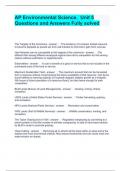
AP Environmental Science. Unit 5 Questions and Answers Fully solved
AP Environmental Science. Unit 5 Questions and Answers Fully solved The Tragedy of the Commons The tendency of a shared, limited resource to become depleted as people act from self-interest for short-term gain from overuse. How fisheries can be susceptible to the tragedy of the commons The different fish among different ecological regions have led to competition for fish among nations without restrictions or replenishment. Externalities A cost or benefit of a good or service that is not included in the purchased price of the food or service. Maximum Sustainable Yield The maximum amount that can be harvested from a resource without compromising the future availability of that resource. Can be be found halfway to carrying capacity on a growth diagram (logistic growth as s-shaped). Will insure a future population of a resource (food), but also leave enough for safe competition. BLM Lands (Bureau of Land Management) Grazing, mining, timber, recreation. USFS Lands (United States Forest Service) Timber harvesting, grazing, and recreation. NPS Lands (National Parks Service) Recreation and conservation. FWS Lands (Fish & Wildlife Services) Wildlife conservation, hunting, and recreation. The Taylor Grazing Act of 1934 Regulated overgrazing by converting to a permit system to limit the number of animals overgrazing. Is said to have been backed by BLM in order to promote grazing. Clear-Cutting Removing all or almost all the trees within an area and is the easiest and most economical method. May reduce biodiversity and can cause wind and water erosion on slopes. Selective Cutting Removes single or small numbers of trees in a given area. Allows for reseeding and younger trees planted but can only specifically target shade-tolerant species. NEPA (National Environmental Policy Act) Mandated an environmental assessment of all projects involving federal money or federal permits. Environmental Impact Statement (EIS) A statement that outlines the scope and purpose of an architectural project, its environmental context, and environmental impacts or alternatives. Impact of Fire Suppression Suppressed fires can often lead to an accumulation of dead biomass, which built up until fire was inevitable. Prescribed Burns Fires set under controlled conditions that help reduce risky fires and recycle biomass, avoiding build-up. Famine The condition in which food insecurity is so extreme that large numbers of deaths occur over a relatively short period. Food Security People's ability to access sufficient, safe, nutritious food to maintain a healthy and active life. Food Insecurity A condition in which people do not have adequate access to food. Effects of Vitamin A Deficiency 25,000 children per year become blind due to vitamin A deficiency. Three Main Components of the Human Diet 1. Grain 2. Meat 3. Fish Three Most Grown Types of Grain Corn, wheat, and rice. Most Meat Eaten Luxembourg Overnutrition The ingestion of too many calories combined with a lack of proper balance in foods and nutrients. Undernutrition Chronic hunger, or not consuming enough calories to be healthy. Malnutrition Lack of proper nutrition. Effects of Overnutrition Being overweight, at risk for diabetes, hypertension, heart disease, and stroke. Effects of Undernutrition During a calorie deficit, the body is deprived of energy for daily activities, lowers the immune system, and leads to improper brain development. Feeding the World Though we do grow enough grain to feed the world's population, some environmentalists argue that the world population will peak by 2050 with between 8 or 10 billion people, but we have now reached the limit of suppling the human population with food, referring back to the Malthus Theory. Irrigation A way of supplying water to an area of land. Negative consequences include waterlogging and salinization. Waterlogging A form of soil degradation that occurs when soil remains under water for prolonged periods. Salinization Accumulation of salts in soil that can eventually make the soil unable to support plant growth. Organic Fertilizers Organic material from plants and animals, typically manure. Synthetic Fertilizers Fertilizers that are manufactured using chemical processes and fossil fuels. Pesticides Substances, either natural or synthetic, that kill or control organisms that people consider pests. Pesticide Resistance A trait possessed by certain individuals that are exposed to a pesticide and survive. Selective Pesticides Target a narrow range of organisms. Broad-Spectrum Pesticides Pesticides that kill many different types of pests. Monocropping Utilizing large plantings of a single species that is encouraged by mechanization and use of synthetic fertilizer, but can cause erosion. Genetically Modified Organisms (GMOs) Organisms that posses an isolated gene from another organism that was transferred to that organism. Benefits of GMOs GMOs can increase the possibility of increased crop yield and quantity. Drawbacks to GMOs GMOs can alter biodiversity and can cause allergic reactions to the transferred gene.
Written for
- Institution
- APES
- Course
- APES
Document information
- Uploaded on
- March 19, 2024
- Number of pages
- 4
- Written in
- 2023/2024
- Type
- Exam (elaborations)
- Contains
- Questions & answers
Subjects
-
ap environmental science unit 5 questions and an
-
the tragedy of the commons the tendency of a share
-
how fisheries can be susceptible to the tragedy of
-
clear cutting removing all or almost all the tre

Also available in package deal