3.1 Importance of ATP
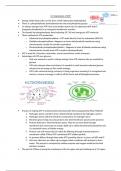
Energy inside living cells is in the form of ATP (adenosine triphosphate)
There is a phosphodiester bond between the two end phosphate groups
To release energy from ATP it has to be broken down into its substrates ADP and Pi
(inorganic phosphate) in an exergonic/exothermic reaction
This breaks the phosphodiester bond releasing 30.7 kJ/mol energy per ATP molecule
Three methods of ATP production:
o Substrate level phosphorylation = ATP made directly from its substrates (ADP+Pi)
o Oxidative phosphorylation =Happens on inner mitochondrial membrane using
chemiosmosis (usually for aerobic respiration)
o Photosynthetic photophosphorylation = Happens in inner thylakoid membrane using
chemiosmosis (usually how ATP is made in photosynthesis)
ATP is used for: Muscular contraction, nerve transmission, active transport
Advantages of ATP over glucose:
o Only one enzyme is need to release energy from ATP whereas lots are needed for
glucose
o ATP only releases when and where it is needed in small amounts whereas glucose
releases lots of energy so this avoids wastage
o ATP is the universal energy currency in living organisms meaning it is recognised and
used as a source of energy in cells by all life forms and all biological processes
Process of making ATP is chemiosmosis/chemiosmotic theory proposed by Peter Mitchell
1. Hydrogen atoms carried to inner mitochondrial membrane by hydrogen carriers
2. Hydrogen atoms split into electrons and protons (or hydrogen ions)
3. Electrons give energy to pump protons into intermembrane space (active process)
4. Protons build up in intermembrane space. They try to move back through
membrane but cannot due to charge. Build up is called electrochemical gradient and
is a potential source of hidden energy
5. Protons can only move back to matrix by diffusing through channel protein in
membrane called ATPase/ATP synthetase/ATP stalked particle
6. As protons diffuse through they make ATP providing there’s a source of ADP and Pi
7. Left over electrons are taken up by oxygen which combines with protons to form
water. This process is catalysed by oxidase enzyme and oxygen would be the final
electron acceptor
The part of ATPase crossing the membrane is the Fo region and part sticking out is F1 region
Energy inside living cells is in the form of ATP (adenosine triphosphate)
There is a phosphodiester bond between the two end phosphate groups
To release energy from ATP it has to be broken down into its substrates ADP and Pi
(inorganic phosphate) in an exergonic/exothermic reaction
This breaks the phosphodiester bond releasing 30.7 kJ/mol energy per ATP molecule
Three methods of ATP production:
o Substrate level phosphorylation = ATP made directly from its substrates (ADP+Pi)
o Oxidative phosphorylation =Happens on inner mitochondrial membrane using
chemiosmosis (usually for aerobic respiration)
o Photosynthetic photophosphorylation = Happens in inner thylakoid membrane using
chemiosmosis (usually how ATP is made in photosynthesis)
ATP is used for: Muscular contraction, nerve transmission, active transport
Advantages of ATP over glucose:
o Only one enzyme is need to release energy from ATP whereas lots are needed for
glucose
o ATP only releases when and where it is needed in small amounts whereas glucose
releases lots of energy so this avoids wastage
o ATP is the universal energy currency in living organisms meaning it is recognised and
used as a source of energy in cells by all life forms and all biological processes
Process of making ATP is chemiosmosis/chemiosmotic theory proposed by Peter Mitchell
1. Hydrogen atoms carried to inner mitochondrial membrane by hydrogen carriers
2. Hydrogen atoms split into electrons and protons (or hydrogen ions)
3. Electrons give energy to pump protons into intermembrane space (active process)
4. Protons build up in intermembrane space. They try to move back through
membrane but cannot due to charge. Build up is called electrochemical gradient and
is a potential source of hidden energy
5. Protons can only move back to matrix by diffusing through channel protein in
membrane called ATPase/ATP synthetase/ATP stalked particle
6. As protons diffuse through they make ATP providing there’s a source of ADP and Pi
7. Left over electrons are taken up by oxygen which combines with protons to form
water. This process is catalysed by oxidase enzyme and oxygen would be the final
electron acceptor
The part of ATPase crossing the membrane is the Fo region and part sticking out is F1 region